In Right Relationship with a Living Economy | John Fullerton
After two decades on Wall Street, John Fullerton began living with a question his industry rarely asks: if we are living beings on a living planet, can an economy really be run like a machine? In a conversation with Jiani on the Magic Commons Dialogic Lab, John explored what unfolds when we stop treating the economy as something to engineer and begin tending it as something alive.
-
Jiani (00:00)
Welcome to MAGICommons Dialogic Lab, where we invite explorers to reimagine a future of flourishing. Today our guest is John Fullerton. He has been a high-profile leader in the space of Wall Street for 20 years. And one day, one question just dawned on him. He wonders: in a space where a dominating perspective views everything as a machine to be leveraged?
minimized and maximized, would there be ever a limit to that? After all, we are living beings on a living planet Earth. So how would this living science perspective impact the space of economy, investment and finance? in the following decades he's invested his energy and dedication to exploring this very question.
by creating courses, creating experiences, and sharing his wisdom and insights so today our conversation explores through the lens of regenerative vitality in the context of
finance and the economic space. we started by exploring what does regenerative economy really mean. And we explore what does in right relationship mean? And then the the conversation naturally evolves into
a few case studies where this living science perspective is truly integrated and what does industry and economy and organization look like. Then we start to open space to re-exam some commonly advocated life values in terms of the finance, in terms of
core values and just take a pause and reevaluate whether those values truly matter. if not what else?
Jiani (01:54)
BBB in front of you lands a spaceship. Outwalks the friendly alien if the alien walks. If we were to use one sound or one movement, to invite the alien to play, what would that be?
john (02:08)
Like
Jiani (02:08)
To play, yes.
john (02:09)
Hmm. I guess I it's a movement or a sound?
Jiani (02:12)
Mm-hmm. Yes.
john (02:14)
I think I
would I think I the thought that comes up is I would I would put my hand over my heart and just stare.
Something like that.
Jiani (02:20)
Love that.
john (02:21)
Maybe I close
my eyes like you just did, even better.
Jiani (02:24)
I love that. It is a movement. Yeah, it's a quiet sound.
john (02:28)
Yeah, the the silence would be key.
Jiani (02:31)
Yeah. But the heartbeat is here. Hmm. Lovely. So Regenerative Economy. What what is this what is that?
And how is this different from the typical way of how we think about economy, how we think about finance and how we think about money and investing?
john (02:51)
Well, I guess one simple way to say it is it's becoming, I think, a self-evident truth that we live in a degenerative economy. so a regenerative economy is profoundly different than a degenerative economy. and the next layer down would be to suggest that
You know, the there's a there's an increasingly common diagnosis of what's wrong with our economic system. it takes many flavors, but the you know, the kind of simple way to describe the problems, so to speak, are the the ecological, the interconnected ecological crises, as well as the you know, increasingly grotesque.
resultant inequality. and those are way oversimplified terms for describing the degenerativeness. But but I think it communicates the essence of the of of what people increasingly are seeing. And often that that conversation can degenerate into a political ideological
debate. you know, you must be for socialism. Are you communist? Are you anti-capitalist? And and it's not at all about that. That's unfortunately the those are the buckets we've got in our minds. But I believe what's happening now is profoundly different than the age-old debates between, you know, essentially conservative and liberal ideologies. and it's because the the system has
has moved to a kind of a climax state where it literally can't keep doing what it's been doing. and and what's amazing to me is that this was this is not a new discovery. you know, people have been talking about this for fifty years. And but it's only now coming into our our kind of frontal consciousness as we watch the ecological crises and the inequality issues spin out of control.
So a regenerative economy is an alternative worldview for how to design and operate an economy. you know, I've been thinking deeply about this now for 25 years. And one of the things that shocked me is to learn, even though I'd spent 20 years on Wall Street, it shocked me to learn that neoclassical economics, conventional economics, what's taught in school, what's what's practiced in in the real world.
Is built on the assumption that the economy is a machine to be optimized. And so just to answer your question, a regenerative economy is actually seeing the economy not as a machine, but as a living system, and then relying on the patterns and principles of living systems instead of Newtonian physics to understand how to how an economy needs to work.
And
and
Jiani (05:21)
Mm.
john (05:22)
it's not that it's not that it's in conflict with Newtonian physics, obviously it's gotta obey Newtonian physics and all other physics. But it's
Jiani (05:28)
Basic physics laws? Yes, yes.
john (05:31)
much more complex than Newtonian physics. And it's startling to me to discover that the entire discipline of economics has never confronted that found foundational error.
Jiani (05:40)
So mm this this integration of the living system mindset or the living system systemic thinking
into the space of economy, into the space of investment is very interesting. And I I'm not an expert but I kind of observed from the sideline into the space of economy. there's a lot of people talk about a lot of about leverage. They talk a lot about maximized return. And to me
It it's just a lot of numbers and we're working out the numbers, we're maximizing the numbers. But I think what is the what what's behind those numbers are real living people, real living community, real living ecosystems that that's that's backing those numbers up. I get a sense that as I'm trying to kind of think out loud and I'm trying to kind of come into your perspective.
For a machine, machine have a set of rules that you run a machine, there's an operational menu. So you press this button, this happens, and there's a way for you to optimize the machine's performance always. Maybe there's an infinite not absolute best, but infinite better.
more faster, stronger kind of mindset. So to me it's very linear and it's almost oversimplified just for our just to be compatible of our ability to think and control and manage. where living system through my perspective is very complex. as you mentioned in your classes you were talking about there's a difference between complete
compli comp comp comp complex
john (07:30)
Yep.
Jiani (07:32)
and complicated. Complicated a machine can be very complicated. if if we layer different
linear steps up there can be complication but complex to my understanding is more on the the system level so it could be a living system could be a machine operating in a living system so there's different layers of complexity and a living system is is that it's it's it's it's complicated and we
we cannot approach it through a single machine perspective but more from a relational perspective that may not render us immediately maximized the short term
return but definitely as the as the living system starts to become more coherent then the natural byproduct would be increased return margins and great performance so I almost feel like the focal point is shifting from
outcome based linear control into a system-based multi-perspective edge effect sort of relational point yeah fing on
john (08:48)
Yeah, and so just describing it is hard, right?
it's easy to describe complicated. Like this is complicated, right? but think about a machine. We can take this apart. It's got very discrete parts. And now that we've figured out how to build an iPhone, the next generation iPhone is essentially the same thing, just
the marketing people figure out a way to make us buy it. But the design is kind of the
Jiani (09:11)
More more relevant.
john (09:12)
design is has just like a bicycle, the design doesn't really change once the optimal design is is determined. and that's because you in a machine you can hold all the variables constant and optimize for whatever it is that we're trying to optimize for.
But you think about, you know, let's let's think about the living system we're all most familiar with, our own bodies.
Jiani (09:35)
Mm.
john (09:36)
imagine trying to describe Johnny by isolating all of her parts and putting them on a table and explaining how they all work together and thinking you're gonna add up to Johnny by the time you get to all of the parts.
Jiani (09:49)
That reminds me of a Frank's Frankstan stories. Horrifying. Scary. That's how the horror movies are made. my god.
john (09:53)
Yeah. I mean it's it's absurd. Yeah, it's absurd. And and and w Yeah. And and
what what we what we learn to think about and to to appreciate in a human body is that it's not that the parts are not there or not real. Yes, you have a heart, yes you have lungs, yes you have two eyes. So it's not a either or. it's a both and
But
the essence of being a human, being a human, human being, is the magic to draw on a word that I'm staring at behind your head, the magic that
Jiani (10:27)
Yeah.
john (10:27)
happens when these parts are in right relationship with each other. So the the the essence of a living system is actually the relationships between the parts, not the parts. Whereas if
You think about the essence of an iPhone, you don't like I don't even know how to describe the relationship between the parts. The parts are the parts and they they they get stuck in this box and and a battery gets put in and if I charge the battery it works and if the battery dies, it doesn't work. But there's nothing dynamic and and complex happening in there. There's some very complicated engineering and very micro engineering.
Which is amazing.
Jiani (11:06)
And electricity
goes through travels through different parts to mmm physics.
john (11:10)
Yeah, and how that gets there is amazing. But the essence of an iPhone is
is is it this is not going to surprise us. whereas my daughter, my son, my other daughter, their essence constantly surprises me because their essence comes through when they manifest their unique humanity.
which is not about their parts. It's about something much deeper than their parts. We talk about the the whole is greater than the sum of the parts. So at the end of the day, this is really a worldview distinction. And this is this is hard to get our heads around because for all of our all of the generations that we can even think of in our world, like
Our generation, our parents' generation, and our great-great-grandparents' generation have all existed in what we now call the modern age, right? The post-scientific revolution, post-Newtonian world. And I'm speaking obviously from a Western perspective. And that whole stream of history was an extraordinary period of progress.
And that progress is directly attributable to what we call the reductionist method, the scientific method. We take things that are very complicated and we break them down into their parts so we can understand them, which makes total sense. So you go to a doctor and you have a general doctor, but you then if you're sick, you go to an eye doctor, or you go to a bone doctor, or you go to a cardiovascular doctor.
And
if you go to school exactly. Or if you go to university,
Jiani (12:36)
But they hardly talk with each other.
john (12:42)
you study physics, or you study English, or you work in the ecology department, or you work in the you know, chemistry department. but we've we've broken the complicated thing into parts to better understand the parts. A holistic worldview doesn't say that's wrong.
One of my teachers likes to say, there's nothing wrong with the reductionist method, so long as we don't confuse the method with the way the world actually works. Now that's coming from a scientist, not a philosopher. and so this this the the real issue that I'm bringing into into you know our our conversation is the importance of understanding that
that holism is the is the I won't use the word truth. I'll say it's the rea it's the better understanding of reality. And yet we in the West have built our understanding of reality on the reductionist method, thinking we can break down things that are complicated into parts. And this is not just sort of theoretical. the breaking things down into their parts triggers
Unintended consequences is a gentle way to say it. but it's essentially breaking the relationships that we don't even understand that have consequences that we don't anticipate. So, for example, we discovered oil and we wanted energy. And we thought, what a great thing this is. And so we've burned up a whole bunch of dead dinosaurs, not understanding that there's a relationship between
the carbon emissions of humanity and the carbon sequestration of the planet. And it operates as something that ecologists call a carbon cycle. And it needs to be in balance or bad things happen. So the unintended consequences is now something we've chosen to call climate change. But it's really the direct symptom of the reductionist thinking about how we could use dinosaur remains as our primary energy source.
without understanding the relationship between carbon in the ground, carbon in the atmosphere, carbon in the water, carbon in the forest, carbon in the soils. So we've we've we've triggered a massive imbalance of carbon. And we call that a problem to solve when in fact that's a symptom of our reductionist thinking in the first place.
Jiani (14:45)
So if we were to implement and embody this wholeism or whole or system thinking or living system thinking at the beginning, what would happen differently?
if i say we're in this parallel universe and all of us are taking living system thinking as a common day thing. So how would they approach this whole oil thing? If they discover oil, what would they well how
john (15:10)
Mm.
Jiani (15:11)
would they do it differently?
john (15:12)
So if we were wise, we would
Jiani (15:15)
Mm-hmm.
john (15:16)
we would have said, wow, this is an incredible resource. There's an abundance of it. how is if we move this oil, what is what is oil made out of? And if we move it from buried underground to burning it, what will be the
consequences of that action. And in order to understand that, the answer to that, we would have to break it down and say, well, what is oil made of? And one of the components of oil is obviously carbon. And then we would need to understand or at least ask the questions, where does carbon sit within the bigger hole that we call life?
And and it would start, it would just trigger a whole bunch of questions. We would discover that our bodies are made of carbon. we you know, now now I'm gonna go beyond my scientific understanding, but you get the idea. We would we would ask many, many more questions rather than just assume that burning carbon because the the planet is so big, the atmosphere is so big, wouldn't matter. Yeah. And and you
Jiani (16:11)
We'll be okay.
john (16:13)
know, frankly, when we started, it was probably a fine assumption.
the the thing we lost track of is that you know there's a there's a difference between you know the scale matters. The the planet is fixed in scale and so any per perturbation of the living system called life you know small things are irrelevant but when they get big enough they become profoundly relevant. But of course when we started burning fossil fuels
that was pre-Gaia theory. So the the only people who thought of the living world as a living thing were our indigenous elders. But because of the scientific revolution and our reductionist thinking and the prod progress it delivered us, we chose to ignore the indigenous wisdom, thinking we were smarter. Well, it turns out that indigenous wisdom from all around the world.
is
inherently holistic understanding. It's it's fundamentally holistic at its core. And so we've chosen to either neglect or forget or demean ways of knowing that are older are as old as humanity itself. and we're now paying the consequences. So in many
Jiani (17:18)
Mm, mm.
john (17:21)
ways the regenerative economy is I I don't like to think of it as going back because we know a lot more now than
our Indigenous elders knew, but it's reconnecting, it's remembering with the wisdom that our indigenous elders have always held to be true. And interestingly, virtually all of the other wisdom traditions that have arisen in the world. so it's it's one of my teachers, Jude Kiravan, likes to refer to it as the unitive narrative. It's it's when our latest Western science actually
reconnects with and and and validates and extends our most ancient ways of knowing. Whereas the modern age was this split where we thought we were smarter and so we went down this reductionist trail. And and again with lots of progress, and we've invented the microchip and we've invented the man on the moon and we've invented airplanes.
Jiani (18:13)
Mm-hmm.
john (18:13)
So it's not to say it's been bad or wrong.
But it's been incomplete and the pieces we've missed are not just trivial. You know, in economics we call them externalities, which is kind of the the ultimate in my mind oxymoron. Like to to call something that can undermine the health of your entire body an externality. that'd be like saying, you know, she's got cancer. That's an externality to her health. it's it's
It's just it just shows you how, in a sense, blind, narrow minded our vision has been.
Jiani (18:45)
Hmm. I can s I'm trying to
john (18:47)
But this is this is radical. Sorry,
just a last thought. This is sort of radical thinking. And so in the real world that exists today and in the politics and the politicians and the business leaders, like this this talk is foreign. It's it's like it's analogous to when Copernicus said the earth is not the center of the universe. Like all of our unquestioned assumptions are in conflict with what I've just said.
And so this is a profoundly difficult paradigm shift to get our heads around.
Jiani (19:15)
Yeah, I personally feel that internal struggle trying to truly, genuinely see things from that angle and I can see how my mind still pulls me back into this comfort zone of
linear thinking or think that we should focus we can't we should prioritize something now. Don't worry about some you know, leave the next generation to worry about that future stuff. And
john (19:41)
Mm-hmm.
Jiani (19:42)
I also feel this like as a human being, our lifespan is
me a hundred years maybe
john (19:48)
Flash. Yeah. Yeah.
Jiani (19:50)
like if that's great if you're like so I do also feel this I don't know it's maybe like a survival stress or something like when I'm thinking of things I think of five years ten years but if we really wanted to incorporate into this living system thinking the the
maybe at least we should think about ten years or or twenty years. And then my my survival instinct or my ego starts to come in, say, hey Gianni, do you know how long you're gonna live? Like, can you think this far away? Like, is this even relevant to you? So I I get a sense that in order to incorporate, maybe one way is to
make this voice comfortable that it's it's okay that i things that we plan may not happen in our lifetime. We're simply planting the seeds and storing whatever is given to us by our previous generation for our future generation. We're simply here taking care of of things for the for the future, at the same time taking good care of ourselves, sure.
Mm, but I think both the future and the present is as important. even future is more important than the present. So but now nowadays we think no, like cease the day right now, life is short, enjoy the moment. If you can make some decisions, make it now, don't procrastinate. So I I can see this tension between
john (21:17)
Mm.
Jiani (21:17)
now and building for the future and having this eternal
non-rushed, non-survival way of thinking, feeling, and being.
john (21:29)
Yeah,
no. I mean I whew.
So there's so much there. I I first of all, I I I a hundred percent get it. and this is this is definitely you know, I use the analogy we're we're I'm I for whatever reason, I'm interested in the project of trying to figure out how to change the plane engines while we're flying. And and we're all in our own little world having to keep flying every day.
And
that burden is huge on what, ninety percent of humanity? You know, just the burden of to keep flying. you know, maybe 80% of humanity if you want to be more or less less conservative, but I mean I think it's probably ninety percent of humanity. So it's a privileged project to even think about this. I tend to think about it as a responsibility.
that word is interesting, response ability. once once you see this, you you yeah. So I have a response
Jiani (22:16)
Response response ability.
john (22:24)
ability, because of of my life, my privilege and whatnot. but I I I would say though that I don't it I don't have a a moral
I don't argue this from a moral perspective. I don't wag my finger and say you must. I can share with you and your audience that I do this. you know how they they say that when you work in service to others, you'd you it's it's you get the most joy from it. I I've actually I actually experienced that. Like I don't do this because of some moral
ethical, righteous, you know, thing. I have no choice but to pursue this question. And it gives me joy to pursue the question. which is very different than, you know, stop driving your car and and use an electric car and stop flying airplanes and, you know, change your diet.
I th I don't think that's ever gonna work, first of all. And secondly, it misses the whole point. The whole point is that in you know, in in my opinion, in my way of seeing it, the opportunity to shift into alignment with how life works is
Is is a form of sort of spiritual practice, flow state, whatever language you want to use, it's something that I believe we are innately hungry for. Maybe that's the best way to describe it. And and and you'll remember from the course I talk about addiction.
And consciousness, for me this is our innate addiction to higher consciousness. And all of the things we do and end up getting addicted to to soothe our lower conscious energy, like fear and doubt and anger, whether they be drugs or alcohol or workaholism or you know, going down the Instagram rabbit hole or whatever.
These
these these are ways and this is what the the science taught this this doctor from h his career in in psychology, these are all of these searches for happiness, the bigger car, the fancy car, the more stuff, the more you know being popular, being famous, those are all
Those are all essentially ways to escape the pain of low consciousness energy. And and what he said we're really addicted to is higher consciousness energy. Like we're addicted to operating at a frequency of love, not fear. And I can share with Yeah. Have you?
Jiani (24:44)
Mm, that's what I've been feeling too. Yeah, yeah, yeah.
john (24:51)
So that doesn't require me to tell you you have to do it or you're a bad person. That's an addiction to higher energy, right?
Jiani (24:57)
Yeah, and I feel like the word addiction is such a loaded word. Mmm, I see this as productive addiction. I see this
john (25:01)
Right. I use it flippantly on the good side, by the way. I'm I'm I'm being facetious. Yeah. A good addiction, yeah, like
Jiani (25:11)
mmm, I see this as like alignment, like a realignment, like
The vitality, right? We're gonna talk more on the regenerative vitality principles that you shared. I feel like when once we are in true alignment with this When we are in true alignment with our essence, with however you see this essence is
then you're in flow. people can see this as an addiction or you just feels like you're always on that path or some other see this as a focus or some other see as dedication. but I think it deep down it it's just it's natural outcome of alignment because once you are aligned
It just naturally happens. we're
not capable to to go other other ways just because it's like it's aligned. You're alive.
john (25:58)
Yeah. 'Cause 'cause 'cause we're alive. That's what it is to be alive. Yeah.
Jiani (26:04)
Yeah, so that's maybe part of the living s system science or whatever. We need a kind of someone t to share with shed some light on this. But like i I feel like once once this vitality th thing is is on the right track, then you don't have to worry about you
distraction or something, it's you naturally
will
john (26:22)
Exactly.
Jiani (26:23)
be on that and then it it won't cost you too much energy. It will regenerate. It will constantly regenerate. Give give you so much energy so you can continue. And it's so joy jo enjoyable. And
john (26:36)
Yeah, just look at your face. I you're smiling as you're talking about it.
Jiani (26:39)
Yeah, love is addicting, right? It's just where again like it if you are aligned if you are in the process of alignment, you will feel that you will be automatically attracted to how your internal energy flows. And that is a wisdom that guides us, each of us. So y
You've you've been talking about regenerative vitality and there's like eight principles. and you also mentioned about the in-right relationship. We can kind of first go from here. What do you mean by in-right relationship? What is right relationship versus a wrong relationship and how
john (27:16)
Hm. Mm-hmm.
Jiani (27:18)
can you discern the difference between
john (27:20)
Yeah.
Jiani (27:21)
those two?
john (27:22)
So let me just first before we drop into individual principles, the the concept here is that we the economic system as it exists today is you know, despite all of its great things that it has going for it, like the way it's mobilized capital to do all kinds of good things and raise our standard of living, that there's
There's some you know, serious, I I would I would argue, you know, i i irreconcilable problems that, you know, we're destroying you know, the most the one that's should be easiest to agree on but isn't because it's been politicized, is that we're you know, we're destroying the the the host. The the living system called planet Earth is being degraded and you know, we could have a long conversation about that. You're
audience can study that. I would, you know, the one simple framework to kind of get a sense of it is the planetary boundaries framework, where we've breached six or seven of nine planetary boundaries. So it's it's not like this is a problem. It's like this is a immediate, urgent issue. and then the inequality issues that I think everyone's familiar with. So the idea of the principles is that
If the economy is going to behave like a living system, what is a living system? how do we design an economy to be like a living system? And it turns out that in complex this gets to the issue of complexity versus complicated. the people that have studied living systems for a living, will will
Jiani (28:46)
Ha ha ha.
john (28:48)
teach you that there aren't that that the way life works is not reducible to mathematics.
it's actually better described through patterns and what I would call first principles. In other words, not not ethical principles, not John's principles, but rather descriptive qualities, first principles, that that that tend to be true most of the time. And because it's complex, it's not always true. So for example, one pattern.
of human of the human race is that men tend to be larger than women, right? That's a pattern. But that definitely doesn't mean every man is bigger than every woman. So it's not like mathematics where you can reduce it to a law, men are bigger than women, but there is a pattern, men are bigger than women. And so think of these principles as the patterns we see, even though there's lots of variation
Within the pattern. I I I like to say every snowflake is unique, but every snowflake looks like a snowflake, right? So
Jiani (29:41)
Mm.
john (29:44)
I've studied this with many bit many different teachers and had this reviewed by scientific experts. And so I'm confident that this is directionally correct, but it doesn't mean that it's correct. and and there are different ways to describe living systems, different words.
Different things get emphasized depending on the context. So take this as, you know, one serious effort to, and now I'm going to switch into reductionist, the reductionist method. So warning, I'm break I'm breaking my law, right? But in order to communicate something that's so complex as life, we actually need to break it down into parts. And each part is not the sum of the parts is not the whole. The whole key is the whole.
Is bigger than the sum of these parts we're going to talk about. And that's what I call regenerative potential. And so the idea is that if we align the economy with these patterns and principles that are
objectively descriptive of how life works, then regenerative potential will emerge as a result of being in alignment, just as you talked about alignment earlier.
other words, the artistic expression, the magic, if we create the conditions.
For the magic to happen, the magic happens because another word for that magic is evolution. That's why we're having this conversation, because that magic has been happening not just on this planet, but in this universe for billions of years. So I don't think we want to cut into a lecture on eight principles, but to talk about just a couple of them, and and you know, this information is in my book, it's on my website, capitalinstitute.org. I teach it in my courses, as you know well.
But probably if you had to force me to pick one principle that's more important than the others, I would pick this one that you you started with in right relationship. And so let's let's think about what that means. So in a again, let's look at a living body, a human body. our cardio our heart is in right relationship with our cardiovascular system. Our cata our cardiovascular system is in right relationship with our brain.
and it's in right relationship with our nervous system. And if any of those relationships fail, we either get sick or we die. and so right relationship is this notion of coherence, it's this notion of symbiosis, mutuality, win-win to put it in modern economic language. so this is not an
idea that is foreign to economics. And yet in economics and in business, we increasingly have broken what we know to be true, the importance of healthy symbiotic relationships, and turned them into extractive relationships. And so for example, the relationship that Amazon has, the company, with its suppliers or with its workers,
Is you know is a relationship, but it's certainly not a right relationship. It's an extractive relationship. Even though the service that Amazon provides you and I, which is books and stuff at our doorstep tomorrow for virtually no cost, shipping cost, and at the lowest possible price, seems like great things. But it came at the expense of the extractive relationships that were necessary to make it possible. and so a so Amazon the
Jiani (32:54)
Hm. Can you
I have
john (32:56)
is
not in right relationship.
Jiani (32:57)
I have a question. can you help us understand what is the the difference between not in right relationship versus in right relationship in business sense?
john (33:10)
to start, you know, a lot of the sustainability conversation starts with the supply chain, right? Or what is the
Jiani (33:14)
Mm. Mm.
john (33:17)
business, what is the product? And that's obviously important. those are important questions. But looked at through a regenerative lens, let's flip it and start on the opposite end, which is a company is essentially a group of people that have chosen to be in relationship for the purpose of the company.
they've
Jiani (33:32)
Mm.
john (33:33)
chosen to organize in a legal entity called a company, but it's
Jiani (33:37)
Mm.
john (33:37)
the relationship of the employees, the workers, the team that is either in right relationship like a successful basketball team, or is
Jiani (33:47)
Mm.
john (33:47)
not in right relationship like I would argue, many, if not most companies doing business. Because
There's an extractive nature between, you know, management and worker. and you know, workers feel the need to unionize in order to not get exploited. And the role of capital is to maximize return on capital, which means put pressure on both the
people that work in the company, the community the company exists in, and increasingly the environment that the company operates in. And and at times those are mutually reinforcing things, and that's what we want. But at times they're in conflict. and if a CEO wants to get paid $20 million and wants to pay the workers in the factory minimum wage, they're in conflict with each other.
And and I would argue not in right relationship. Now, what is right relationship? What does it look like? There's no there's no equation for that. But there's a pattern, and another principle that that I would look to is, you know, I call it empowered participation, which again comes from ecology. And empowered participation is another way of thinking about inequality.
We need less inequality because inequality is is unethical or immoral. again, let's go back to our body. If our feet are not empowered to participate in the circulation of oxygen, our feet are going to get sick and ultimately die. And then we can't walk.
Jiani (35:11)
We can w yeah, and we won't be able to walk.
john (35:14)
So that's really bad for our feet, but it's also bad for the rest of us. so the holistic understanding of empowered participation is make sure our feet
get circulation of oxygen so they can c participate in the health of the body and contribute to the the the potential of the body. So imagine if we treated workers in the factory the same way. And this is not a new idea. The Japanese what do they call something circles
Not factory circles, but they had they had this idea of empowering their workers to contribute to the ideas of how to make the business better. And it worked better. so again, a lot of these are
Jiani (35:48)
Mm, mm.
john (35:49)
not new ideas, but in our in our drive to become more efficient, more productive, more profitable, we've tended to rely on the mechanistic thinking of the machine and extract from employees, the environment.
the communities that businesses operate in. Or trading parts.
Jiani (36:07)
Mm, feel like
the f feels like the focal point is focusing on one 'cause the relationship is in is not just one part, but many parts. So as l feels like the weight is heavily skewed to just one part one party in this whole party of multiple part parts.
john (36:24)
Yeah, and it tends it tends to be short term return
on capital, right? That that tends to be that algorithm is what drives decision making. and it's out of
Jiani (36:32)
Mm, yeah.
john (36:33)
balance. It's not that profitability is bad. a business needs to be profitable to survive. but it's the balance, and balance is another pattern that we see in living systems. It's another one of my first principles. So again, it's not it's not anti profit instead of pro profit, it's balance.
Jiani (36:49)
I think I'm seeing I'm I'm able to draw a a kind of a analogy also in the body about this balance thing. It's like our body need blood to to function, but we don't we don't produce too much blood that the body cannot process.
Too much blood will end up being clogged and then the whole system will have problems. A disease. Mm.
john (37:10)
Yeah. That's actually a disease. I I yeah, it's actually a disease
producing too much blood.
Jiani (37:16)
Mm, yeah, so so yeah, okay, so yeah, so it's time
john (37:18)
And and people have to have their blood taken out of them. Yeah. Yeah.
Jiani (37:23)
for you to like de blood 'cause you have too much too
much blood. It's not healthy.
john (37:27)
But you know, the other thing is it's it's not it's not
balanced like on a scale that becomes static. It's it's balance like a unicycle rider. It's dynamic balance because the context is always changing. So what makes sense today, the balance, let's call it the balance between quote labor and capital. maybe it's out of balance in one direction, but but maybe it was out of balance the other direction before, and we're we've overreacted.
and so it's dynamic. And so the this holistic thinking, holistic decision making cons requires a constant reassessment of the current context. And and this is critical at this moment because the context is changing faster than it's ever changed before. The external environment is always, you know,
Jiani (38:07)
So it's always mmm.
john (38:10)
everything's changing. Like look at the whole AI thing, changes all of the context of what's the right relationship between, quote, labor quote capital.
It's a whole new ball game. So balance is not a static thing. It's a constant reassessment. And another another principle which explains this is innovation that's adaptive and responsive. So innovation is good, but innovation for the sake of innovation leads us to, you know, stupid decisions. But innovations that's adaptive and responsive to the ever-changing context.
Is how living systems actually survive. so for example, yeah. So a tree
Jiani (38:44)
So adaptability.
john (38:48)
in a forest, when there's not enough rain, they start husbanding water and sharing resources through their root systems. And when there's lots of
Jiani (38:56)
Mm.
john (38:56)
rains, they soak up all the rain into their trunks and into their branches. So it's constantly
Jiani (39:01)
How do they know
what to do?
john (39:02)
Life is intelligent. That's one of the principles of life. Like, shouldn't we just sort of
Jiani (39:05)
How do we how do
john (39:09)
learn from how life works? That's the point. It's incredible.
Jiani (39:12)
Yeah, observe
life and and witness how magical, how intelligent life is. And how do we then channeling or integrating this wisdom into the systems that we're building? Are we still do we s do we still build systems? 'Cause it feels like the system feels dead to me. Like a lot of systems are
john (39:30)
Yeah.
Jiani (39:30)
non-responsive, it's very dead, it's just for the show or just for the sake of
being there, it's not responsive at all. And then how do we is there s how is there a living system that man made that is is already here or or it's not being born yet?
john (39:49)
So
the word system is tricky, right? Like we when we say system, we we could think of, you know, a transportation system, like a railroad system. That's essentially a machine, right? That that's a mechanism. that's definitely not a living system, but it's a system. and and yet the
Let's imagine there was such a thing as a well functioning dem democracy.
That's also a system. It's a political system. and a well-functioning, genuinely well-functioning democracy is totally aligned. it expresses this principle of empowered participation, right? By by definition. So
Jiani (40:22)
Mm, mm.
john (40:24)
a well-functioning democracy happens to be aligned with how living systems work. And I'm I'm simplifying this for our conversation. unfortunately
we don't happen to live in a well functioning democracy and and we see the results of that, right? in this country, in the United States, we call it a democracy, but it's clearly not a well-functioning democracy. And the consequences are apparent for all to see. but to answer your question, how about how about the how about the internet? Let's think about the internet. Because I think I think
Jiani (40:45)
What is a well functioning internet? Okay, yes.
john (40:52)
the internet
emerged in a very organic
Jiani (40:55)
Mm.
john (40:55)
way. Obviously there was a lot of public investment. But let's think about, and I'm not talking about businesses that run on the internet. I'm talking about the internet infrastructure itself. It it lets let's just think about it from the principles, the patterns. as you'll
Jiani (41:11)
Mm.
john (41:12)
remember one of them is robust circulation, right? Think metabolism. So in an economy
Jiani (41:15)
Mm, yes. Mm.
john (41:17)
that's moved from a
primarily material economy to a primarily information economy, the circulation of information is profoundly regenerative. The the ability to circulate information the way the internet enables is absolutely a regenerative infrastructure. In fact, we can also circulate empathy by sharing emojis and pictures and smiley signs. So it's it's incredibly
innate innately regenerative. But what did we do? We allowed extremely extractive degenerative business models to exploit this shared infrastructure, which in my mind is no different than enclosing a commons. It'd be like letting, you know, some some company with five massive fishing boats fish a fishery dry.
at the expense of destroying the fishery for everyone else. The fishery is an abundant source of of of of life. And, you know, one can fish a fishery at a at a sustainable level and and and collect the surplus just like you can collect the apples that fall out of a tree. But if you take all the apples out of the tree and all the fish out of the ocean, you don't have life anymore. And essentially we've done that to the internet.
We we and we're doing it in spades now with artificial intelligence where we're we're allowing a few companies to extract essentially the cumulative cultural digital intelligence of humanity and and
Jiani (42:40)
Mm.
john (42:41)
take it for free unless unless they start paying for copyrights.
on a on a scale that is hard to imagine. So they get to take it all for free. Like they take all the fish for free. And then they're gonna sell us fish cakes that taste better than fish. That we want the fish cakes. So
Jiani (42:55)
Yeah. I every month
I pay subscriptions to a lot of AI subscri companies. Yeah. For what I have yeah, even that it's not mm. Yeah, that's true. That's true.
john (43:01)
Yeah. Yeah, but you don't pay much for what you you know. I mean you can you can do an awful lot for free. Yeah. But so the point
to your question, is there an inf is there a technology or as you said, a system that is a living system that humans have created. I would argue the greatest one we've created so far is the internet, but we've we've managed to not manage it and allow it to be
Treated as an a a commons to be extracted from the same way we've treated the atmosphere as a commons to be polluted. So it's the same error we've made. but the hopeful part is that the internet emerged organically out of the genius of our technological progress. So the possibilities are there. We just need to learn to see things differently and design and manage them differently.
Jiani (43:49)
Mm.
john (43:49)
Is it overwhelming?
Ha ha ha.
Jiani (43:51)
I notice there is a strong desire emerging is to explore and ask more questions about how exactly can we shift the perspectives from a reductionist, machinistic perspective and into this regenerative living system perspective.
And how can we make this threshold easy to cross? and I have no answer to that, but only feeling this strong desire to ask more questions so more clarities can be developed. And in your course you did mention a few kind of a case study, there's like Patagonia is a one company that you've shared as a
case in this living system consciousness way of doing business. are they still are they still like that? If so can you share with us some specific examples or things that they do that does actually incorporate and weave and integrate the living science into the space of business.
john (44:57)
So
the way I talk about Patagonia, and it's a company I have great respect for, and and Yvonne Shenard is is a legend as a founder, CEO. But they themselves would say that their business is not sustainable, much less regenerative. They're they're they've moved into food where they believe their food business can actually be regenerative on the planet.
But what I talked about in the class, I believe, what you're referring to, was the decision by Von Channard, the founder, to essentially give away the company into a trust so that the earnings of the company would be recycled back into life. And so if you think about from a living systems perspective, what he's done is he's transformed the capital.
what we call the capital, the ownership, the equity of the business, into he's composted it, in a word. he's he's turned it back into a source of nutrients for the health of the whole system, as opposed to keeping it for himself or keeping it within his family. He's feeding it back into the system, just like compost. And one of my ideas about
you know, truly transforming an economy to behave like a living system is to think about the capital cycle as analogous to the carbon cycle or the water cycle or the nutrient cycle in a in an organic living system, or just to think of capital as the nutrient cycle of an economy. And that means that, yeah, a little bit of philanthropy is nice, give back is nice, but what Yvonne did is profound.
He's actually put all of it back into circulation for the health of the system. Yeah. So that's probably what I was referring to with Patagonia. you know, the other example I like to to point to is the Mondragon Cooperatives in Spain. for a large scale example, this is now some, I believe, eighty companies that are managed as a single ecosystem.
They happen to be co-ops, but they don't need to be co-ops to be managed as a single ecosystem. So, you know, most people that go study Mondragon come away thinking co-ops are the answer, like the silver bullet. But I would argue that the the real magic of the Mondragon cooperatives is that it's a collection of businesses managed as a single whole. So they have a very holistic approach. They actually transfer profits between the
the businesses to enhance the health of the whole as opposed to maximizing the profits of the parts. So that's what's very interesting to me.
But
Jiani (47:25)
That's so beautiful.
It feels it feels like it's all different organs inside of a human body and they're collaborating, they're sharing resources.
john (47:30)
Yeah. And it's not perfect. Yeah.
And if you talk to them, you know, it's they're in the real rough and tumble world of global capitalism. It's not a small little project. It's eighty companies. I think in total it adds up to twenty billion a year in sales, Euros. so this is not a little a little, you know, bench project, and it's filled with paradox and complexity and difficulty and challenge.
But what is also true is that they've never fired one person in their roughly 60 years, I think, of existence, or no, it's more than that, 80 years of existence. they in addition to to circulating the the profits in a way that serves the health of the whole, they ensure they they commit to employees that if business A needs to lay off people because
Business times are hard, they'll find work in business C D and E to transfer transfer those people. Now you can't do that in a single company. You can only do that in an ecosystem. so there's resilience embedded in the design of the ecosystem, which by the way is the way it works in a forest or in a coral reef. so it's it's fascinating. so again, learning to see. Yeah.
Jiani (48:36)
Yeah, just by hearing about this I feel so mmm
hopeful. That's so interesting. Yeah.
john (48:41)
It is. And again, it's it's
it doesn't mean it's easy. but there is absolutely a pathway forward. The other thing it's important to know is that the cost of that systemic resilience in MondraCon is that it's produced guess how many billionaires?
Jiani (48:56)
Twenty.
john (48:57)
Zero.
In other words, the leaders of the Mondragon ecosystem essentially take a huge pay cut in order to build this legacy in the Mondragon culture that they care about more than becoming a billionaire. So n there you know, there's one expression in economics is there's no free lunch. You can't maximize the profits of a single company and the wealth of the single
founder or CEO, if you're at the same time trying to serve the health of the whole, any more than a brain can take all the oxygen in a body and think that the body's gonna be healthy. So it's a different way to think about inequality. They are consciously choosing not to take everything they can because they they are serving a higher end than their personal wealth or their personal financial assets.
And
when you talk to them, it's a no-brainer because the higher the higher end that they care about way more than money is culture, is the is the Basque culture. And the language in the Basque culture is older than Latin, just to put that in perspective. So the the lesson in that is how do we how do we invite people to to to value
something more than than money, which gets us back to all of the ancient wisdom traditions that have asked us that question since time immemorial.
Jiani (50:16)
Hmm. Yeah, and you mentioned about the living wealth. Mm, because we do have the tendency because when you first asked me this question, how many billionaires? I'm like, I don't know, more, less? That's a tricky question. I like, billionaire.
john (50:24)
Mm. It was a trick question. Yeah.
Jiani (50:29)
I and I noticed that part of me is like, I guess billionaire is still a thing. so we should value it. so let's give it a number.
And then the other part is like, maybe it's not a thing. So how do how do we I feel like there's a a lot of inner work that is required in order to shift this perspective. A lot of things that the modern world kind of p applaud and and and hold high.
needs to be needs to shift into a different narrative. 'cause people love billionaires, people love to have wealth and status and vi visibility with this mindset. billionaire status is no longer something that is even healthy for the whole system. the ability to circulate wealth versus someone accumulating wealth
reasine a few will actually be able to produce robust circulation for the system, for the house, for the well-being, for the regeneration. so I I do feel like there is this feeling of enough. Like like if you are not a billionaire, so what? You're enough. Everything that you have is enough.
So so that's something I've been kind of I see that emerging just based on your case. Hmm.
john (51:48)
Yeah, and I I I would even say that in a dynamic economy with technology shifting rapidly the the the I I I think of billionaire status not as a you know, we've had a lot of conversations well should the economy even create should it be possible to be a billionaire? And and I actually don't I don't have a problem
I mean I actually I actually think that systems should be designed with a s with a this is a a much this is a whole chapter in my book. This is a big rabbit hole to go down. But in a in a in my ideal world, there might be billionaires, but there'd be way fewer of them because the businesses that created that wealth would be paying essentially think of it as they'd be paying a a fair license fee to the fishery.
be fishing. The problem is we don't charge the license fee for the fish. And so
Jiani (52:39)
Mm.
john (52:40)
the wealth all flows to the fisherman or fisher person. So if if if every fisherman didn't have to pay for a license, they'd be richer, but there'd be no fishery. if if we had an institution of the commons properly set up, it would be bigger than the private sector. Just hold that thought. Literally
It's more valuable than the entire private sector. and that would have the effect of making companies less valuable and entrepreneurs and CEOs ability to earn wealth would be constrained. Not eliminated, just constrained. Having said that, I don't really think the problem is, you know, if if Jensen Huang, the the founder of NVIDIA, obviously is a brilliant man.
Obviously has created an amazing company with amazing technology. And if anyone deserves to be a billionaire, it's probably Jensen Wang. My problem is that there isn't this automatic imperative to compost that capital back into the system. Whether he's a billionaire or a hundred billionaire, or God forbid a trillionaire, the more, the bigger that number is, the more the imperative to recycle that capital.
But by the way, that conversation doesn't end with the billionaire. That extends to the Sovereign Wealth Fund of Norway, who has essentially built a fortune, a trillion multi trillion and a half, I think, investment portfolio, largely out of the oil wealth that Norway got lucky to dis have. And when they drew the line between Norway and Sweden, all the oil was on the Norway side and not on the Sweden side.
So why does that why is that any different than the billionaire? in fact, it's actually it's different than the Jensen Wang. That's more like the billionaire that inherits the wealth, just sort of wakes up and gets lucky, right? That wealth, in my
Jiani (54:18)
Mm-hmm.
john (54:19)
worldview, is exactly the wealth that needs to be composted and recycled back into the health for the health of the whole. So this is an entirely different mindset to to think about wealth and to think about.
ownership and and whatnot. But I but I I I do it from the perspective of not wagging my finger at as an ethical argument, but rather to, as you were saying earlier, invite people, you know, wh why does a billionaire hoard billions of dollars? There must be some low conscious energy fear, drive that's causing that. Yeah.
Jiani (54:51)
Mmm survival or safety.
john (54:55)
Which gets back to the inner work that you talked about
earlier, which I couldn't I I couldn't agree with more. So rising consciousness is is part
Jiani (55:00)
Mm, yeah, the the ability.
john (55:04)
of this project.
Jiani (55:05)
Yeah, the ability to feel enoughness, but not lose motivation and the capacity to see multiple layers through a system lens, not trapped in a one person nagging narrative or a few persons nagging narrative, and the ability to mmm
see what's to see the truth of what's really authentically valuable. Is that a status that is the true authentic valuable thing? Or is this immersed joyfully in flow, in deep alignment and in s in contribution, in service, in play?
in experimentation, in collaboration, is is that the true authentic value that we all we all have the possibility to hold together. So it so that leaves like we open this conversation with some questions and we're concluding this conversation with more questions. And I think this path is
filled with questions. And I think just like how you reimagined a world where regenerative consciousness set at the beginning when we first discovered oil, it's about a lot of questions. So I think the first step is just to question, question as many things that we take as granted as possible.
and and find out w what what does your essence if there is one or maybe multiple truly truly desire truly truly enjoy the enjoy the process of alignment with I I think that is the the key and and I have the belief that most of us will
come to a realization that what what truly matters what will surface, they will know. if it is a billionaire status, then fine. Maybe for that person. But if it's something different, like enjoy the connections with people, building something that contributes to the community
then that's fine too.
I think as long as we start asking questions, I think things will fall into place. I mean that's the
john (57:18)
Well, questions are certainly
good. you know, I'm I'm old enough now that I can look back and share my own personal experience. And I was in the rat race, I was in the competitive thing, I did competitive sports before I joined competitive Wall Street, and it was always never enough. I I I I actually ended up coming in second a lot, both in my
competitive sailing days and then metaphorically on Wall Street I came in second is the way I think about it. Never never satisfied. and all I can say is that I've since found my purpose and work in flow and work in a creative out of a creative mindset, which by the way, one of the Fritchav Capra's one of the the the the great living system scientists still
still teaching today. he's reduced life to four principles. and the last two are life is creative and life is intelligent. And what I've discovered is that my my creative my creativity is building a course community, writing a book, imagining these things.
And I never would have considered myself a creative or an artist. but you've experienced my course. it's an artifact. and so what I've come to believe that if life is inherently creative, we're supposed to manifest our creativity as a fundamental purpose of our life. And and our capitalist system doesn't teach us that, and our education system doesn't teach us that.
And the economy doesn't reward that yet. Well said. But that's where
Jiani (58:43)
Yet. Yet. I'm so hopeful.
john (58:48)
that's where our our our our purpose and joy and fulfillment will come from. And I say that full well recognizing that it's easy for me to say 'cause I spent twenty years working on Wall Street and made some money to make it easier. So it's
It doesn't say it's a it doesn't say it's easy.
Jiani (59:04)
Yeah. And there I believe that there is micro integrations that we can do. no matter what context that we're in, what situation that we're in, at least we can ask us this question when we make decisions,
Am I coming from a reductionist machinistic perspective? Or am I coming from a living system, living science system perspective? I think before each major discussions or decisions, just simply asking us this question, we create space for life as intelligence to flow and
john (59:42)
Yeah. And if I could I've I could one one sort of gating question should always be not is this a good job, is this a good career, is this the right decision, but rather who will I be in relationship with or what will I be in relationship with?
Jiani (59:57)
Who will I
be in relationship with?
john (1:00:00)
Focus on
relationships. Because the cool thing about the regenerative the regenerative paradigm is that we don't know, we we can't know, we can't control the future. So if we build healthy relationships, we'll manifest possibilities we don't know in advance. And if we hang out with quote the wrong people, we'll manifest bad experiences and bad outcomes. so it's letting go of the control.
Jiani (1:00:20)
Mmm, so
mmm, so one more question after your question would be so first in who with who would this be would this relationship be with? And will this be a right relationship? And or how would this be in right relationship? Are we sure? How are we we how are we sure?
john (1:00:33)
Yeah. Are are we sure? Yeah. In in invest and you and you know you
don't know. I've been in business with people who turned out to be psychopaths. So you you don't know. But but but know when you're you know, it's just like if you're gonna get married, you you wanna do your homework and and make that decision based on confidence that you're gonna be in right relationship for a long time.
And it and it doesn't mean we won't make mistakes, but you know, if you think about the way the whole venture capital business works, the the relationship, the courting process is a PowerPoint deck and a meeting and what can I get out of this? You know, it's very extractive and and transactional. And lo and behold, you know, how many founders end up what percentage of founders end up in good, right relationship with their investors?
After f after a year, much less after five years. I I'm I don't know the answer, but it's it's it's probably nowhere near what it could be and should be.
Jiani (1:01:30)
can't help but asking this follow-up question.
john (1:01:32)
Yeah.
Jiani (1:01:32)
So so for the VC industry, the whole VC industry, it's all it's all about relationships, right? Who you know, who you pitch and and who will give you fundings and it's it's a whole yes, transactional relationships. If we if we truly as a s as an industry incorporate and integrate this whole living science in right relationship into this whole playground.
How will this potentially transform venture capital as an industry? or will we VC still exist? If so, how would they how would they look and feel and exist differently than w what we see nowadays?
john (1:02:10)
Well,
that's a whole other podcast, but
Jiani (1:02:13)
As a podcast. Yeah.
john (1:02:16)
I mean, I think you you touched the key issue, right? It in your in your framing, which was yes, they're all relationship driven, but how much of those relationships are extractive at core? What can I get out of this relationship? You know, who can this person introduce me to? how will this be good for me? And I'm not saying that I don't mean to be naive. Like of of course there's
An aspect of that. But you know, we're we're experimenting, and it's it's a longer conversation, but we're experimenting with and and by the way, this is a really hard piece because of the power of money in our culture. I I think working with money in right relationship is one of the hardest pieces of this whole challenge. even extremely well-meaning, aligned in in, you know, in advance, thoughtful people that come into relationships.
in business with money, find out that it's harder than it seemed on paper at the beginning. I think that's the work we have to figure out is how we can, in a sense, depower and decenter the money and and make it a more human relationship. And and in my experience, it's quite interesting that there are
There are women investors who are way better at this than men. because they approach they are inherently more relationship. And this is an unfair generalization. I should say feminine energy investors that tend to happen to be more likely to be women than men. but they're inherently more relational in their DNA, in their core. And it shifts the way
those investor or philanthropist, entrepreneur relationships can evolve. And so maybe that's a lesson for us is is to and again going back to the balance. You know, the the venture capital industry is inherently very masculine. and that imbalance of masculine feminine energy is has a cost. and we see it.
Jiani (1:04:00)
And I'm hopeful that I think as more and more people become aware, I think awareness is the first the half of the problem. As long as we become aware,
john (1:04:09)
Yeah. Yeah.
Jiani (1:04:10)
then life as intelligence will flow and will help us. Yeah.
john (1:04:13)
It's the unquestioned beliefs. It's the unquestioned beliefs
that are that get us in trouble, for sure.
Jiani (1:04:19)
Yes, the
lack of awareness, yes. Wow, beautiful. So as we conclude this conversation,
We will redirect the light back to you as the wisdom sharer or co explorer in this conversation. when you were
little kid, maybe six years old, seven, eleven years old, twelve years old. What did little John enjoy playing, creating that time simply disappeared for him?
Mm-hmm.
john (1:04:51)
Well, I guess I'll just throw out the first thing that comes up from that age time period was I lived I lived next door to a a family that had two horses. and I remember when I was seven the the neighbor there was there was a guy who was four years older than me and then he had a older sister who was seven years older than me. And I remember that because I remember when I was seven, she was fourteen.
And she was the horse lover. So I learned how to ride a horse and take care of horses and hang out with horses. in that period. It was sort of, you know, I went and did the whole riding lesson thing and and so you know it's interesting now in now that I'm a lot older than seven, I'm
Jiani (1:05:29)
Mm-hmm.
john (1:05:30)
I'm I'm learning to appreciate
the connection with animals that I think I innately i was attracted to. and and of course, you know, we're a dog family. So through dogs, but also through through other animals. I live more in the country now than in the city. So there are more animals around. so maybe that's what I've I've not I've not lost, but I've re remembered is maybe a better way to say it is the
Connection with animals.
Jiani (1:05:55)
Yeah, it's so beautiful. Yeah, animals does when we connect with the animal, whether it's a horse or whether it's a rabbit or whether it's a dragonfly. I still have issues with mosquitoes, like that's that's still no go so about
john (1:06:09)
Yeah, I'm not sure. I'm ready for yeah.
Jiani (1:06:13)
opossum or birds, big bird
john (1:06:15)
Yeah. Yeah, birds are big birds. I we we live near the coast and
we have a seagull that comes and sits on our stone wall. I feel like he's our own Jonathan Livingston seagull. I'm afraid he's dying. He's old and and coming to chill out. but he's he's been there almost every day for the last three weeks. which is kinda interesting. Yeah.
Jiani (1:06:34)
That's so beautiful. My
goodness. Do you give him some like we cannot feed wild animals? Yes.
john (1:06:39)
No, we sh sh we we
we we s we sort of throw some tomatoes and stuff out there, but he's he just comes and hangs out. He he doesn't seem to be I think he'd rather go get the the clams, but he just comes and hangs out.
Jiani (1:06:52)
Yeah.
That's so beautiful. I think all the animals are in their own way in right relationship with the ecosystems that they live in. for the seagulls they can hunt forever but they only hunt as long as they feel full. And for the bunnies, they destroy seeds, yes, but but
There's a limitation of how far they will go. and so it it feedback and balance, yeah, dynamic balance.
john (1:07:16)
Yeah. There's feedback loops that keep them all in balance. Yeah. But those feedback loops
include death, you know, like it's not all roses and cherries. and so, you know, we we we obviously don't want to live in a in a wild, totally wild situation. But you know, there are a lot of things in our current
culture and economy that need to be allowed to die. And I don't mean people, but I do mean things we've gotten used to that maybe we maybe aren't so good for us. And and you know anything that spews fossil fuels is something it's a habit we need to figure out how to put back in balance.
Jiani (1:07:55)
Yeah, or our internal attachment to the idea of never enough, to the idea of status, mm,
john (1:08:03)
Yeah.
Jiani (1:08:04)
power, money as the only living wealth metrics, all that.
john (1:08:08)
Yeah, the th the whole influencer thing
with young folks i is really depressing to me.
Jiani (1:08:14)
destroying yeah yeah yeah yeah as if there's
john (1:08:17)
sad.
Jiani (1:08:18)
only one way to be successful sad
john (1:08:19)
Yeah. And w and at all costs.
Jiani (1:08:23)
at all costs yeah and so how do you keep your vitality alive how do you keep your vitality as this creator manifester
alive on a day-to-day basis? Is there like a simple practice that you do? yeah, how do you steward your own vitality
john (1:08:42)
Mm.
Jiani (1:08:43)
in this case?
john (1:08:44)
you know, there's l there's lots of things I I do, but I I would say the the predominant one is that I I live now in a beautiful place, by the sea, on the coast. And I just I I am nourished by the light here, the breeze, the seagulls. so I don't I don't need to go to a yoga class. I I
I can breathe outside my door and it's a yoga class. I wish I was more disciplined about
Jiani (1:09:08)
Mm-hmm.
john (1:09:10)
going to yoga class, but but no, re you know, r living on the coast is is is my happy place and I'm very lucky that I can do that now.
Jiani (1:09:19)
Mm. That's so beautiful. Yeah, there's something about look at an open ocean. feels like everything else is not as important in front of you. It this
john (1:09:27)
Makes you feel very small. Yeah.
Jiani (1:09:29)
small, yeah. Big open space and put everything into right relationship into perspective.
john (1:09:35)
There's there's
also something because I'm far enough away from both Boston and New York that the light here is different. That it's dark at night and the light on the water and the light sunset, sunrise, it's just incredible. particularly in the winter. and and there's and there and like I get more happiness about experiencing the that changing light than the thought of going on some, you know, big trip to wherever.
And running around with my suitcase like a nut like a a nut a chicken with my head cut off. I mean it just there's so much to appreciate in the in the moment, in the place. they were all too busy racing to get our bucket list completed and snap our pictures and and we miss I just think we miss what's right in front of our face. So
Jiani (1:10:17)
Yeah, and yeah, and also I have an ocean view is it there are there are folks who are making mm
houses more accessible for people. So there could be anchors, anchors of open ocean lines and spaces that people can reside in without shouldering a heavy mortgage of of whatever millions of dollars. So that
john (1:10:42)
Yeah. Yeah.
Jiani (1:10:45)
living environment can be made more
accessible to people who desire that. I think that is something the future entrepreneurs needs to can be can be focusing their
energies on. So beautiful.
john (1:10:58)
Yeah. Absolutely. Yeah.
Jiani (1:11:02)
My goodness. Aw thank you, John. For this very
john (1:11:05)
All right. Good to be with you.
Jiani (1:11:07)
deeply thought provoking conversation and
I feel I'm very hopeful. I think throughout this conversation, hearing what you've shared and what's what's what progresses have been made. I have this deep sense of hopefulness and I just can't help but smile. So yeah,
john (1:11:28)
Well good.
Jiani (1:11:28)
future can be great and as long as we all are made aware, we all are
conscious what truly matters and how do we live in right relationship with this whole ecosystem planet earth and a bigger universe and what's the meaning of being a human how what is the what is a human life how can we live live it
in this right relationship and how do we when facing systemic injustice or reductionistic or digit degenerative systems how do we respond with intention consciously and how do we recreate possibilities for even in a microscope for alternative possibilities and
that can be done by anyone, regardless what who they are, what gender they are, what race they are, what position that they have, what yeah. So
john (1:12:24)
Well, I'm glad I've left you with some hope. Hopefully it's grounded hope, not naive hope. But I think there's plenty of reasons to be and remain hopeful, even in the storms that are clearly coming.
Jiani (1:12:35)
Thank you, John.
john (1:12:36)
Thank you.
Machine We Mistook for Life
John's inquiry took root in a discovery that surprised him, even after his years in finance. "It shocked me to learn that neoclassical economics," he said, "is built on the assumption that the economy is a machine to be optimized."
A machine can be taken apart, its variables held constant and its output maximized. A living system cannot. John shared an image: imagine trying to understand a person by laying all of their parts on a table and assuming they will add up to the whole. In his words, it is "absurd."
He honors the scientific method that gave rise to microchips and moon landings, and shares a line from one of his teachers: "There's nothing wrong with the reductionist method, so long as we don't confuse the method with the way the world actually works." When we do confuse the two, the relationships we sever resurface as crises. Economists call them "externalities," which John finds revealing. "That'd be like saying, you know, she's got cancer. That's an externality to her health."
Magic Between the Parts
If the economy is alive, what helps it thrive? John answers that "the essence of a living system is actually the relationships between the parts, not the parts." That is why, if asked to choose among the regenerative principles he teaches, he chooses being in right relationship: coherence, symbiosis, and mutual benefit, like a healthy heart in rhythm with a healthy nervous system.
Living systems, he explains, move in patterns rather than laws: "Every snowflake is unique, but every snowflake looks like a snowflake." When we align with those patterns, vitality isn't forced; it emerges. "If we create the conditions for the magic to happen, the magic happens."
Two related patterns nourish his view of business. The first is empowered participation. "If our feet are not empowered to participate in the circulation of oxygen, our feet are going to get sick and ultimately die," he said, and the whole body suffers with them. The second is balance, not a static scale but "dynamic balance because the context is always changing." Profit has its place: "It's not anti-profit instead of pro-profit, it's balance."
Joy of Enough
These principles take root closest to home. John recalls his years in competitive sailing and then on Wall Street, where "it was always never enough." Today he nurtures courses, writing and community. "I never would have considered myself a creative or an artist," he reflects. Yet, he now believes that "if life is inherently creative, we're supposed to manifest our creativity as a fundamental purpose of our life."
He doesn't frame this as a moral obligation. "I have no choice but to pursue this question. And it gives me joy to pursue the question." Jiani described the same experience: when we are aligned, our energy doesn't deplete; "it will constantly regenerate."
Composting Capital
What holds true for a person holds true for an organization. John sees capital as the nutrient cycle of an economy, and he turned to organizations that treat it that way. When Patagonia's founder, Yvon Chouinard, placed his company in a trust so its earnings would flow back into the living world, John said, "he's composted it, in a word."
His larger example is the Mondragon Cooperatives in Spain, which he describes as roughly eighty businesses stewarded as one ecosystem, sharing profits and welcoming workers into sister companies rather than laying them off. "You can't do that in a single company. You can only do that in an ecosystem." The choice is intentional: the ecosystem has produced no billionaires, because a healthy whole can't flourish when one part takes everything, "any more than a brain can take all the oxygen in a body and think that the body's gonna be healthy."
Tending the Commons
Beyond any single organization lies the economy we all share. John sees the internet as perhaps the greatest living system humans have co-created, because "the circulation of information is profoundly regenerative." Yet we allowed extractive business models to exploit it, which he sees as "no different than enclosing a commons," like letting a few massive fishing boats dry up a shared fishery. He sees artificial intelligence repeating the pattern on a vast scale: companies "take all the fish for free. And then they're gonna sell us fish cakes."
His invitation is for enterprises to contribute a fair "license fee" to the commons they draw from, and for large fortunes to be recycled back into the health of the whole. He acknowledges the deepest work is cultural: "Working with money in right relationship is one of the hardest pieces of this whole challenge." The path forward, he says, is to "depower and decenter the money and make it a more human relationship."
One Question to Carry Forward
John shared one living practice for anyone facing a decision. Instead of asking whether a choice is good for our career, ask: "Who will I be in relationship with?" Because the future can't be controlled, relationships become the soil for what comes next. "If we build healthy relationships, we'll manifest possibilities we don't know in advance."
It is a quietly radical idea, radical in its original sense of returning to the root, and John shared it with care, hoping to leave listeners with "grounded hope, not naive hope."
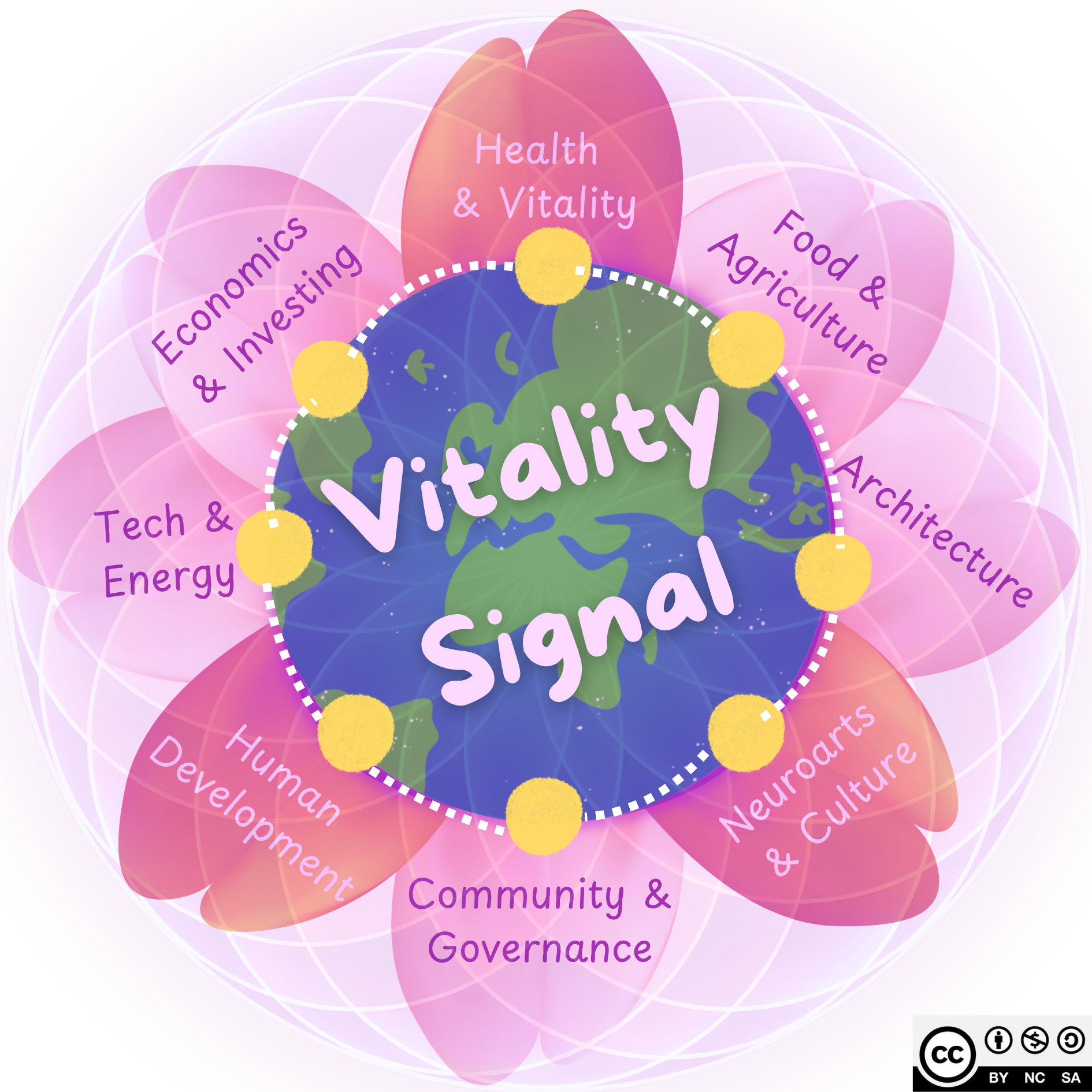
How does it relate to Regenerative Vitality
Across this conversation, John reveals regenerative vitality not as a single solution but as a quality that emerges whenever living systems are in right relationship, at every scale. On a personal level, it appears as the shift from "never enough" to creative, joyful work that renews rather than depletes our energy. In organizations, it takes shape as composted capital and ecosystems like Mondragon, where the health of the whole matters more than maximizing any single part. And across the wider economy, it calls for balance, empowered participation, and robust circulation, stewarding shared resources like the internet as commons rather than extracting from them, so that vitality can flow back to people and the planet.

⭐ John Fullerton & MAGIC
Background: John Fullerton is an economist, author, and impact investor who invested two decades on Wall Street, becoming a Managing Director at JPMorgan and leading global capital markets businesses before stepping away in 2001. In 2010, he founded Capital Institute to explore what an economy that works like a living system would look like. His 2025 book, Regenerative Economics: Revolutionary Thinking for a World in Crisis, traces the roots of our economic crisis to our worldview. He lives in Stonington, Connecticut.
The magic: John's magic lives in stillness and relationship. Asked how he would invite a visiting alien to play, he would simply place his hand over his heart, because "the silence would be key." As a child, time disappeared while he cared for his neighbors' horses, a connection with animals he has "re-remembered," now echoed in the old seagull that visits his stone wall. The coastal light of his home nourishes him, and he has discovered, to his own surprise, that he is a creative, weaving courses and community as his art. For John, magic is what happens when parts are "in right relationship with each other."
Creative Process (non-linear): Develop + Iterate Outlines & Drafts (Human + ai) ~Guest Alignment Feedback~Final Alignment by MAGICommons
