Research Methods
MAGICommons' North Star is Regenerative Vitality: a state of being sustainably fully alive and engaged. We explore it across many areas of life, including the arts, health, education, governance, economics, agriculture, architecture, and technology, and we pay special attention to the places where they meet, because the health of people, societies, and the living world is one ecological whole, not a set of separate parts.
Systemic Approach
We learn through cosmo-locally (Bauwens & Ramos, 2018), close to home and across the world at once, and each nourishes the others:
Reading widely, through a living literature review. We keep an ongoing review of research across the fields that shape vitality, and weave its insights together with what people share from their own lives, so what we learn is both deeply felt and carefully grounded.
Living Labs, rooted in place. In partnership with pioneering communities, incubators, and change agent collectives, we listen closely to people's lives and the places they belong to and, over time, co-develop the Vitality Signal: a living compass rather than an abstract theory.
Dialogic Lab, reaching wide. In open, unhurried dialogue, a space of Ma (a Japanese idea of the meaningful space between things, where meaning has room to form), with Signal Bearers (pioneers and practitioners who carry regenerative vitality into the world), we learn from voices far beyond any one community (Eringfeld, 2026).
Together, they form a decentralized signal network, described in Ecology.
Three Guiding Questions:
What is Regenerative Vitality?
What environmental and ecosystem conditions deepen or suppress it?
What practices allow individuals, organizations, societies, and our relationship with the living world to awaken and regenerate vitality?
Whatever else a Living Lab brings, it always listens and learns in the same way. This is MAGICommons' own foundation, rooted in Participatory Action Research: research done with people, not about them.
An ecological lens. We see people, their relationships, the systems around them, and the living world as one whole: body, mind, spirit, society, and ecology together. We listen for vitality at four levels: within each person, in the organizations they belong to, in their wider society, and in their relationship with the planet.
The whole of what people know. We listen to what people think, feel, and sense in their bodies, and welcome drawing, movement, sound, or a meaningful object when words fall short. What a creation means is always for its maker to say.
Seeing, re-imagining, and acting. Every dialogue, every reading of it, and every portrait moves through this rhythm, and what people imagine and hope to do counts as much as what they describe.
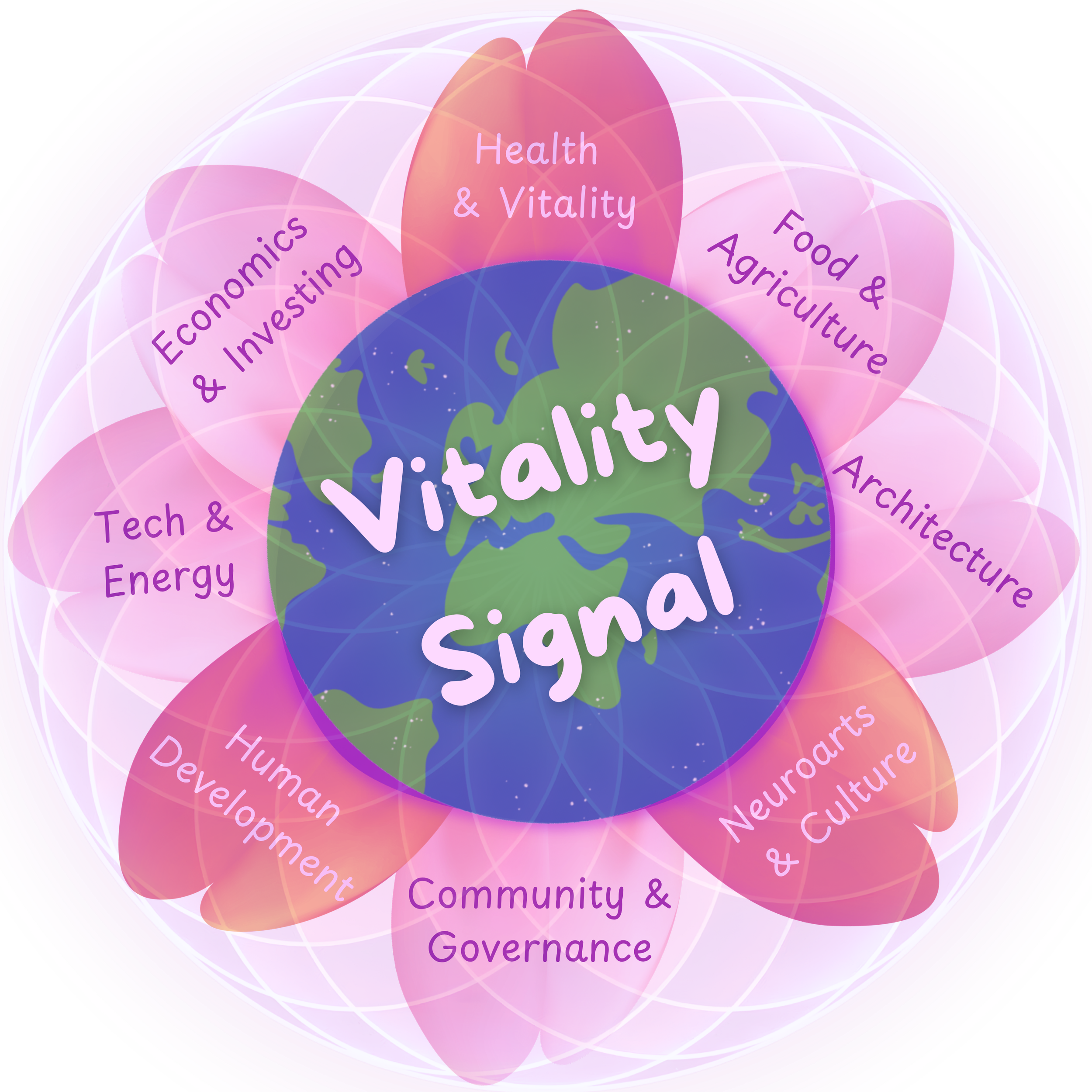
Letting meaning emerge. Themes grow only from what people share. MAGICommons' own early picture of vitality, the seven-petal flower, is held as a question still to be tested, and is never used to sort what people say.
Evidence you can trace. Every finding can be followed back to the words it came from, and anything we add by way of interpretation is clearly marked as ours.
Care at every step. People give their consent, their identities are protected, and their data is handled with care. Members help shape the findings, and the research always gives something back.
A spiral, not a line. Each cohort deepens what the one before began, through cycles of acting and reflecting.
Stewards who notice themselves. Vitality Stewards stay aware of how their own presence shapes what is heard, and honor what is created together.
Holding what we make, together. What grows from a Living Lab is co-stewarded.
The soil we grow from. Three strands of participatory research nourish this foundation, and we honor those whose work nourishes ours. From Burns, Howard, and Ospina (2021), we draw a way of seeing each community as a living system, and a commitment to fairness in who holds knowledge, data, and power, carrying forward the work of Freire and Fals-Borda; it shapes how a Living Lab unfolds, cohort by cohort, and how we care for data. From Kara (2020), we draw creative, arts-based ways of researching that reach beyond words on a page; they shape the invitations in every dialogue and the visual way findings are shared back. And from our own commitment to care, rooted in these traditions, comes how every person is met, credited, and protected.
The Core Foundation
Every Living Lab already looks through the ecological lens, the heart of its core. Alongside it, a Living Lab may look through one or more other lenses: particular ways of exploring and knowing, often brought by partners and Stewards who, like everyone, are multidimensional and may carry many. The Vitality Steward or the partnership chooses them, and names them at the start, or none. Lenses shape how people are invited to explore, while what people discover remains their own.
Lenses can come from many ways of knowing: dialogue practices such as Conscious Conversation (Montse, 2026), and embodied, ecological, and artistic practices, among others.
Lenses
References
Bauwens, M., & Ramos, J. (2018). Re-imagining the left through an ecology of the commons: towards a post-capitalist commons transition. Global Discourse, 8(2), 325-342.
Burns, D., Howard, J., & Ospina, S. M. (Eds.). (2021). The SAGE handbook of participatory research and inquiry (Vols. 1–2). SAGE Publications.
Eringfeld, S. (2026). Podcasting as a research method: A practical guide. Policy Press.
Kara, H. (2020). Creative research methods: A practical guide (2nd ed.). Policy Press.
Montse, M. (2026). Who must lose for tomorrow to be won? Relational imagination and the reproduction of war. Possibility Studies & Society, 27538699261492090.