Vision
We envision a world where every person, organization, community, and the living planet can be fully alive, each renewing the others in a reciprocal flow of vitality. Through Living Labs, this capacity is cultivated place by place. Communities see clearly what is, re-imagine freely what could be, and act, however small, from an ever-expanding heart. Like roots finding one another beneath the soil, their discoveries weave into a decentralized signal network and a shared Vitality Signal, co-stewarded by all who tend it.
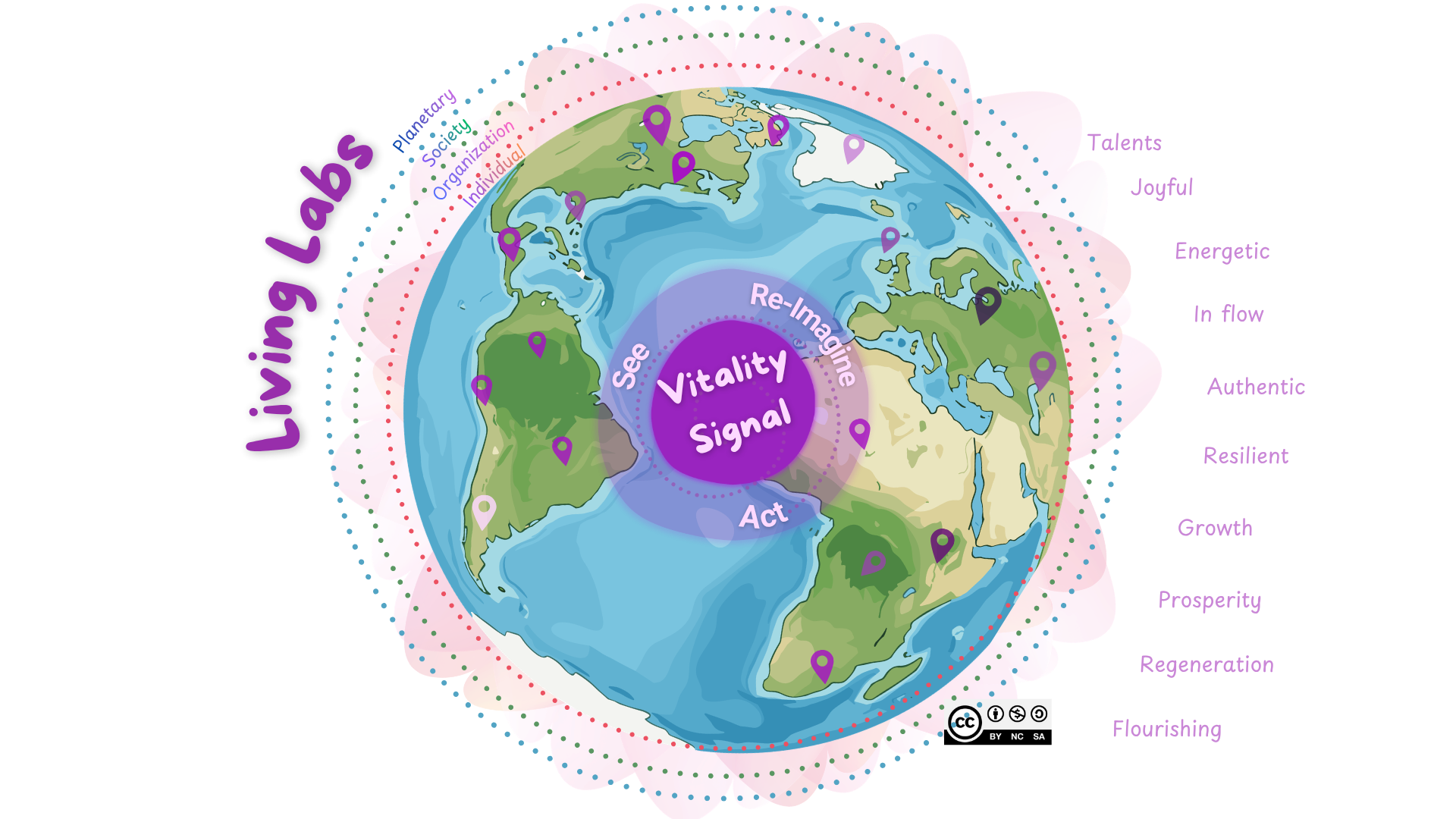
Across individuals, organizations, societies, and the living planet, we are experiencing a systemic loss of regenerative vitality: the capacity of living systems to renew themselves faster than they are drawn down.
Many of us have learned to keep going by spending more than we restore. We draw down our bodies, our teams, our communities, and the Earth as though they were resources to extract rather than living systems to tend. The conditions that let vitality flow are rarely seen or named, and few of us have been invited to imagine how things could be otherwise.
Human and ecological vitality are not separate stories. They are one reciprocal web, and what depletes one starves the other. When we are depleted, we lose touch with the living world we belong to, and that distance accelerates the degradation of the ecosystems we depend on. Degraded ecosystems, in turn, erode the conditions for human flourishing. The depletion echoes through every nested layer of life:
The evidence shows this at every level:
Individuals. Only 16% of people worldwide report high vitality, and 53% report disruption to their mental health (Cigna Healthcare, 2025). Among those who build, the well runs lower still. 72% of startup founders say the journey harms their mental health (Startup Snapshot, 2023), and 40 to 69% of creators experience anxiety, depression, or burnout (Lupiani Insights & Strategies., 2025). Women and BIPOC founders face further systemic barriers to the support that replenishes (MaRS Discovery District, 2025).
Organizations. Depletion travels outward into the structures we share. Low engagement costs the world economy about $10 trillion in lost productivity, roughly 9% of GDP (Gallup, 2026). Organizations that tend vitality create, on average, 3 percentage points more shareholder value each year (Gjerstad, K., et.al., 2025).
Societies. When the relational roots of community wither, the harm is measurable. The U.S. Surgeon General (2023) likens the health impact of loneliness and isolation to smoking 15 cigarettes a day. Diminished vitality in creative sectors frays social cohesion and local economies (UNESCO, 2026). As AI scales, the World Economic Forum (2026) warns it threatens “the value of being human,” which calls on us to cultivate what keeps us alive.
Living Planet. The depletion does not stop at the edge of our bodies. Six of the nine planetary boundaries, the safe limits for Earth’s life-support systems, are now transgressed, and most are trending further (Myers et al., 2025). Over 200 health journals call the climate and nature crises one indivisible global health emergency (Abbasi et al., 2023). We feel the loss from the inside: places with richer natural diversity are associated with greater mental wellbeing (Hammoud et al., 2024), and biodiversity appears to shape mental health through microbial pathways (Wong & Osborne, 2022). As living systems thin, so does our own capacity to thrive. Human and planetary depletion are one compounding cycle, each deepening the other.
Living Labs make vitality visible again, in each person and each place. Every dialogue is an invitation to pause and re-imagine how we live and build, in ways that renew us and the world around us.
What is a Living Lab?
Living Labs make vitality visible again, in each person and each place. They act as bioregional catalysts, grounded in the understanding that restoring soil, renewing biodiversity, and replenishing the human spirit are one and the same work. Every dialogue is an invitation to pause, to restore before we spend, and to re-imagine how we live and build, shifting our role from extractors to reciprocal partners in life’s renewal.
A Living Lab is a season of participatory research held with a community, cohort by cohort. Each cohort opens with a community launch; members who choose to take part each have one dialogue with a Vitality Steward, exploring what lets their vitality flow and what drains it, across their lives, relationships, and the living world. Their words return as Vitality Portraits the community can recognize itself in, and people choose what to act on, together and on their own. Then the next cohort begins, and the picture deepens.
A Living Lab is one of the ways MAGICommons explores its North Star, Regenerative Vitality: a state of being fully alive and engaged. It sits alongside MAGICommons' other endeavors, the Dialogic Lab, activations, the Play Space, and Vitality Immersions. Its approach is systemic: it sees each community as a living system, with vitality flowing within each person, between people, through organizations and communities, and with the living world.
At its heart is one rhythm: seeing clearly what is, re-imagining freely what could be, and acting, however small. Imagination is a capacity that grows when it is welcomed, and stirs the courage to act. There is no small act, as long as it comes from a full and ever-expanding heart.
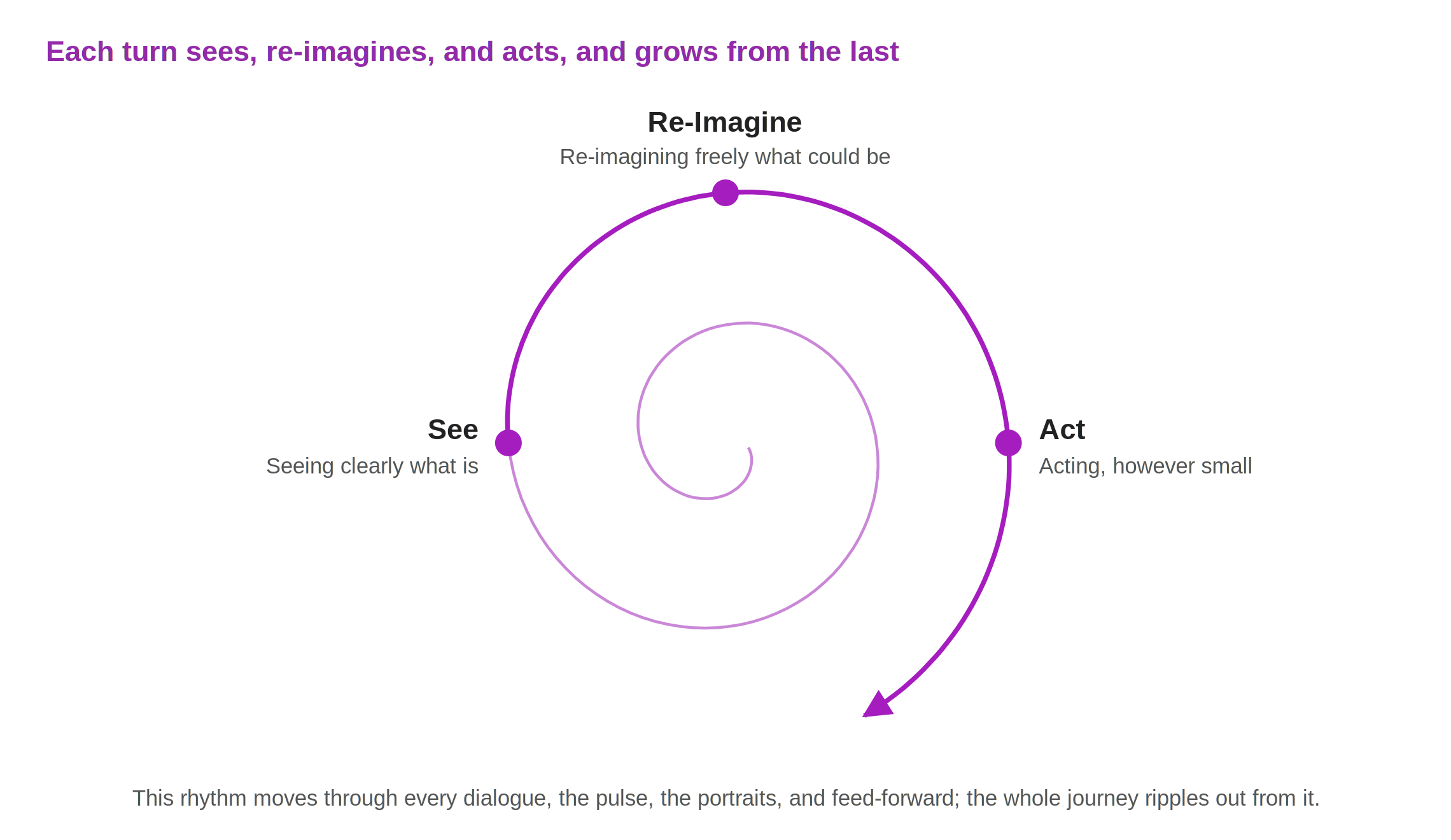
Each turn returns to seeing, re-imagining, and acting, but never to the same place: it grows from what the last turn planted. This rhythm runs through the whole Living Lab, from each dialogue to the portraits and the feedback that shapes them, and the whole journey ripples out from it, cohort by cohort.
What we embody
Growing from MAGICommons' Principles for Regenerative Collaboration, we hold ourselves by an internal code, know, embody, co-steward, and the Living Lab is that code turned outward: see, re-imagine, act. One is how we hold ourselves; the other is the space it opens for co-explorers.
How we inquire
A Living Lab is participatory research, done with people, not about them. Meaning emerges only from what people share, and every finding can be traced to their own words. Alongside words, people may share a drawing, movement, sound, or a meaningful object: creative expression as another way to express and to inquire, whose meaning is always for its maker to say.
How it unfolds
Each community's journey unfolds like a fern frond, cohort by cohort, through three seasons: Discovery, where dialogues, portraits, and seeds of action take root; Compass, where many communities' discoveries help develop the Vitality Signal; and Stewardship, where the community carries its journey on, with MAGICommons walking alongside.
The ecology that is emerging
No Living Lab grows alone. Each community becomes part of a decentralized signal network, rooted in its own place and connected to others through a shared core and the Vitality Signal they co-develop, with the Dialogic Lab carrying dialogue across the world. People take part in many ways, from a light touch at the edges to holding a Living Lab across seasons. The network offers each Living Lab shared learning, connection, the Vitality Signal, and an emerging ecosystem of offerings, always as invitations; the Play Space and the regenerative incubator are its emerging spaces; and all that grows is co-stewarded, with each community keeping sovereignty over its own story.
References
Abbasi, K., Ali, P., Barbour, V., Benfield, T., Bibbins-Domingo, K., Hancocks, S., ... & Zielinski, C. (2023). Time to treat the climate and nature crisis as one indivisible global health emergency. The Lancet, 402(10413), 1603–1606.
Cigna Healthcare. (2025). Cigna Healthcare international health study 2025: Exploring multi-dimensional well-being globally. https://www.cignaglobal.com/static/cigna-rebranding/pdf/cignaglobal-uvsl/cigna-healthcare-international-health-study-2025-final.pdf
Gallup. (2026). State of the global workplace: 2026 report. Gallup, Inc. https://www.gallup.com/workplace/349484/state-of-the-global-workplace.aspx
Gjerstad, K., Manly, J., Hansell, G., Ernst, C., MacDougall, A., Romanov, V., & Harnoss, J. (2025, April). The vitality code: How growth leaders master strategy, technology, people, and culture. Boston Consulting Group. https://web-assets.bcg.com/2b/c4/6c9523ad416f84599c10625d7f86/the-vitality-code-apr-2025-r.pdf
Hammoud, R., Tognin, S., Smythe, M., Gibbons, J., Davidson, N., Bakolis, I., & Mechelli, A. (2024). Smartphone-based ecological momentary assessment reveals an incremental association between natural diversity and mental wellbeing. Scientific Reports, 14(1), Article 7051. https://doi.org/10.1038/s41598-024-55940-7
Lupiani Insights & Strategies. (2025). 2025 creator mental health study. Creators 4 Mental Health. https://www.creators4mentalhealth.com/research
MaRS Discovery District. (2025, March 24). Mind balance project: Helping founders in health sciences find support. https://www.marsdd.com/research-and-insights/mind-balance-project-helping-founders-in-health-sciences-find-support/
Myers, S. S., Masztalerz, O., Ahdoot, S., Gabrysch, S., Gupta, J., Haines, A., Kleineberg-Massuthe, H., Lambrecht, N. J., Landrigan, P. J., Mahmood, J., Pörtner, L. M., Rohr, J., Traidl-Hoffmann, C., Wendt, A. S., Wray, B., & Rockström, J. (2025). Connecting planetary boundaries and planetary health: A resilient and stable Earth system is crucial for human health. The Lancet, 406(10501), 315–319. https://doi.org/10.1016/S0140-6736(25)01256-5
Startup Snapshot. (2023). The untold toll report: 400+ founders open up about their deepest fears and stress. https://www.startupsnapshot.com/research/the-untold-toll-the-impact-of-stress-on-the-well-being-of-startup-founders-and-ceos/
UNESCO. (2026). Re|Shaping policies for creativity 2026. https://www.unesco.org/en/reshaping-creativity-reports
U.S. Surgeon General. (2023). Our epidemic of loneliness and isolation: The U.S. Surgeon General’s advisory on the healing effects of social connection and community. U.S. Department of Health and Human Services. https://www.hhs.gov/sites/default/files/surgeon-general-social-connection-advisory.pdf
Wong, Y. S., & Osborne, N. J. (2022). Biodiversity effects on human mental health via microbiota alterations. International Journal of Environmental Research and Public Health, 19(19), Article 11882. https://doi.org/10.3390/ijerph191911882
World Economic Forum. (2026). The global risks report 2026 (21st ed.). https://reports.weforum.org/docs/WEF_Global_Risks_Report_2026.pdf