Deep Connections Start with an Intentional Arrival | Abraham Burickson
We are surrounded by masterworks. Why do so few of them touch us?
You have done it. We all have. You have stood in front of a painting that has moved millions of people across centuries, in one of the great museums of the world, and felt — nothing. Not unmoved exactly. Maybe vaguely impressed. Maybe slightly tired. You shuffle on to the next room, the next canvas, the next masterwork, and the feeling doesn't change. By the end, you are mostly thinking about lunch.
This is a remarkable fact about human experience, and almost nobody talks about it. Abraham Burickson has been thinking about it for 25 years.
"You can go to an amazing museum like the Louvre or the Met and feel nothing," he says. "These great masterworks of all human history, you just wander through, feel nothing. That's incredible. But true — we've all done it."
The question Abraham has invested two decades asking, through his artist collective Odyssey Works and his work as an experienced designer and architect, is not why the art fails. The art hasn't failed. The question is why we arrive at it already closed.
-
Jiani (00:00)
Today with us is Abraham ⁓
Abe (00:05)
Thank you for having me, Jiani Thank
you for having me. It's really nice to be here.
Jiani (00:09)
So great to have you. Abraham is an international design leader, leading the Odyssey Works and
exploring how design, research, and storytelling and co-narratives and deep empathy can come all together to design transformative experiences. And the experiences can go beyond just a simple event experience. It could be world building, it could be building new futures, it could be building, new environment, new cultures, and new
BBB in front of you lands a spaceship and out walks a friendly alien. If you were to use one word, one sound or one movement to invite the alien to play, what would that be?
Abe (01:00)
I would grab their hand and we would go for a walk until we were in rhythm together.
Because who knows what their bodies are like? How are we going to even start if we're not somewhat rhythmically aligned? You know what I mean?
Jiani (01:14)
Yeah, yeah, that's beautiful to get to know them first. Yeah.
Abe (01:17)
And then we'll see. Yeah, yeah,
I feel like there's a, I don't know, we rush in, we rush in, right? We rush in with ideas, we rush in with presumptions.
when we design things, we sort of put the chair out there and assume the butt that's gonna sit in that chair is gonna do what we want it to do. If they fail to do it, there was something wrong with the butt, not something wrong with the chair, or it was the wrong butt, or something like that. And we rarely think about this process of design as
a process of discovery between the designer and the person on the other side. It's not really the idea, right? We have like Stark techs. have, I don't know. Did you ever see the matrix? Did you know that movie? Right, so you remember like the architect in the studio at the end of, I forget which one it was, or almost at the end. he said, I made it perfect and you guys messed it up. That's kind of the, that's the designer.
Jiani (02:01)
Yes.
you
Abe (02:17)
attitude, especially in architecture, I come from this attitude of like, I'm going to make the perfect thing, you better step up to it. And I think there's a different approach. There's a relational approach. There's kind of a there's a way of, having it, having what we put into the world in any form, be an offering via a step into finding the other person. This is not something that seems natural.
world of scaling, you know what I mean? In a world of mass production. But it is not entirely contrary to it.
And I think when we think about the things that matter to us, when we think about our making in a way that is rewarding, we realize, ⁓ it's the birthday parties, it's the perfect gift, it's the playlist you made for somebody, the one that they really got that is what I'm doing this for, right? And the rest is for the money. Well, what if it wasn't that way? What if...
everything we did had this kind of longing for the other person as its basis. And it sounds so strange to say, like, the making of a podcast, you think so much about it, but also...
Certainly the design of a house. There's people on the other side of that design. Certainly any event. Certainly human resources. We don't think of human resources as this wildly creative, imaginative field, but in fact it is. And it can be. If it's not, it should be. But there are people who are actually looking at the people they're working with and saying, whoa.
What could touch them? What could transform the way they view their lives? This is my job and I have these tools. I, not me, but I, the human resources person have these tools. I'm working with pay and I'm working with designing a little society and I'm working with physical environments. All of these things. What if we thought of them not as good designs and bad designs, but as...
the opening of the conversation, the opening of the search, the longing for the other person, the possibility of connection with that other person. That's why I love taking walks with people. It's like a trick, you know? If you go for a walk with somebody, your bodies start to understand each other. You're kind of cheating, right? So it's hard to connect on Zoom. We don't even have legs.
We can't possibly go for a walk together, right? So, know, right? We have the filters, we have the filters, you know. So yeah, it's a long answer to a short question. And I know you have other questions that only get stuck on your standard question.
Jiani (04:28)
We have filters.
I
love it. It's kind of like have a sort of like reflection into the future topics that we're going to talk about because it's like we're talking about understanding. We're talking about discovery. We're talking about co-developing, co-creating. It's a very fluid and dynamic and creative process. And also you're implying that in spaces where we traditionally don't see creativity like human
resources and people developments and that could be an art itself. Of course, there is a science part of it as well. And the world building feels like it needs those parts to come together. ⁓ Otherwise, it's gonna be very challenging. Before we dive deeper for those who may be curious about the Odyssey works, like you've been running this for almost like
up to like 25 years and two decades and moving into three decades now. How, what was the, the beginning moment? What inspired you into creating Odyssey and, and, um, and, and where are you right now? And where are you moving toward?
Abe (06:01)
I have a picture. Do you want to see a picture
just one picture, but it's nice background for it. That's Big Sur. Those are the cliffs of Big Sur. And Odyssey Works started like almost 25 years ago. ⁓ We were so young and my friend Matthew and I were walking along these cliffs and we were having a conversation about
Jiani (06:06)
Beautiful.
you
Abe (06:29)
audience. He was a painter and a theater maker and I was an architect and a writer. And we're talking about this thing. Artists send their work out into the world and hope that it finds the ideal audience. And we said, well, why don't we just find the ideal audience? Right? What if we, what if we didn't, what if we reversed it? What if we just found the audience and then made our work for them? I mean, people are always saying, if I could change just one life.
that would be worth it. So we walked to the end, we took this long walk, came to the end and we sat down and said, maybe we should try it.
question was, try what? We didn't know. Then a couple months later, it was Matthew's birthday. He said, you gotta do something along these lines. So I got all his friends together and we talked about him and what he was going through. Then we wrote up a quick set of, we sent him some questions. We said, what's going on in your life? What are you thinking about? He was thinking about his mortality. He was thinking about life and death. I thought, what if we created artworks around that?
We were running an artist collective at the time, wasn't yet called Odyssey Works. And so we created this day-long experience for him where we killed him and resurrected him in five different ways. Some of it was a little extreme. He was buried alive at the end of it. And we had a breathing tube. We checked it to make sure air was coming in and out. It took him a while to get out. But when he got out, he was so ecstatic.
Jiani (07:42)
What?
Cool.
Abe (07:52)
He so ecstatic, he ran, I don't know if you know San Francisco, but the water is cold. And he ran and he took off, was nighttime too. He was on the beach, ran out of the, got just, just got climbed out. Took him half an hour to climb out and he just ran right into the water. It was so ecstatic. Naked. Couldn't believe it. And he said, Abe, we gotta, we gotta try this again. And they did it for me we did it for somebody else. Actually, we did it for somebody else in the group. And then they did it for me and then we started experimenting and doing.
Jiani (08:07)
you
Abe (08:19)
things because we were onto something. There were so many little things. There were so many little things that were like revelations. Like, ⁓ just to be seen is transformative. Just to be accepted is transformative. ⁓ as an artist, I actually don't think that my...
Metric for success is tons and tons of accolades. Actually, maybe my metric for success that I really care about is really moving people. Maybe just moving one person. Maybe it's not the same metric for success that Pepsi has. And it was far more satisfying than our work had been previously. And we kept going like this for years. I think I have a couple more pictures here.
Here's a scene we had in New York City subway. We did this piece for this writer named Rick and we put dancers all over in his life. We had him for months. We were doing this thing in his life for months. Everywhere he went, dancers in red would show up. This is the New York City subway, right? It just going from one place to another and there they were. All some of his life was infused with this.
Compare the power of that to our making something that we put on a stage and maybe people like and maybe they don't, right? This one person, totally transformed. For months, his life was all meaning.
We were onto something and so we kept doing this for years and in fact we still do it sometimes. And what we saw was that actually we were doing a kind of a research project. We were studying what it takes to open to experience, to be moved by experience, to be transformed by experience. are the, more importantly, what gets in the way?
How is it possible that you can go to an amazing museum like the Louvre or the Met and feel nothing? These great masterworks of all human history, you just wander through, feel nothing. That's incredible. It's incredible, but true, we've all done it. We've all done it. Why is that? It's because we're not, right? We're not set up for success. We're not prepared in a certain way. We have this idea, there's this idea in our culture. It's very sort of.
modernist idea, post all the 20th century, there's this idea that the thing is what matters. That the thing has its own power. It is a magic object and we don't have to worry about the rest. That's up to everybody else. You just put it there and if you don't get it, that's your problem. Actually, we've come to see through Odyssey works that through this work, through these experiments, that it's actually... ⁓
Jiani (10:47)
Hmm.
Abe (11:08)
really a question of how you arrive, of how you enter, even of how you leave, whether or not you receive an impression. Because the truth is, you could look at a leaf and be blown away. You can look at the stars and be blown away. You can look at your lover, your partner, your children, whatever it is, and be floored with the gorgeousness of it.
There are barriers, there are boundaries, there are blockages that stop us. And so we spent many years studying what it is to open. And then we started realizing, ⁓ when we have our audience and we're thinking about their experience and not about the stuff, not about ourselves, I'm a writer, I'm a theater maker, whatever, when we're not thinking that way, we didn't have to stick to one, we didn't have to
make, write a poem. We didn't have to make a play. We didn't have to do any of these things. All we had to do was ask the question, what is it we're trying to make? And then the rest falls in place. And maybe we don't have the skillset to compose an opera, but somebody does. And it's not just about me. It's not about my creation. It's a relational situation. It's a longing. It's a search for the other person for
What might move them? It's a collective questioning. And so we call up the composer. We call up the musician. We talk to them. We explore together. Suddenly it's much bigger than just, I'm making my book. You know what I mean? And ⁓ eventually we wrote our first book. Aidan and I wrote the first book. Not the one you were talking about. That was just me. And ⁓ people started coming to us.
And we started to realize, ⁓ these principles apply everywhere. I had already started thinking about how I can revise my architecture practice as an experience design practice, because it seemed to me we were missing the point. It seemed to me that every time I designed a house, I was too late. I hadn't actually.
I'd sort of missed the boat by the time I started. People already knew how big the house was going to be and how many bedrooms and where it was. All this stuff. They knew all this stuff.
We've forgotten to ask the question, what's the point of this thing? We forgot to tell you. How do you want to live? How do you want to live? How do you want to affect the world?
Jiani (13:30)
How do you want to live in this space?
Abe (13:37)
What is your purpose here? Because when you build your home, you are literally laying a foundation on the earth for that purpose to exist or not. Why are we not looking at that? Because it may not just be walls that we need to build, or maybe we don't need to build anything. Maybe you just need a tent. Maybe you just need an RV. Maybe you just want to camp in the woods for the rest of your life.
I don't know, but the question is so huge. We spend all of our lives expending our resources, expending our emotional resources, our physical resources, all of us. You and I were talking about this right before this interview, right? And we don't ask the question, what are we doing it for?
but we could, that could be part of the process of making anything.
Jiani (14:20)
That's where the participatory piece comes in. It's a co-creation, but with the right question at the beginning. You mentioned the key to opening is important. And a lot of times people tends to get just trapped.
Abe (14:21)
gardening.
Jiani (14:39)
before the beginning even starts and how would you open people up for the possibilities? How do you open them up by
sharing their purpose and being able to be receptive rather than be closed because the world feels very overwhelming. And sometimes by closing, we feel like we're protecting ourselves and how do we safely open that and toward a new possibility, a new world and new experience that this person can enjoy and.
Abe (15:10)
Yeah. ⁓
Yeah, yeah, I mean, there's enough, you I think you said this earlier, there's an art and a science to it, right? And in the art is you're relating to that other person, if it's one person, right? Or a few people. If you're good, you can read a room. Reading a room is an art, right? What does it mean to walk in and have a sense of the place? I had a friend who was a,
tactile sign language interpreter. She was, she could see and hear, but she would guide people who couldn't and then come into a room. And when she first started, she thought people wanted to know, you know, is this a restaurant? Where's the tables? What's the, how much does it cost? Things like that. No, the first thing people wanted to know was what is the affect in the room?
She wanted, people wanted her to read the room for them, to see the vibe, to understand where people were at. There's an art to that. There's something, there's a personal sensitivity. You have to be in your body to relate to other people. And you have to know your strengths and your weak, your empathetic strengths and weaknesses. You have to have a sense of what you can and cannot understand. There's also a science to it. And some of that is actually like.
done in labs, right? Like there's neuroesthetics and neuroesthetics, know, the researchers, neuroesthetics researchers figured out some things that maybe some of us thought were already obvious, like, you know, you're not going to feel good if you're under, you know, blue fluorescent light all day and you need windows and you need to see nature and we need this, but they've, you know, they've established it with research. There are environments that open us or close us. Absolutely.
But there's also an understanding of what it is that blocks me. And it's a little different for everybody, but there's a number of things. One of them, of course, is my self-consciousness, my need to look good, my need to be accepted. If I come into a place, I'm coming in all with all my ego there, right? I come into a...
party, I'm all dressed up, right? Like, I'm trying to be witty, act like I have the right friends, something like that, you know what I mean? And I'm not really open. Can't be. There's nothing wrong with it. I should be acting this way. This is what it is to be a social animal. And yet...
and doing this and unable to necessarily receive something. That's why it's such a shock when you have a real connection with somebody while you're doing this. We find that when we create experiences, making somebody feel truly accepted and not judged is enormous. Also, people carry their tensions in their body. It's really clear.
certain physical things that can just get us to move away from those tensions. Sometimes it's as simple as moving, right? Like actually moving, taking a walk together is another reason I recommend doing that with aliens. But there's something about moving, which when you're sitting still, you know.
Jiani (18:04)
taking a walk together.
Abe (18:14)
slumping, whatever, you're just in this head space. We don't have feet, you and me. And we don't even have, I don't even have like a torso right now, right? Like there's, know, all I've got is this, this that I can project onto, you know, into the world to protect myself. And moving the body does an enormous amount to do that. I think this is a large part of why people love immersive theater, because they move through it.
Jiani (18:39)
They get
to play together, being part of the story.
Abe (18:41)
Yeah, exactly. Exactly. And then there's
then there's giving people up, inviting people in in a clear way like like you did with me. There's inviting people in with clear directions, clear roles and something to long for. Right. If I'm invited into a little world and I know my role.
I'm happy. One of the things I defend against most is messing things up. And I defend against that because I might. And then people will look badly on me, you know? And if you tell me what I can do to do the right thing, I will relax. It's like a role-playing game. Life is a role-playing game. If you don't know our role, we're really...
really frustrated.
Jiani (19:30)
So there are a few specific points I wanted to like dive a little bit deeper into. you mentioned about having the ability to make them feel or make the participants a sense of belonging. And obviously one of the biggest hurdle is this ego thing, whatever that is, and it's common among us and even
those who really are mindful, sometimes those type of ego kind of still creeps in from time to time and prevent us from opening up and feeling safe. If we were to build a new world, a new possibility, how do we make people feel belong in a space that's yet to come and transcend beyond that ego limitation? How, how do we do that? Like,
Abe (20:18)
Well, it depends what kind of world you're talking about. Right?
Jiani (20:21)
a
world where it's to their highest good, a world where they can align with their most aligned possibilities, potentials where they feel joy effortlessly and they create
beauty and they create experiences and they create offerings in a way that it's so effortless and yet it just comes through them and they just are immersed in their work in their environment and all they feel is joy and love and open heart. Let's go together!
Abe (20:55)
Take me, take me there. Let's go. I can't wait.
Jiani (21:03)
This is the world I dream to have, like just feel safe, to just be us and we may not be defined in any way because we are undefinable and yeah, we feel safe and accepted. So how do we do that? I'm giving you very big question.
Abe (21:21)
that? This is the million dollar question. I think,
you know, I think one of I think we have to take it in pieces really, Jiani. And what you've described sounds like a paradise, a utopia and impossibility. And so but but if we take little pieces of it, of course, everywhere we every world we enter into. And when I talk about worlds, I'm not talking about the universe. not talking about a scientific understanding of worlds.
talking about a subjective understanding of worlds. In that sense, we move between worlds all the time. And we're constantly...
Why do I go to the office? I could have done this at home, but I came here. There's something about this place that puts me in a different mind, right? I was walking in and I was thinking, God, it's cheesy, but I just love having an office, right? Because I come here and I'm like doing things, you know? Like I have this burned piece of wood so I can experiment with like pieces of wood that are burned for kids for this.
Jiani (22:07)
You
Abe (22:19)
experience we're doing. And it's in the nature of worlds to allow us to be different people. And I think, you know, the courtroom is a world. Do you want to be one of those people? The subway, that picture, the New York City subway, the Metro, is a world that's got its own thing going on. It's got physics. It's about movements. Worlds are about things.
They're not just places. They're not just contexts. They're contexts with a value system. A world has a value system. And the bigger it gets, the more contested that value system can be. What's the world of your family? The value system matters. Is the value system of your family love and care? Is it getting things done? Is it preserving a set of philosophical ideas? Is it violence?
Is it control? These values, if we say family from a thingy point of view, it's people who live together. If we say it from a world building point of view, we have to ask the question, what is the value system of that world? What is it about? You go to a university, the value system is learning, or it should be, right? But then you have to dive a little deeper. How open is it to that? What does it mean to learn? What is open inquiry? What are these values?
And then we start to differentiate and then we start to ask questions. How is learning happening? We get even deeper. How are you valuing each individual? Is the point for a person to learn what they long most to learn? Or is the point for an individual to learn what you long most for them to learn? Are they getting your skills that you're giving them or are they finding something? Actually, these are...
wildly different ideas from a world building point of view, it really matters. The world you're talking about, it's amazing. And I can think of worlds that aspire in that direction. think of...
meditation retreat centers, for instance. And I think of Burning Man, ⁓ which I went to once. I think of this place I went to in Mexico, Hostal de la Luz, for a...
Jiani (24:18)
Mmm.
Abe (24:27)
recharge for a reset time, right? And they all had pieces of what you're talking about. And then I think about intentional communities.
know, people who've gone off and built communities together around the value system. There's one I sometimes like to visit called the Rochester Folk Art Guild. They believe in craft, actually, pottery.
weaving, farming, right? They believe in the meditative power of these things. They believe that this is something that will help them live the way they want to live. It's a little world and I think, you know...
Jiani (24:57)
Mm-hmm.
Abe (25:03)
you know, we can talk about.
and being free from this ego thing, which is an ideal, that's kind of a personal transformation in a way. And we can also talk about understanding and having compassion for each one of us. What if we knew, I've got kids, I know they're gonna melt down, they're gonna be exhausted after school and grumpy. I can be really upset about that every time and sometimes I am. Or I could just understand it's in their nature. It's in our nature.
protect ourselves, to have this ego fear. Sometimes maybe we transcend that, but the worlds we build can support that. Contrary wise, they could really put us at risk ego-wise, right? Think about what happens to kids who are bullied. Sometimes they don't recover ever in their lives. Those scars can be huge because they can feel They will never be safe, right? We want to create context where that is.
sometimes possible and I think about what is a therapist, what is a psychotherapist, right? In some sense, yeah, they have trainings, but in some senses they're custodians of little worlds where you're accepted, right? And that's it.
You know, world there's elements like you can study what a world is, right? It's not just this place, that place, right? The world has, yeah.
Jiani (26:17)
It can be small
and big so it varies in sizes. ⁓
Abe (26:24)
Absolutely. This is a little world
here in my office. You have one in your home. There's also America. And there's also that meditation retreat. There's also Hasd al-Dalaluz. There's also the chess club, whatever it is. There's these little worlds and they vary in size. But every time I enter into one, I get to be a different person. Sometimes people call that code switching. I think it's liberatory.
It's freeing. I think I'm just this person. Why do kids go off to college and discover that there's something, discover themselves? What's that mean? It means they've been invited to be a different person they were never invited to be when they were growing up. The world made it possible.
And so I think if we study, if you study what is the nature of a world.
in a realistic way, you can start to ask these questions in a really practical sense. For instance, a place where creativity flows freely. What are the elements of a world that support that? Contrary-wise, what are the elements of a world that stop that?
You want to start an art school? You want to start a group? You want to start a commune? You want to create a place where that's possible? Ask the question.
Jiani (27:31)
ask people who want to join and ask them what they would like to experience in a way. Is there... Yeah.
Abe (27:36)
Yeah, yeah. And then see then experiment,
try. Work with people who have compassion for one another and are willing to ask the question. Have an understanding of what worlds are and then are willing to experiment until they make it right.
Jiani (27:54)
How about inner worlds? The world inside of us? Rather than outside, more of like an internal world. Are they similar to the external world's context?
Abe (27:55)
Thank
I would, I would, look, you could make an analogy, you could make a metaphor. And what I would,
What I think might be more helpful is to look at this internal self and ask the question how it's related to the external self as defined by the world, which is really interesting. Right? How is it that I go somewhere new and discover myself? It's a wild thing. How is it, you know, like sleep no more? You know, this show, sleep no more.
It's closed now, but people put on a mask. The audience puts on a mask. This is a practice, right? There's a long tradition of this mask work.
And then they explore a space where performances are happening. People love it. They say, I love who I get to be when I'm there. They didn't get to be that person anywhere else. What is that? What does that say about us? We're so certain about ourselves and we know ourselves and yet put on a piece of plastic on our faces and we get to be somebody totally different. Maybe the internal world isn't as...
Jiani (28:58)
Hmm.
Abe (29:11)
certain as we think it is.
Jiani (29:13)
So it's coming back to the discovery piece, asking the question and discover by yourself and or together with someone that you trust and someone who is open, who's willing to ask the question together with you. Just like the founding moment of Odyssey where you and your friend is standing there and asking those questions. And who knows what will come out of the questions. It could be a new different inner world, could be a new different
Abe (29:36)
Yeah.
Jiani (29:40)
outer world could be a new different, whole different venture and initiative. And the, the unpredictability, the uncertainty becomes the excitement becomes the fuel for more co-creativity, more co-participation.
and frees the ego in a way, switching it from the mode of self preservation and self protection to self opening, accepting the self, accepting others and accepting the unknown, even excited for the unknown.
Abe (30:15)
Imagine that, imagine being excited for the unknown, right? What does that mean? How well prepared do you have to be be excited for the unknown?
Jiani (30:20)
we get to create.
maybe have some baseline preparation. Curiosity is definitely something we need to get equipped with and a deep sense of trust, a trust for ourselves and for people that we walk together that no matter what, we will figure it out.
maybe not just by myself, maybe just not by two or three of us, maybe because we got to meet people along the way and all of us will figure that out together.
Abe (30:54)
So how does one become trustworthy? Actually trustworthy, right?
Jiani (30:58)
I think trustworthy comes from a sense of self-trust as the foundation and then the ability to trust others because there's not a lot of big things that can be accomplished by oneself. So in order to be trustworthy, you need to be able to trust others. So the collaboration can happen. And then
an openness, receptiveness. ⁓
Abe (31:21)
So, okay, so consider this.
I think that's really interesting what you've just said. Consider the difference between a safe institution and a trustworthy individual, right? You have, for instance, rules in an institution. have rules that determine transparency, that keep people from doing bad things, that...
that say what's safe and what's not, that have proper punishments for misdeeds that endanger others, all these things. Or a relationship with somebody where you don't have any of those rules but you trust them. It's a really interesting difference. And I think when we're designing things, we tend to want to design systems. Right? And what you're talking about,
is about individuals with trust as opposed to systems with transparency. And I think we really need to question
how much we rely on this. And I think an example of this is, and I'm pretty focused on kids because I'm involved with them all the time, being a dad, I'm a young children, but we're also working on a for kids. There are countries which have more robust legal and public safety systems and countries which have systems that are less so.
Like in the United States, there's a lot of laws and there's a lot of fear of others and there's a lot of kind of.
sense of a systematic public space, etc. Whereas in Latin America, not as much. And in this country, famously, kids could wander around without anybody saying, where's your daddy? Where's your mommy? Without anybody sort of saying, let me help you back in to the school. My kid wandered out of school, wandered out of his pre-K.
and onto the street. It just went the wrong way. And it was only a woman who's passed many adults. And there was an Indian woman who's from India who just come over who said, what are you doing? Where's your, what are you doing outside of school? I said, are you with your mom? kid said, I don't know how I ended up out here. And she walked him back in. And there's a sense in.
in countries that are less wealthy and developed and have less regulation in public space of responsibility for others in public space. I think that's a small example of a question we need to be asking ourselves, which is, you know, if we're designing to create systems that work regardless of the individuals involved, are we creating the world we want? Or do we want to create systems that
step aside so that individuals can become trustworthy, can connect, can have, can need to rely on each other. It's a really interesting question and it filters down to every creative process, right? know, the modernist architect made systems, made machines for living and then you did it right or you did it wrong, right?
Jiani (34:06)
That's very interesting question. Yeah, and the policy makers.
Yeah. One thing that came to my mind in order to be trustworthy and in order to have a world where
Everybody is trustworthy without much of a system restriction or, or guidance. It requires a lot of tremendous amount of self responsibility. We need to be mindful. We need to be responsible for ourselves. And then we will have the bandwidth or the.
ability to be mindful and take care of others. Otherwise we may easily fall into neglections and, it just ignore things and, or get into the fear state because that's the more of a primal reactive part of being. And, that gets us to.
strange things. Yeah. So that's kind of my feeling. And maybe it's a combination. Maybe it's also where technology can happen in a non-invasive way as a support.
Abe (35:20)
I mean, this is
the question of the day.
as we dive relentlessly head first into an AI enriched future where we don't even know who we're talking to or what's being written by whom, et cetera, et cetera.
How do we have spaces that are still human? What does it require? What does it require of each one of us? Because if we just believe in systems and proper responses, codification, then the AI is fine. We don't need people. The AI can get rid of us. It's OK.
Jiani (35:52)
Yes, right.
We can have a world full of AIs and bots and with static rules and guidelines and it's gonna be probably a peaceful place.
Abe (36:02)
Yeah, it'll
be a peaceful place. We won't mess things up so much. But if we ask ourselves what is truly valuable, I think there's something in the dynamism of trust, of the unknown.
There's a question about what our responsibility is as designers, as makers. I don't think we can any longer say we are ones, we were making brilliant things because the machines are gonna make them better than us pretty soon. No doubt.
question is how can we be making things that are part of our engagement with each other, not just a kind of intellectual muscle flexing.
Jiani (36:41)
the full body experience, collective experience.
Abe (36:44)
What is it to be alive? I know that it ain't AI, right? It ain't the machine. It ain't being a good machine. There's something more to it. There's some dynamism. There's some unknown. There's some engagement with you as a human who matters, who can affect me.
Maybe safety isn't the only thing. Maybe if I'm in really good, really alive, risk can happen as well. We can design for that.
Jiani (37:10)
That's great. And now let's, as we conclude our conversation, it feels like this, ⁓ can be an ongoing conversation. And as we conclude this, what did, you enjoy creating so much that time disappeared for you when you were a little. Yes. Like 11, eight, 12.
Abe (37:23)
when I was little.
Yeah, yeah, I loved making books. I still love making books. Making books, yeah. Yeah, I used to make pop-up books. I mean, I didn't know how. I would just cut things out and tape them together and make little rolls of tape and then they would pop up.
Jiani (37:31)
making books.
Abe (37:41)
And I thought it was so cool. I make tons of books and my kid now is making books all the time. We have like 50 little books that he made. He's made all over the place. They're pretty simple. The machine is good. He writes, but he's learning to write. All of it. loved doing it. I loved it. I just love the fact that I created something in the world that was real. You know what I mean? I would just get lost in it.
Jiani (37:53)
Help us make things.
That's beautiful. What do you think is your magic then?
Abe (38:08)
I think it's to be able to see the brilliance of other people. It's my longing anyway. It's what I hope is my magic. This ability, I believe in it. I believe in the genius in everybody. And sometimes I can see it.
Jiani (38:16)
It's like
What role does Childlike Wonder play in your creative life?
Abe (38:27)
You know, it's like when I get stuck in the same thing as everybody else, you know, in the same, same mess, this is the rules, this is how it works.
And then every so often somebody points out, you do something wholly new. And I just start wondering, I just start wondering, it's great. It's great feeling. Like I've been, it's terrible idea, but I've been thinking about creating an experiential MFA program, experiential writing MFA. And I was like, I don't have time for that, but I keep thinking, ⁓ what would it be like?
Jiani (38:55)
Hehehehehe
Abe (38:56)
What would it be like?
we can do this, we can do that. I just love to let my mind wander on the possible and creative possibilities. It's always so fun. My wife's like, wait, yeah.
Jiani (39:03)
That's the risk. Yeah,
that's us embracing the uncertainty and risks and feel excited about it to create possibilities. Thank you, Abraham, for your valuable time with us today. it's such a...
relaxing and safe experience to have this conversation with you and all the craziness feels feels there's a space for it to explore and to unwind and to unpack and into something beautiful and experience and more than a thing.
Abe (39:40)
Jiani, you are a kind and patient host. You make a really nice space.
Jiani (39:44)
I hope I...
My pleasure. I hope you had fun too.
Abe (39:47)
Yes. ⁓ good, well, keep me posted. ⁓
Jiani (39:52)
Yes.
The dominant assumption in modern culture is that great things contain their own power. Make something good enough — beautiful enough, true enough, technically accomplished enough — and it will do its work on anyone who encounters it. This is the logic of the museum, the concert hall, the bestseller list. The object is magic. The rest is up to you.
Abraham calls this the modernist fallacy, and he traces it through 20th century design and architecture in particular. He describes a scene from The Matrix — the architect in his control room, surrounded by screens, explaining that he made the system perfect and that humans kept ruining it. "That's the designer attitude," Abraham says. "I'm going to make the perfect thing. You better step up to it."
The problem is that human beings don't work this way. We don't arrive at experiences as blank, receptive vessels. We arrive carrying everything — our self-consciousness, our need to be accepted, our social armour, the tension we've been holding in our shoulders since Tuesday. Abraham is precise about this:
"I come into a party, I'm all dressed up. I'm trying to be witty, have the right friends. And I'm not really open. Can't be."
There's nothing wrong with any of this, he is quick to add. It is simply what it is to be a social animal. But it means that the idea of the powerful object and the receptive audience is, in most real-world conditions, a fiction. Something has to happen before the art. Something has to happen to us.
Abraham didn't arrive at this through theory. He arrived at it through years of experiment — investing two decades creating months-long, immersive experiences for individual participants through Odyssey Works, studying in granular detail what opened people and what shut them down.
Some of the answers surprised no one. Neuroaesthetics research has confirmed what many of us intuited: that blue fluorescent lighting, the absence of windows, disconnection from nature — these environments close us. "There are environments that open us or close us. Absolutely," he says.
But the more interesting discoveries were subtler. One came through a friend who worked as a tactile sign language interpreter — someone who guided people who were deaf-blind through the world. When she first started, she assumed her clients wanted the practical facts of a room: where are the tables, what does it cost, what's on the menu. She was wrong.
"The first thing people wanted to know was what is the affect in the room," Abraham says. "They wanted her to read the room for them, to see the vibe, to understand where people were at."
We all need this, he argues — to know the feeling of a space before we can settle into it. The problem is that most designed experiences, from museums to offices to events, give us the content first and assume we'll find our way into the feeling on our own.
Physical movement, it turns out, is one of the most reliable ways to get there. Abraham is a devoted advocate of the walk — not metaphorically, but literally. When you move alongside someone, your bodies begin to understand each other. Tensions release. The head-only mode that sitting still enforces starts to loosen. This is part of why immersive theater, where audiences move through space rather than sit facing a stage, tends to land so differently. "People love it," he says. "Because they move through it. They get to play together, being part of the story."
Clarity of role matters just as much. One of the things we defend against most fiercely, Abraham observes, is the fear of doing it wrong — of messing up the experience in front of others. Give someone a clear role, a sense of what they are there to do, and that defense collapses. "If you tell me what I can do to do the right thing, I will relax," he says. "It's like a role-playing game. Life is a role-playing game. If you don't know your role, we're really frustrated."
What Abraham is describing, taken together, is a kind of infrastructure of openness. Not the artwork itself, but everything that surrounds it — the approach, the environment, the body, the social permission, the sense of being genuinely welcomed rather than merely admitted. Without this infrastructure, even the greatest work lands in a closed room.
And in a world increasingly shaped by AI, by digital environments that offer frictionless content without any of this surrounding care, Abraham thinks the stakes are getting higher. If we believe that good enough content will find its own way to move people, we may be engineering a future in which the conditions for being moved disappear entirely.
"If we just believe in systems and proper responses, codification," he says, "then the AI is fine. We don't need people."
What we need instead, he argues, is to take seriously the question of arrival. Of how people enter. Of what they are carrying when they walk through the door, and what it would take — really take — for them to set it down. You can look at a leaf and be blown away, Abraham says. You can look at the stars and be floored. The capacity for wonder is not the problem.
The interesting challenge is everything that gets in the way before you get there.
How does this relate to Regenerative Vitality?
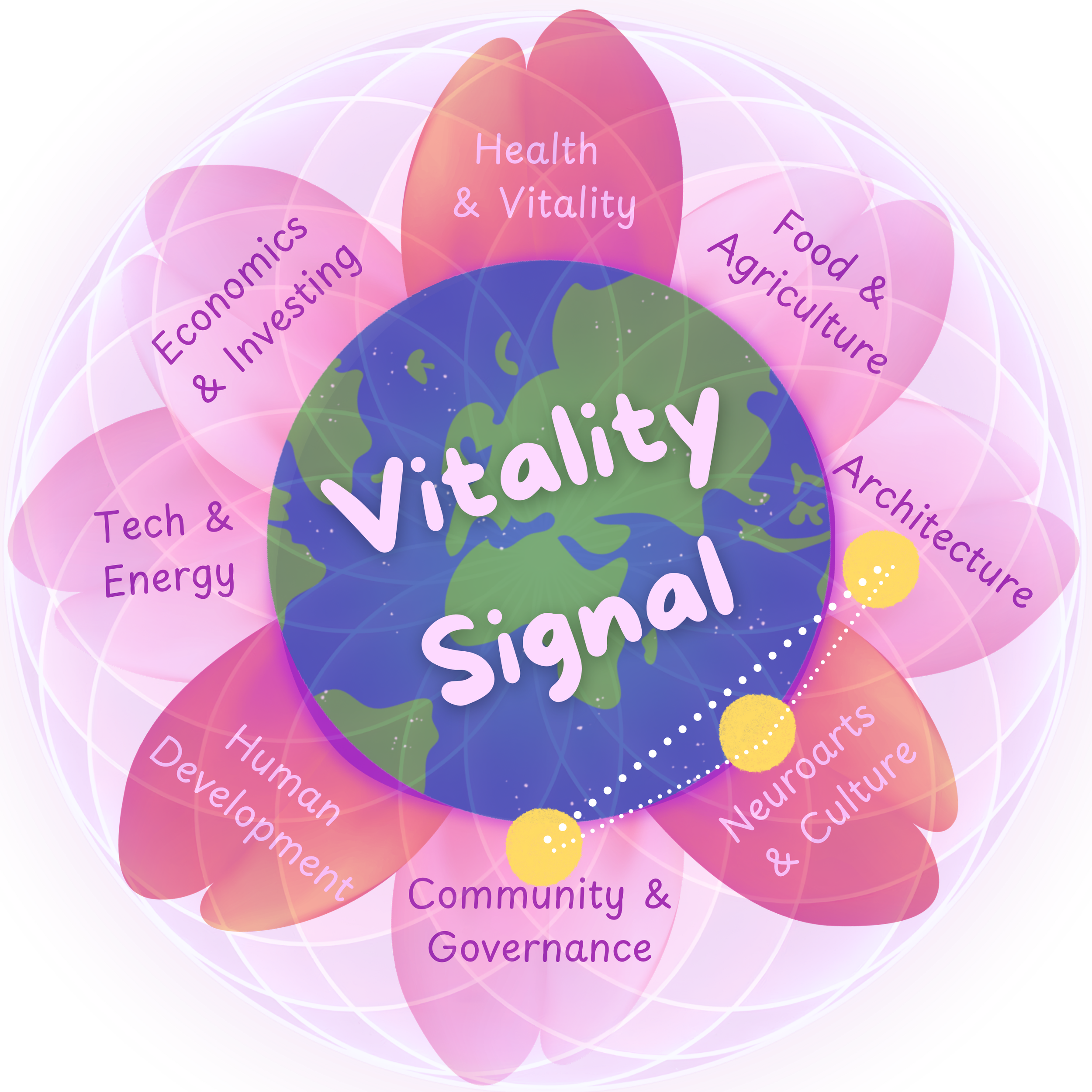
Everything we explored today — designing for one person, building worlds with intention, asking what an experience is for before building it — mirrors the core logic of regenerative vitality: that true aliveness comes not from extraction and scale, but from deep listening, reciprocal relationship, and creating conditions where life can genuinely flourish. Abraham's work reveals that the most transformative experiences aren't produced, they're grown — through curiosity, trust, and the willingness to invest in what opens people rather than what impresses them.
⭐ Abraham & MAGIC
Trained in architecture at Cornell, then in poetry and playwriting at the Michener Center for Writers, Abraham has also invested years studying transformative experience with the Whirling Dervishes of Turkey and the Shuar of the Ecuadorian Amazon. When asked what his magic is, he doesn't reach for any of it. He pauses: "I think it's to be able to see the brilliance of other people. I believe in the genius in everybody. And sometimes I can see it." For a man who has invested 25 years designing experiences that make one person feel truly seen, that may be the only answer that matters. The work was never about the object on the wall. It was always about the looking.
Creative Process (non-linear): Develop + Iterate Outlines & Drafts (Human + ai) ~Guest Alignment Feedback~Final Alignment by MAGICommons, Initial Publication: June 16 2026
