Some kinds of energy run out the more we use them. Others seem to grow the more we draw on them — renewing themselves through the very act of use. According to creativity researcher James C. Kaufman, creativity belongs firmly to this second category. It isn't just something we spend; it's something that replenishes us, often in the same moment we're producing it.
Kaufman, a professor at the University of Connecticut and co-editor of the Cambridge Handbook of Creativity, has devoted his career to studying what creativity actually is — and who gets to claim it. His answer might surprise people who think of creativity as something reserved for artists and geniuses.
-
Do one thing a day a little differently than you have before. Whether that's something at work, whether it's a chore you have to do, whether it's something fun, whatever it is, do it little bit differently. Swap out one thing for another. Try it a different way. Try a different path. you shake up the routine, whatever it is, do at least one little thing different.
Jiani (00:36)
Dr. James is an international leading researcher in the topic of creativity, weaving in wisdom, research,
and also applications in the business and wider life landscapes.
the goal of today's conversation is to explore what is creativity? How can we describe creativity? And what's the relationship between creativity and healing and also the emotional equilibrium?
when we think about creativity, it's such a big and wild topic. feels like everything can be creativity. So from your
decades of research and understanding and exploring, can you help us understand what describes as creativity? If it's hard for us to define it, or maybe we already know how to define it, just a little bit.
James (01:28)
We actually agreed decently well on a basic definition, which is that creativity would be anything that is both new, but also task appropriate. So it's not just that something is different or novel or original, but that it kind of does what it's supposed to do in terms of if...
If you're going to read a story, you expected to have certain parameters of a story. If you were to buy a novel, you'd be concerned if the novel was just blank pages. If you wanted to pave your driveway, you would assume that whatever materials would be used would be somewhat akin to concrete or gravel or the types of building materials one often uses for driveways.
and not cheese or pastrami or toothpaste. We tend to not think of that second component, but it's one of the main thing that distinguishes what is actually creative because otherwise it's just chaos. It's just like someone running around screaming isn't creative. That's noise. And again, depending on what you want to do,
the parameters shift a great deal. So something like performance art, maybe there aren't a whole lot of ways to be task inappropriate because there are relatively large boundaries. Whereas something like, let's say if you were trying to fill a hole in your wall, there's pretty clear parameters you would want the hole to be filled and you could do it creatively. You could do it not creatively.
But whatever you would do, you'd want the wall to still look like a wall. The Four Cs is a model that I developed with Ron Beghetto, where creativity had traditionally been thought of as big and little. Where you had creative genius, you had Shakespeare, you had Einstein, and then you kind of had everything else. And we felt...
That
was a little too...
We felt those categories weren't enough. And honestly, you could probably have 300 categories, of course, but we broadly defined four where we started with what we call mini-C and this is personal creativity. This is if you have an idea, a thought, you make a connection and insight and maybe you don't share with anybody. Maybe you don't pursue it, but it's something that's meaningful to you personally.
that still counts as creative and it's small. And sometimes we might think about it, ponder it, but then abandon it. But other times maybe we keep thinking about it and we try to...
develop it. If it's an idea, maybe we try to figure out how to make that idea be kind of a little more concrete. Maybe we start sharing it. At a certain point, your creativity is something that can be enjoyed by other people. And this can be, again, can be anything. It could be making a few variations to a standard recipe to make a nice dinner. It could be
creating a song, could be an idea for a new product, it could be almost anything. And little C is that everyday creativity that can be appreciated and enjoyed by people in your community. So if you're going to a county fair, the kind of things that you would see, you know, the handmade art, the interesting, you know, deep fried, whatever, all of that.
everyday creativity.
If it's something that particularly excites us and perhaps even we devote our careers to it, with practice, with time, with expertise, we reach the level where our work can be published, produced, recorded, distributed, manufactured, aired, and where we're actually contributing to a domain.
and perhaps we're even influencing others, even if it just starts as a little bit. And that's what Ron and I call Pro-C. And that's this expert level creativity. And to a certain degree, this is the peak for nearly all of us. And that's great. You can be Pro-C and be very, very accomplished. Big C or this creative genius, it's almost...
You can't even really know until after you're gone, until generations and generations later are people still moved by your work or able to enjoy your work. And that's when it hits that, that genius level that people aspire to. And
I mean, I understand that, you know, people want to be remembered, they want, you know, to be a star, but at a certain level, so many of the benefits and the wonderful parts about creativity, they happen at the mini C level, the little C, pro C, every level.
Jiani (06:02)
Everything, all the professions actually carry that pro creativity because we are creating, we're dedicating time. We're building something, building a product, building a company, building an initiative. It's all, and dedicating our time and years and years of hard work.
research, practice, observation, reflection, improvement that proceed is something very interesting. I feel like the world has so much attachment about the idea of creativity as something that has...
not a lot to do with our day to day professional life, entrepreneurial life and creative life. how can we build this bridge between the understandings of the mini-C?
James (06:52)
so much of what we want to think creativity is?
It often isn't, but I actually think that's kind of beautiful because we like to think of creativity as this, you know, sudden divine inspiration or the sudden burst of insight or the muse. And yet if it comes from us and if we know that we can put in the time and we can work hard and there are specific strategies and tools and thinking processes that we can practice.
and used to get better, makes creativity to a certain extent for everybody. Not genius necessarily, but that's okay. But creativity, the ability to use our imagination to have insights, to innovate all of these ways of being creative, again, at some level, to some degree, I believe everybody can do that.
Jiani (07:41)
So it's more accessible in common than we normally think we would.
James (07:48)
I think so much.
of creativity is realizing how broad the scope is. Like, I teach a class on creativity at my university and the first two weeks is often just talking about what's true, what's not true. And so many of these ideas we have, oh, kids are more creative than adults. I mean, not really. I mean, no.
Jiani (08:11)
Not really! I thought that way. No, not
James (08:15)
I mean...
Are kids less inhibited? Yeah. Are kids perhaps more likely to use their imagination? I don't know. Maybe. But in terms of creativity, creativity, as you continue getting better, I mean, it requires knowledge, requires expertise. We like that idea of, the novice trying something for the first time and they're...
amazing at it and they solve that equation nobody can solve. In real life that doesn't really happen a whole lot. And I mean it's a story we like. You know we love this idea of the young child picking up the sword or whatever and realizing that it is their destiny to be the leader of the new revolution or whatever. I mean it's a nice story but
In real life, you probably don't want a revolution that's led by a 12 year old kid. The same way you... I mean, it's funny. I mean, if you needed a really creative surgeon, would you want to go to a 12 year old?
Jiani (09:09)
You
James (09:10)
It's, and even with art, I mean, we can like and enjoy and appreciate children's art. It doesn't mean kids art is better than Magritte, Picasso and Frida Kahlo and so
Jiani (09:21)
appreciate this insight about the importance of time compounding as we dedicate our energies and practices and reflect and improve in a particular domain so the expertise does kind of play a role.
in the space of creativity and I maybe I think the reason I cannot speak for everyone however I do assume maybe the reason that we like that type of stories that you just mentioned is the lightness because if we come from a kid's perspective there's not a lot of burden as you mentioned they may feel less inhibited to tap into their creativity into
their imagination and maybe see restrictions as something that they can work with rather than something that they feel restricted and can do nothing about. How can an expert with decades of trial and error and research and development still dedicate and still create space for creativity as if
there's not a lot of burdening, there's not a lot of restriction, there's not a lot of limitations within reason. How can that sense of levity and vitality, fearlessness, reasonable fearlessness help experienced experts and professionals regain that sort of
freedom to create.
James (10:47)
I think there is some things that's part of our personality, which is this openness. Are we open to new experiences, to new ideas?
But even if instinctually maybe we're not, we can still make ourselves do those behaviors and in small steps. So have something to eat you've never had before. You know, go somewhere you've never been. Maybe try and relatedly tolerating ambiguity. Have a day where you don't make any plans and you drive somewhere and park and you just wander around and do whatever. Allowing yourself
I mean, in essence, being open to new experiences and ideas, you could argue is like seeing things through the eyes of a child. At least some children, not my children, but some children who love to try new things.
Jiani (11:31)
sense of openness.
James (11:32)
and including two ideas. And again, anything in the extreme isn't great. So being open to ideas doesn't mean, well, maybe I don't need to get vaccinated. No, some classic wisdom is still good. But so many of the constraints and restrictions, some are real. So if you are an ice sculpture, then
ice melts, you can't undo that constraint. Some are put in place by the audience or let's say by clients if you work in a business and those are challenges. Other constraints are put in place by us and sometimes these are constraints that don't need to be there. Other times we put them there on purpose and they can make us more creative. I mean if you're feeling stuck, one way is to
put a fun constraint. mean, if you have to write something, and again, maybe not if you're writing directions for how to use a medication, but if you're writing something that you have a little more leeway, I mean, see if you can write it without using the letter E or C. There are a lot of little things that can help engage what we call divergent thinking or idea generation. Try to come up with many different ideas or try to come up with a super
original idea that other people wouldn't think of. And you can do that in response to something that you're actually stuck on. Or you can do it, we have a few standard questions like thinking of many different uses for any household object like a pen. How many uses can you think of for a pen? Or a what if question. What would happen if we could fly? What could happen if we had four arms and just...
Give yourself a certain amount of time, try to come up with a whole bunch of different original answers and again you can kind of kick your creative thinking a little bit into gear.
Jiani (13:11)
like that. You mentioned about the topic, the idea of divergent thinking and through your research and articles that you shared, there's on the other side, there is this convergent thinking and as you mentioned at the beginning of this creativity, did not say it specifically. I did hear there's some sort of implementation that we can be as divergent to come up with
as creative ideas as possible to complete the circle or the loop of creativity. Ultimately this creativity needs to be put into practical usage of some sort and then that reminds me of the convergent thinking. So from the creative perspective how do divergent thinking
work alongside with convergent thinking and how can we intentionally allow those two models of thinking to work together
James (14:11)
So, convergent thinking, or when you evaluate and then select which one of your ideas to pursue. I mean, I think that many of us instinctually prefer one or the other. And I think part of it is make sure you're doing the one that is less instinctual. So, if you're somebody who is very focused on practical and this is the next step and we have to do this.
Allow yourself a little bit of time to explore, to consider, to generate, to think, are there other ways we might do this? If you're somebody who loves generating ideas, but doesn't instinctually think more convergently, I mean, some of that is learning what we call metacognition. So kind of, can you evaluate your own ideas? Can you learn?
to tell the difference between, these creative ideas I've had, they're really good. These ones, I thought they were great, but they didn't really work out as well. And the better that you can get at identifying these ideas will probably be really good. These may be less so. It's almost like eliminating a step or two of the process because you can then, it's not like we generate and then we evaluate.
It's really like this. So we generate, got these two or three ideas. Yeah, but that one's bad, but I like this one. What about that? I could do ba-ba-da-da-da. well of these possibilities. Good, good. not sure about that one. Definitely not. Okay. Well, like these two, of these two, and we keep in this process all the while reminding ourselves of what the original problem was. What was our goal? What are the parameters and the restrictions? that's a great idea, but...
you know, what I have to do must fit into a shoebox or whatever. And so it's that mix between thinking of ideas, evaluating these ideas, and then making sure they're all lined and relevant. and again, sometimes relevance is a really big deal. Sometimes it's much less of a deal. Cause again, you know, some things you have a huge freedom, some things you don't.
So much depends on what you're being creative in.
Jiani (16:12)
So it is actually an iterative process.
way that we collaborate or the way that we collaborate between those two models harmoniously like you described is rare? Would you say? Or not so much?
James (16:24)
It's a hard question to answer because these things happen so quickly. So one of my former PhD students, Greg Bolt, who now has his degree, he's in Canada, he's done this study with me, but it's him, where he had people think out loud while they were being creative. And that was a way we could really see in that micro moment what people were thinking.
One thing we were finding is that it was much more than just thinking divergently, was all this stuff like, bong, bong, bong, bong, bong.
But it's really hard to do these studies because these things happen so fast. Often we're not even aware of them.
Jiani (17:01)
We can't even speak out loud.
James (17:02)
Yeah, I mean, some of these things go in and out. mean, how often do we have an idea and we're like, how did I possibly think of that? Where are we? What was I thinking of before? You know, and like we know that while I was originally, you know, answering this email and then I stopped and I began asking questions, how did I get there? You may not even know it a millisecond after you think it, let alone if we're trying to get you to say it out loud or let alone if
we're trying to ask you to remember, you know, so think of the last time you were creative a week ago. I mean, I don't remember what I did yesterday, let alone a week. It's, we study these things, but often in a very constrained way where we'll give these divergent thinking items. And again, they're useful. They're a nice way to start, but
the stuff that happens in the micro moment is a little harder to exactly narrow.
Jiani (17:52)
Is there a way to measure brand waves and use the brand waves as a potential indicator for creativity? Are there brand waves that matches our creative thinking?
James (18:08)
There is absolutely work done on this. There's a whole society, which is wonderful, called the Society for the Neuroscience of Creativity. And although I work with a lot of neuroscientists, So I can almost understand it when they explain it to me, but I can't explain it to other people.
Jiani (18:25)
Yeah, it's hard. That's a hard topic.
So let's kind of come back to the topic of creativity. And then we've we've kind of delved into the space of what is creativity. We've mentioned about the mini creativity, the daily creativity coming from maybe making a cookie, the bakeries, making juries, creating some patterns to
professional creativity as we conduct a research into the space of whether it's creative research or whether it's any ordinary jobs like even plumbing to solve problems through creative thinking. We've talked about the bigger C which is the big creativity like all those creative geniuses which are hard to predict and then we kind of circle back to the space of creativity and the balance between
convergent thinking and the divergent thinking and how as we create those things kind of works harmoniously together or at least we hope so and then let's kind of dive deeper into the topic of healing and creativity in an ideal scenario if everybody is
it's creative whether they're funneling their creativity in their professional work through their professional creativity or they're funneling their creativities at the same time or not at the same time into the mini creativities in the daily life. That would be perfect. We won't face any sort of like burnout or stress or anxiety because our existence always creates so it's going to be perfect. But how, why, how come in this current world we are facing
As creative beings, are facing so much challenges as anxiety and burnout and stress and all that. And it seems like this has anything to do with our creativity. It feels like it's a void of it. So what is going on here?
James (20:17)
Well, I mean.
Creativity can absolutely help.
But for better or worse, can't necessarily, we can do nearly anything creatively. But when we think of the kind of creativity that gives us that joy, that spark, that's similar to what Mihaly Csikszentmihalyi would call flow. And these are wonderful moments.
But we can't do that 24-7.
It's the same way, like I love writing books. That's my favorite things in the world to do. But when I say I love writing books, I love it when I'm at my computer and I'm typing and the ideas are coming. There's also the parts where I'm editing, I'm looking up references, I'm critiquing my writing for grammar or copy editing. We tend to not enter flow with those type of things.
And yet all of it is often necessary if we want to create in almost anything at a pro-C level. So if you think of being creative and in literally anything, there's the parts that are the exciting and the sparks and everything's flowing and you feel great. And then there's all this stuff where, okay, now I need to sandpaper the wood. Now I need to clean up the dishes.
Now I need to check and recheck and measure and re-measure this to make sure before I start cutting or before I add this chemical solution.
those are absolutely necessary, they do not necessarily bring that same level of joy.
Not to mention, of course.
There are so many outside stressors from everything from our job to our lives to the world that I'm still just talking about within being creative. You add in all that other stuff and it's...
Good job.
Jiani (21:51)
And in your books, you've mentioned creativities can potentially be a solution to help us heal. You've mentioned about creative expressions like art, like painting, and you yourself wrote lyrics for a few songs and maybe dance is a sort of creativity. how does the creativity
being a potential healing solution to help us regain this sense of emotional equilibrium.
James (22:22)
many, many different ways.
One way is if we are in a bad mood, if we're feeling sad or angry or frustrated, creating, and the research has largely been on the arts, but it doesn't mean it's just the arts, is that if you engage in being creative, in essence you distract yourself. And so you're not thinking about the stuff that is making you sad or upset. You're thinking about writing or drawing or singing or whatever you're doing.
And that helps improve your mood. Longer term, if you regularly involve yourself with writing, any type of narrative, so if you journal or blog or keep a diary or work on a novel or any of this stuff, the act of this helps us. Some people call it the writing cure. And it basically reduces
all the stuff in your head which
can reduce stress, reduce anxiety, and that frees up your mind to do other stuff. And that's another pathway. There's the fact that when we think about our past traumas, we can engage in what's sometimes called cognitive reappraisal, where we might think of it and instead of
only focusing on the bad, we might look at the eventual repercussions, some of which might have led to some good things. It's the same way when we've experienced a trauma, there's often a period afterwards where we grow. And it's this growth period. And again, it's not the trauma that helps us, but it's this growth period that can help us with gratitude, with just re-approaching our lives.
And this again, creativity can help in this transition. Creativity can also help in the ability to see the kind of trickle down positive implications of events that by themselves may not have been good. All of this stuff is helped by creativity. A lot of times when we feel...
alone in the universe, like does it matter I ever existed? There are several ways that people can feel like, yes, they matter. They will leave a legacy. They will have what can be called symbolic immortality. And there are many pathways. mean, children are one pathway. Religion, spirituality is another one, nature.
creativity is another one. And that can be wanting to be the next Shakespeare and leave plays that are performed for the next hundreds of years, but it also can be something smaller. And enjoying your creativity and knowing that even if it's your family, your friends, your community, who might appreciate it that your creative work will still live on
Jiani (24:57)
How can we in our day to day existence as we devote ourselves to our professional creativity whether it is writing an article, doing a research, developing a product, building a business, leading an initiative, how can we
channel this type of healing creativity into our daily life to make day-to-day existence
grounded,
James (25:33)
I think some of it is to allow time that often we can be so focused on being productive that we can get too focused on it. I mean, I remember when I had my first child and then my second child, I had to kind of recalibrate what productive meant because if I was spending some good time with my boy or my boys that counted.
as being productive when I was trying to get in better shape, I would again, recalibrate and exercise was just as good as getting productive work done. think the same is true for being creative. If you can be creative in your job and that gives you meaning, that's wonderful. And you've hit the jackpot. that's, I I consider myself very lucky because a great deal of what I do gives me that excitement and that rush.
Not everybody has that. And if you're not getting from any aspect of your job that creative enjoyment and release, it matters. And the same way that you build in time to go jogging in the morning.
Try to build in time for that when you can. So not in a way that's going to stress you out. But part of it is valuing it. I mean, one of the burgeoning areas of lot of research is this idea of creativity and our own beliefs about it. And do we value it? Do we have that as part of our identity? Do we believe ourselves to be creative? And that is not the same as being creative, but it sure is pretty important.
and simply valuing it, caring about it. Like anything, being creative means you need to value it, allow time for it, devote yourself to it. And even if that's 20 minutes a day, it's not like you have to take a day off work. You can fit it in.
as long as you're doing it consciously.
Jiani (27:18)
like tying the...
cognitive reappraisal with assigning meaning and assigning value to simple things that we are doing on a day-to-day basis and also consciously and intentionally carving out time and space for us to do things that gives us a sense of joy such as taking a walk, appreciating the beauty of a flower,
playing tennis with our family, with our friends, sharing a story and from a spiritual or even like a belief system assigning meaning to that moment.
and see that as not as something that needs to be discounted but assigning this to be something that needs to be valued and even see it as something that's productive because as you mentioned it's not typical productivity divine right to be counted as productive playing anything that helps us to feel more
grounded and joyful and fulfilled and valued is something considered as productive as well. Even though on the surface people may see it as just play or non-productive times, things like that.
James (28:35)
And yet play is so...
You know, mean, all kinds, but including imaginative play. mean, it's so good for us. It helps link us with other people.
it's
It's worth it. I think we're worth it.
Jiani (28:47)
so as we move into the magic portion of it, the first question for you is, as you were about 11 years old, what did you enjoy creating or playing so much that time disappeared for you?
James (29:06)
Writing, always writing, stories.
Always thinking of stories, writing.
to a certain degree it's what I still do it's just now expect creativity.
Jiani (29:13)
Yeah, it's a creative act talking and exploring about a creative topic. That's a bit...
James (29:19)
which is kind of fun.
Jiani (29:20)
Yeah, I like how you weaved that together. Was there a particular challenge in that period of time that...
that helped to shape you into who you are as of now or shaped the pathway that leads you to be who you are and where you are as of now.
James (29:42)
I certainly.
We moved a lot.
I was probably late in high school before I had what I would call like a real close friend.
And I feel like that led me to really appreciate the people I have in my life.
I mean...
One thing I love about creativity is that the research community is broadly filled with pretty terrific people. It's one of the nicest fields. mean, as somebody who's dabbled in other fields, I mean, we had this conference in New Haven maybe a month ago and there was over 200 of us and it was just...
In addition to it being intellectually stimulating, it was just so good to see so many people who I've known for years and who I consider some of my dearest friends. And I think finding that community, wanting it so badly when I was 11 and now having found it makes me appreciate it even that much more.
Jiani (30:32)
nice what role does Childlike Wander do you think play in the space of creativity as an expert as an adult
James (30:42)
I think that kind of childlike wonder, it's still rooted in...
intense interest and curiosity and passion. And I think ideally, even if you learn more about something, you don't lose the absolute fascination with it.
I mean, I've been very lucky. I've gotten to pretty much study stuff that I really, really like and it's stuff that I was really interested in. Now I'm, I'm still really interested in it. It's just now I get to know a little more about it. So to me, if you're lucky, you can kind of keep a certain degree of that wonder and excitement about at least a little bit for about what you continue to do.
Jiani (31:19)
for practitioners who constantly have to, to practice creativity and also have a strong outcome that they need to meet and deliver. And even sometimes the outcome does not prefer too much creativity because time is short. For
And also like for people who building startups and initiatives, there's a lot of constraints that that like moving to the space or put like snuggle into the space where we could have enjoyed the very act of curiosity and exploration more. However, we found that there's so much thing that we need to compromise. So how
how would those type of professionals
gaining insight from the space of creativity, the space of childlike wonder as a adult who constantly delivers impactful outcome, or at least we try to.
James (32:11)
mean, the moment of insight, the moment of realizing what needs to be done, of finding the solution, regardless of whatever you're doing, that will usually bring a certain amount of joy or at least relief. I think for a lot of folks who are more entrepreneurs, a lot of it is getting to see your audience, getting to see people use and enjoy
And it's in a sense, depending on the product to see that wonder in other people responding to the stuff that you've done. And the fact, of course, that
These moments will always be special because our day isn't filled with them. Like it's not insight, insight, insight, wonder, wonder, wonder, but it does allow us to appreciate even if it's one or two moments a day to still appreciate and hold on to
Jiani (32:58)
one simple activity to keep wonder moment alive what would that be the moment of creativity the moment of creative insight what would that simple activity be
James (33:13)
Do one thing a day a little differently than you have before. Whether that's something at work, whether it's a chore you have to do, whether it's something fun, whatever it is, do it little bit differently. Swap out one thing for another. Try it a different way. Try a different path.
Jiani (33:34)
you
James (33:34)
shake
up the routine, whatever it is, do at least one little thing different.
Jiani (33:40)
to create those micro open moments for a little surprise. What do you think is your magic overall?
James (33:47)
That's a hard question.
Jiani (33:48)
As of now, we can change. We will always change, we will always shift. As of now.
James (33:52)
I mean, what brings, what is magical to me is always the people close to me, my wife, my boys, my dogs, my friends. If it's my magic in terms of my special ability, I think.
The same thing that made me want to write plays. Now I apply that to writing my books and weaving stories, anecdotes, connecting things towards a larger...
take-home point or piece of information.
Jiani (34:18)
It's the magic that weaves integrates more the information coming from research and insights into something that's helpful and insightful through the technology of words and writing.
James (34:33)
hopefully.
Jiani (34:37)
Beautiful.
Dr. James, it's such a wonderful pleasure to have this conversation with you.
to dive deep into the critical and foundational ideas of creativity and how creativity is such a universal and accessible technology that we all have and how through our daily life
even if we're not creative geniuses like those in the history, we can still curate spaces and moments to have a creative insight, to have a creative moment and be creative Practical,
James (35:21)
Thanks.
Jiani (35:21)
practical creativity.
And for our audiences, if you are curious and you wanted to learn more about creativity and how creative energies or practices or even frameworks help you in your daily creative endeavors, definitely I encourage you to get connected with Dr. James or read his books.
James (35:46)
Thank you so much.
What Creativity Actually Means
"Creativity would be anything that is both new, but also task appropriate," James explains. It's not enough for something to be different or original — it also has to work. A novel can't just be blank pages. A driveway shouldn't be paved with cheese. "So much depends on what you're being creative in," he says, and the boundaries of what counts as "appropriate" shift depending on the task.
To make sense of just how wide creativity's territory really is, James and his colleague Ron Beghetto developed the Four C Model:
mini-c: a private insight or idea — something meaningful only to you, maybe never shared.
little-c: everyday creativity enjoyed by your community — a new recipe, a hobby project, a homemade fix.
Pro-C: expert-level creativity that contributes to a field — the level most professionals actually operate at.
Big-C: the rare, generation-spanning genius of a Shakespeare or an Einstein — something that continues to be appreciated for years and years.
Each level offers its own kind of recharge. Mini-c is a private spark. Pro-C, meanwhile, can be a sustained, self-renewing kind of vitality — the sort that keeps refueling itself through mastery, growing stronger the more it's drawn on. James still feels that pull decades into his career: "a great deal of what I do gives me that excitement and that rush." That's vitality regenerating itself, not depleting.
The Mechanics: A Small Renewal Cycle
Underneath all four levels are two simpler processes working together — divergent thinking (generating many different possible ideas) and convergent thinking (evaluating and narrowing them down). James describes it less as a straight line and more as a loop: "we generate... and get these two or three or ten ideas... Then we consider them -- I'm not sure about that one... what about that?" The generative half expands and energizes; the convergent half grounds and clarifies. Together, they form a small cycle of renewal — not just a method for solving problems, but a rhythm that restores as it produces.
The Deeper Payoff
This is where creativity's regenerative power becomes most visible. In the moment, creative activity can lift and redirect our attention. "If you engage in being creative, in essence you distract yourself," James says. "That helps restore your mood."
Over the longer term, something deeper happens. Regular writing — journaling, blogging, working on something ongoing — functions as what some researchers call "the writing cure," clearing away mental clutter and restoring a sense of calm. And when we revisit past difficulties through a creative lens, we can engage in cognitive reappraisal: "we might look at the eventual repercussions, some of which might have led to some good things." That's not rest — it's a slower, deeper form of regeneration, vitality rebuilt through meaning rather than downtime.
There's an even wider layer to this. James points to what can be called symbolic immortality — the sense that our creative work, however small, might outlast us. "There are several ways that people can feel like, yes, they matter," he says, whether that's raising children, practicing a faith, or simply knowing "your creative work will still live on." This is vitality that regenerates beyond the self — a sense of ongoing contribution rather than a countdown toward depletion.
A Small Daily Practice
None of this requires chasing Big-C brilliance. James's advice for sustaining this cycle is refreshingly modest: "Do one thing a day a little differently than you have before... shake up the routine, whatever it is."
It's a small, renewable act — but it taps the same well that sustains a lifetime of creative work. You don't need a masterpiece to feel more alive. You just need to keep the mini-c moments coming. Vitality, it turns out, doesn't have to be chased in big bursts. It can be regenerated daily, one small shift at a time.
Regenerative Vitality & Creativity
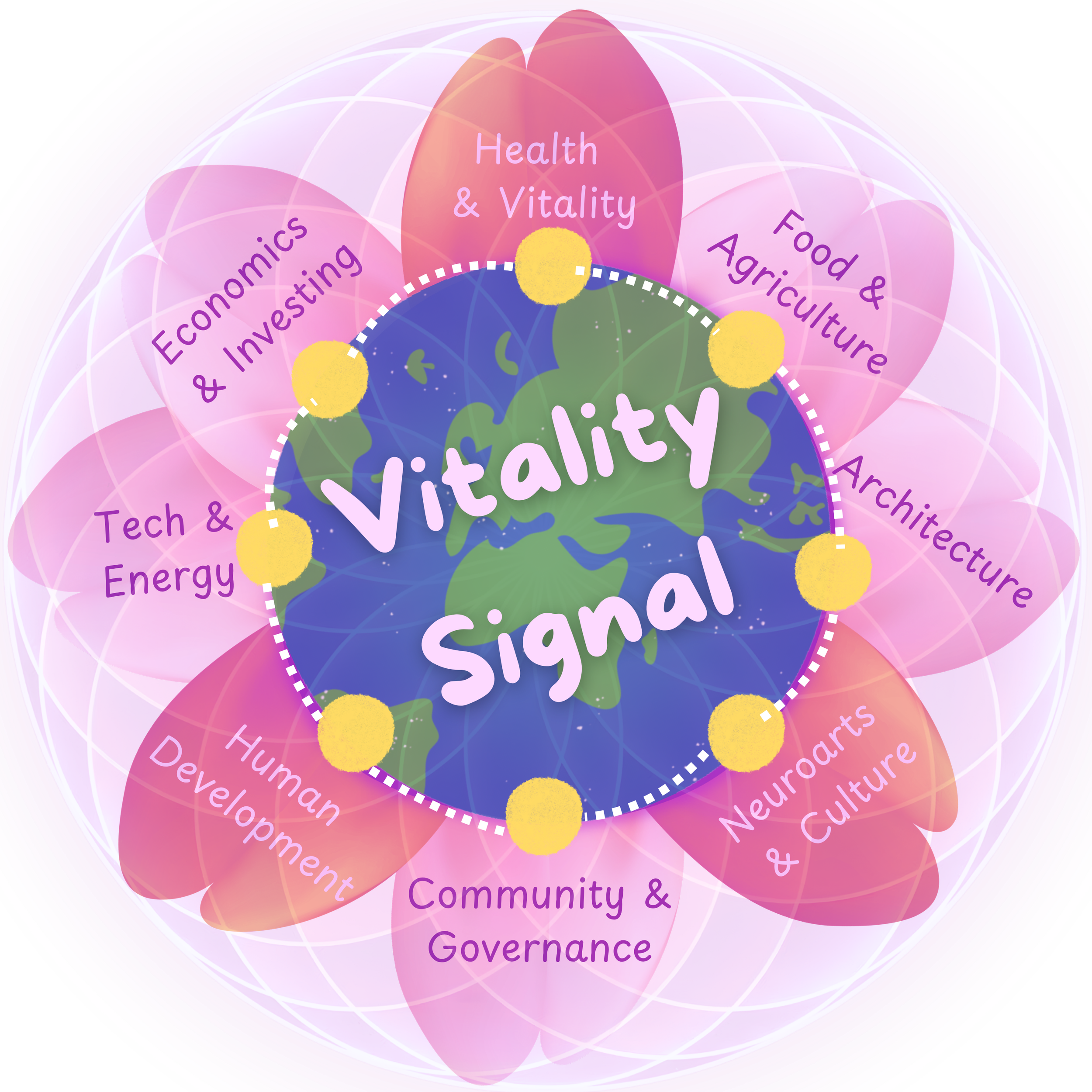
Zooming out, this pattern reaches well beyond creativity itself — the same regenerative logic shapes how people can grow across a lifetime, how communities govern and sustain themselves, and how health and vitality can be restored day to day.
Seen this way, creativity and regenerative vitality aren't two separate ideas but the same process from two angles: creativity is what regenerative vitality looks like when it takes form — an idea, a story, a solution, a small shift in routine — and regenerative vitality is what creativity feels like from the inside, the sense of being replenished by the act of making rather than depleted by it.
To create, in even the smallest way, is to practice renewal itself.
⭐ James Kaufman & MAGIC
James Kaufman has invested decades building creativity into a rigorous field of study — co-editing the Cambridge Handbook of Creativity, authoring Creativity Advantage, and now coming out with a new book that explores creativity through film, all while cultivating the next generation of researchers at the University of Connecticut's Neag School of Education. Yet when asked to name his own "magic," he didn't reach for any of it. He traced it back to the same source that first drew him to writing plays as a child: the ability to weave stories, anecdotes, and research into a larger take-home point. That thread — turning raw material into insight that renews itself in the telling — is what he still draws on today. It's a fitting close to a conversation about creativity's many levels: the person who built the framework for measuring creative greatness locates his own magic not in Big-C achievement, but in the ongoing, generative act of connection itself.
Creative Process (non-linear): Develop + Iterate Outlines & Drafts (Human + ai) ~Guest Alignment Feedback~Final Alignment by MAGICommons
