
Quiet Powerhouses For Inclusive Organizations | Alex Furman
Dive into the world of organizational dynamics and talent management with @MAGICademy S3E9 featuring @Alex Furman, CEO of @performica as we discuss a range of topics from organizational psychology, the need to move away from traditional hierarchical models to focus on mapping collaboration networks within companies to the potential impact of AI and emerging technologies on work.

How AI Tutor is Igniting Wonder to Build Skills | Dr. Kristen DiCerbo
💕 #MAGICademy S3E7, we had the great pleasure of meeting @Kristen DiCerbo, chief learning officer @Khan Academy to discuss basic principles for designing AI-powered tutors to power up the skill development process for learners across age groups. She emphasizes the importance of curiosity and wonder in the learning process. She also highlights the need for a balance between AI tutors and human teachers, as human relationships and motivation are crucial for student success.

Tiny Lessons Shift Organizational Cultures | Ryan Laverty
MAGICademy S3E5, Ryan Laverty, co-founder of Arist, discusses the potentially transformative impact of micro-learning on organizational behavior change and culture shifts. He also highlights the importance of nurturing curiosity and childlike wonder in the process of skill development.

AI Learning Companions For Complex Skill Development | Samreid Manez
💕 #MAGICademy S3E4, we had the pleasure to meet @ Samreid Manez, founder of Valearnis. Integrating AI learning companions and non-player characters (NPCs) in a gamified learning experience has the potential to enhance complex skill development.

Digital Charisma Through AI-Amplified Storytelling & Branding | Tim Zhang
Imagine a world where anyone can conjure vivid visual stories at will for skill development or for creative branding, where AI becomes the paintbrush of the masses. This is the vision @Tim Zhang, the mastermind behind @Artflow AI, brings to life in this captivating conversation in #MAGICademy S3E2.
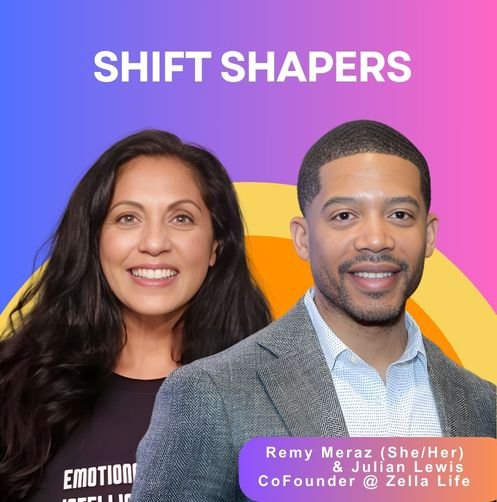
Shifting Organizational Culture for Passionate Plays | Remy Meraz + Julian Lewis
#MAGICademy S3E1, we had the great pleasure of meeting @Remy Meraz and @Julian Lewis, founders of Zella Life, a cultural shift engine with a mission to democratize coaching for underserved middle managers and create a paradigm shift within existing organizational systems. Our discussion revolves around creating psychological safety, fostering curiosity and childlike wonder, and promoting a culture of “playaholics” (trust me it is much more fun than workaholics).

The Neuroscience of Wonder | Dr. Jeff Tarrant
In #MAGICademy S2E11, we will dive into the fascinating world of brain waves with Dr. Jeff Tarrant, a counseling psychologist and expert in psychophysiology. He unravels the mysteries of our brain's electrical activity, from the slow, dreamy delta waves to the lightning-fast gamma frequencies during the flow state, where creativity and productivity soar.

Harnessing Curiosity to Thrive in an AR-Enriched Phygital World | Anna Belova
In the #MAGICademy S2E10 story, we are having a conversation with Anna Belova, founder and CEO of DEVAR (Canva for Augmented Reality). Anna explores the concept of "Phygital" (physical + digital) experiences that fuse the tangible and the virtual, creating an immersive 360-degree multi-sensory playground for audiences, customers, and learners alike. As we navigate this new frontier, we're not just entertaining or educating; we're unlocking a deeper understanding of each other, peeling back layers of interaction to build more authentic connections. We also explored the power of curiosity & imagination by asking the question “What If…?” daily to help our brain get comfortable with always expanding its perceptions and open to new possibilities.

Charting the Course for Responsible AI Innovation | Josh Cavalier
In this conversation with @Josh Cavalier, who highlights the role of AI policies and governance in organizations and shares examples of AI policies in different companies. He also emphasizes the importance of data and compute power in AI and the considerations for uploading intellectual property (IP) to AI models.

Navigating the Future of L&D with Neuroscience and AI | Stella Collins
It was such a great honor to meet up with Stella Collins, co-founder and chief learning officer of Stella Labs, and author of “Neuroscience for Learning and Development: How to Apply Neuroscience and Psychology for Improved Learning and Training.”
In this conversation, Stella explores how AI & neuroscience can empower talent upskilling, transferring learning into behavioral change and performance improvement to align with business objectives and outcomes. We also dived deep into her GEAR framework and the role of curiosity in transcending traditional learning development.

Exploring the Empathy Power of AI Image Generation | Danyang (Delia) Wu
In this #MAGICademy conversation, Danyang (Delia) Wu, co-founder of Huhu AI, discusses innovative ways to leverage AI to help us visualize internal/hidden emotions and feelings to enhance self-awareness and leadership…She also touches on the challenges around cost and accessibility. She also touches on the challenges around cost and accessibility.

AI Social Storytelling for Individualize Learning | Brian Carlson + Erin Lamb
Brian Carlson, founder of Storytime AI, and Erin Lamb, CEO of HASA discuss the learning impact of "social stories."
Social stories are short, personalized stories that describe a specific social situation, skill, or concept in a structured and straightforward manner. They aim to break down complex social interactions into easily understandable steps, providing individuals with a framework for understanding social cues, expectations, and appropriate behaviors.
While social stories are originally used as an intervention for individuals with ASD or other social-communication difficulties, they can be equally helpful for anyone who needs to develop specific skills across social situations, such as leadership.

The Story Mind: Unlocking Skills with AI and Storytelling | Elliott Masie
Elliott Masie, a learning expert and Broadway producer, discusses the connection between storytelling and learning. He emphasizes the importance of engaging learners through storytelling and personalization. Masie also explores the evolution of AI and its impact on learning and skill development. He highlights the need for curiosity in the learning process and the potential of immersive technologies like virtual reality. Masie encourages individuals to embrace the future of learning and remain open to exploration and experimentation.

Demystifying AI Literacy | Amanda Bickerstaff
Amanda, the founder and CEO of AI for Education, discusses the importance of AI literacy in education and the potential of AI to personalize learning. She emphasizes the need for educators and organizations to understand the capabilities and limitations of AI and to use it in an ethical and responsible way. Amanda also highlights the biases and cultural limitations present in AI models and calls for the development of more representative and diverse training data sets. She encourages workplace learning and leadership development to prioritize AI literacy and to approach AI implementation with a problem-solving mindset.

Unleashing AI Avatars | Kevin Alster
In this episode, Kevin Alster discusses the concept of digital twins and how his team uses AI avatars to create high-quality videos. They explore the applications of digital avatars in video training and the potential for AI avatars to act as coaches. Kevin also shares his passion for performance and the challenges he has faced in bringing joy to the workplace. He also provides advice for using AI tools effectively.

Just-in-Time Micro-Feedback For Inclusivity + Mastery | Chris Du
Artificial intelligence is emerging as a transformative tool in educational assessment, offering nuanced ways to support learning through personalized feedback mechanisms. While AI can efficiently generate individualized insights for students, especially in scenarios where instructors face time constraints, its true potential lies in collaborative implementation with human educators who can refine and contextualize the generated feedback. The technology's capability extends beyond direct student interaction, providing valuable trend analysis that can help educators identify systemic improvements in teaching methodologies. However, this promising technological integration comes with critical ethical considerations, particularly the need to prevent over-dependence on AI systems and maintain a balanced, human-centered approach to learning that preserves the essential interpersonal dimensions of education. By thoughtfully integrating AI as a supportive tool rather than a replacement for human instruction, educational institutions can leverage technology to enhance, not replace, the nuanced art of teaching and learning.