Proactive Vitality Management (PVM) for a Creative State of Mind
Make it stand out
Whatever it is, the way you tell your story online can make all the difference.
This research explores how talents can proactively foster their own creativity through "proactive vitality management" (PVM)—the intentional management of physical and mental energy—and the subsequent role of mindfulness as a cognitive mechanism.
Key Concepts
Proactive Vitality Management (PVM): A goal-directed, self-regulatory behavior where individuals manage their own physical and psychological states to achieve optimal functioning at work.
Mindfulness: Defined as a state of attention to and awareness of present-moment events, which helps individuals direct cognitive resources toward tasks.
The PVM-Creativity Link: The study posits that PVM generates the cognitive and energetic resources necessary to achieve a mindful state, which in turn facilitates creative performance.
Research Methodology
The study replicated its findings across two daily diary studies spanning five consecutive workdays:
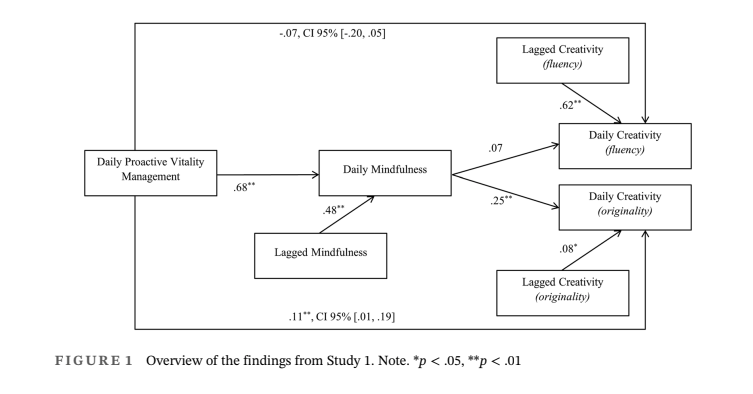
Study 1: Involved 133 participants from the United States. Participants reported on their daily PVM and mindfulness levels and completed a daily brainstorming task to measure creative performance.
Study 2: Involved 62 talents from creative agencies in Germany. This study used supervisor ratings to assess the daily creative work performance of the talent.
Findings
Positive Relationship: In both studies, daily PVM was positively related to daily levels of mindfulness.
Mediation: Daily mindfulness served as an explanatory mechanism, linking PVM to improved creativeperformance (measured by the originality of ideas in Study 1 and supervisor ratings in Study 2).
Practical Implications: Individuals can manage their own vitality to promote creativity, and organizations can empower this by encouraging proactive behaviors, such as allowing for "quiet hours" or providing autonomy for talents to manage their energy needs.
Practical Proactive Vitality Management (PVM) Strategies
Environmental Control: Proactively shutting off your phone and email for a period to eliminate distractions and protect your ability to focus.
Mental Breaks: Intentionally going for a walk specifically to "clear one’s head" or seek fresh inspiration away from the immediate work environment.
Auditory Stimulation: Listening to favorite music while working to intentionally foster an energized and driven mindset.
Scheduled Focus: Incorporating designated "quiet hours" into the workday to ensure the cognitive resources necessary for deep work are protected.
Self-Motivation: Taking active initiative to motivate yourself and ensuring you feel energetic throughout your work tasks.
How Does it Relate to Generative Vitality?
We selected this research because it associates mindfulness with creative performance. According to the research, mindfulness requires abundant cognitive and energetic resources, which can be generated by proactively managing one’s own vitality. The concept of proactive vitality management (PVM) is very interesting, as it provides a tangible approach for us to intentionally curate space for creative vitality to arise on a daily basis, giving us a sense of super agency and sovereignty.
Disclaimer: The summary story is co-developed with Gemini and reviewed by human.
