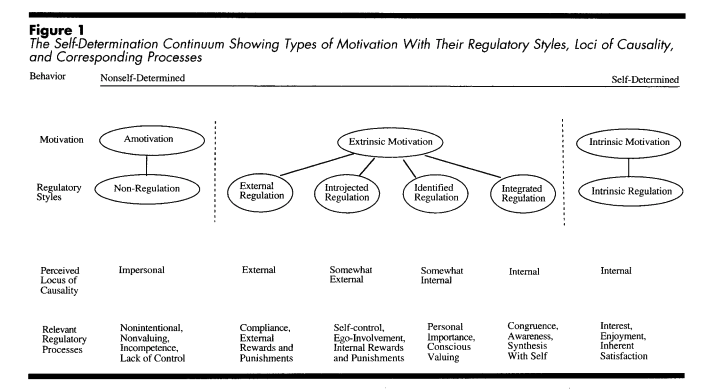
Self-Determination Theory (SDT) is an approach to human motivation and personality that posits humans have innate growth tendencies and psychological needs. The theory explores how social-contextual conditions either facilitate or hinder these natural processes.
Core Psychological Needs
SDT identifies three innate psychological needs essential for optimal functioning, personal well-being, and social development:
Competence: The need to experience efficacy and master new skills.
Autonomy: The need to experience behavior as self-determined and endorsed by the self.
Relatedness: The need to feel connected, cared for, and to belong.
When these needs are satisfied, individuals experience enhanced self-motivation and mental health; when thwarted, they face diminished motivation, alienation, and ill-being.
Types of Motivation
SDT differentiates between various forms of motivation based on the degree to which they are self-determined:
Intrinsic Motivation: The inherent tendency to seek novelty and challenges, explore, and learn for the inherent satisfaction of the activity. It flourishes in environments that support competence, autonomy, and relatedness.
Extrinsic Motivation: Performing an activity to attain a separable outcome. SDT classifies this along a continuum of autonomy:
External Regulation: Driven by external rewards or demands.
Introjected Regulation: Driven by internal pressures like guilt, anxiety, or ego enhancement.
Identified Regulation: Driven by a conscious valuing of a behavioral goal.
Integrated Regulation: The most autonomous form, where regulations are fully assimilated into the self. (note: through MAGICommons’ perspective, this would be the ultimate intention of inner development)
Internalization—the process of taking in values and regulations—is facilitated by social contexts that support relatedness, competence, and especially autonomy. Satisfying these needs is critical for mental health, performance, and well-being across diverse domains, including education, work, and health care.
How Does it Relate to Generative Vitality?
Self-Determination Theory (SDT) provides a foundational framework for understanding the "vitality" and "proactive engagement" essential to human nature (individual and collective). A majority of research on vitality cites this article as the core theoretical foundation. SDT identifies three innate psychological needs—competence, autonomy, and relatedness—which, when satisfied, catalyze intrinsic motivation, heightened vitality, and optimal psychological growth. By examining the social-contextual conditions that either facilitate or thwart these needs, the research offers practical insights into designing environments that foster "generative vitality" rather than alienation and passivity. This aligns with a focus on human potential, as it explores how integrated and authentic, self-authored motivation leads to enhanced performance, persistence, and overall well-being across diverse life domains.
Disclaimer: The summary story is co-developed with Gemini and reviewed by human.
