How Love Transforms Leaders | Marcel Schwantes
This conversation explores how love, defined as deliberate action rather than emotion, transforms leadership from performance-based authority into a sustainable human connection. The discussion reveals why self-compassion must precede organizational compassion, and how anyone can lead through loving action, regardless of title.
Love in the workplace. For many, the phrase feels uncomfortable, even inappropriate. Yet mounting research over the past four decades reveals a surprising truth: the qualities that make exceptional leaders aren't strategy, charisma, or drive—they're the "soft and fuzzy things" we've long dismissed as secondary.
"It all boils down to how you care about other human beings," explains leadership expert Marcel Schwantes. "People want to feel loved at work, especially as they come into a new environment. They want to feel safe. They want to feel protected."
But this isn't about feelings or emotions. True leadership love requires something more demanding: action.
-
MAGICommons Podcast (00:00)
Agape love is the one that actually helps with building up effectiveness as a leader. You cannot have agape love without action. They walk into the room and it's like everybody's eyeballs are like, ⁓ who is this person? We are falsely evaluating leaders based on these concepts like charisma. These things are not sustainable because if you have confidence but you don't have the skills of true leadership.
humility, emotional intelligence, empathy, you become overconfident.
Jiani (00:38)
Marcel is an international speaker, author, executive coach, and also a contributing editor for Inc Magazine. His sole focus is in the human side of businesses, and he explores human connection, human care, and human belongings
he's also host for the podcast, Love in Action.
and he explores how love plays a critical role in the practice and art and science of leadership. And he published a book called
human leadership. the core focus of this conversation, we're going to explore what is love.
And how does love play a role in the context of leadership? Is there a way for us to potentially redefine leadership? And how can we harness the magic and power of love to lead not only ourselves, which is important, but also people around us? So good to have you Marcel with us today.
Marcel Schwanntes (01:42)
It's a
pleasure. Thank you for that introduction and setting the table for what I know is going to be an awesome, awesome conversation.
Jiani (01:50)
Beautiful.
beep beep beep, in front of you lands a spaceship and out walks a friendly alien. If you were to invite the alien to play or into a conversation to use one word, one sound or one movement, what would that be?
Marcel Schwanntes (02:12)
It would have to be curiosity. If an alien is walking right in the living room, the first thing I want to know is all about them. Make it all about them. I think that's how we begin to learn and grow ourselves. Start to be curious around people or aliens and how they behave and how they think and how...
Jiani (02:30)
Thank
Marcel Schwanntes (02:36)
what their belief system is. And so to me, it's curiosity. It's invite them into dialogue and learn all about their lives.
Jiani (02:48)
Beautiful. Interview them. Nice. So why love? And what is love in the context of leadership?
Marcel Schwanntes (02:56)
Yeah, that's a great question. You know, when you track all the research for the last, what, 40 years, you can reference places like Gallup and, you know, the conference board and all these other great organizations that have the data. If you start to look at what makes a good leader or a good manager, it's not
the things that we think about traditionally, strategy and drive and charisma and all that stuff. It's really all of the soft and fuzzy things that lend to success as a leader. And then so when you start looking at those soft and fuzzy things, it all boils down to how you care about other human beings. But what I did is I went a step further.
I call it for what it really is. that's love. People want to feel loved at work, especially as they come into a new environment. They want to feel safe. They want to feel protected. They want to know that somebody is there to guide them, to set them up for success.
to make sure that their voices are heard and they are seen. And all these things boil down to love when you think about it. And so love is sort of an off-putting term, isn't it, in the business world? You don't loosely throw around the word love, but what we're finding is that more and more scholars,
authors, thought leaders are actually welcoming the words love into the business lexicon now. Because a lot of it, that's what it takes to be a good leader. You have to be able to love well. And we can get into, you know, all of the different aspects I came up with in our chat.
Jiani (04:51)
Yeah, how does love contributing to business outcomes and well-being for everyone?
Marcel Schwanntes (05:02)
Well,
we are still in a society that rewards the wrong type of behaviors when you're talking about leadership. And a lot of those behaviors lend to toxic work environments, stressed out employees that burn out eventually. so bringing more love and care into the workplace.
Now you're talking about creating wellbeing across an organization. That's really good
business, but that's not why you do. mean, that's the kind of the icing on the cake and the cherry on top is the business outcomes, right? That you're going to get when you have a workforce that isn't stressed out. They're not looking over their shoulder. You know, they don't have a micromanaged environment.
All these things lend to great wellbeing and great mental health. And when you have those things in place, you're going to have high performance. You're going to have people that love coming to work and contributing at a high level. And so I think that's why we need to have more of the love and the leadership aspects and, you know, and bring that into the business world to kind of address the toxicity.
so that we are taking care of our employees first, right? And that's the reason that you're doing it is because it's the right thing to do. You're driven by knowing that you care about other human beings. And then like I said, when you do that, all the other things will fall into place, right? High performance, high retention, et cetera.
Jiani (06:47)
beautiful. It's like if you want to achieve something we need to focus on the right conditions to bring that out and then the outcome is just by default it's gonna come. But there's a deep sense of trust. This is also a topic in your book, the ability to trust also.
Marcel Schwanntes (06:59)
That's very good.
Jiani (07:06)
So in your book, it's divided in a few elements and it's guided by the core tenets of the concept of love in the context of leadership. What are the core five tenets for the love leadership concept?
Marcel Schwanntes (07:24)
Yeah, when
I investigated love in a business sense, we have to back up and kind of put some definition around what do we mean by love, right? And so if you consult the Greeks, they have this whole love business down pretty good. They define it in several ways, I think eight different ways.
And one of those ways is they define it as agape love. And Agape love is the one that actually helps with building up effectiveness as a leader. You cannot have agape love without action. And so that's what it's about. So if you're going to perform through that kind of love,
It's action oriented. It's not a feeling. It's not a fuzzy emotion. There's no such thing as agape love without action and backing it up with practical elements. So that leads us to, well, what are those practical elements? And I basically narrowed it down to five.
Jiani (08:21)
Yes.
Marcel Schwanntes (08:25)
And if you're going to lead through a ⁓ humane approach, you're going to lead with patience. You're going to lead with kindness. You're going to lead with humility. You're going to lead through advocacy. In other words, advocating for others. And you're going to lead through trust. You're going to be a trustworthy leader.
So that's the framework of the book right there when you talk about, you know, what is, if you're going to build a loving leadership culture, those are the five.
Jiani (08:58)
That's beautiful. so very curious. So out of those five elements, obviously they hold equal kind of weights contributing to the impact of love, the action of love. And in your book, you mentioned about self-compassion, the importance of self-compassion as a premises. Before we can truly...
love people who are outside of us in a very compassionate and action-oriented way, why is it important to first talk about self-love and self-compassion? And how does self-love and self-compassion contribute to all the tenets of love in action? ⁓
Marcel Schwanntes (09:44)
Yeah. Well,
if you are in any form of leadership, whether you're a parent, a partner or spouse, and especially as a leader in the workplace, if you are, leading from a place where you're an empty shell, you have nothing to give. have nothing to offer. And so before addressing the, the, the team aspect of
of leading others right through love, have to address the self-loving aspect. Otherwise, you have nothing to give to, you have no love for others if you can't love yourself first. so, self-compassion is a way to do that. It's a way to really care for yourself, care for your own wellbeing.
care for your own mental health, If it
whatever, bringing in spiritual principles, spirituality into how you love yourself, right? Are you taking time to meditate? Are you taking time? We did this right before we started, right? Are you taking time to maybe even look after your physical wellbeing, right? If you are stressed out, if you are burning out.
that and you can feel your body give you signals that requires some self compassion, self love. So how do you do that? Well, I'll leave that up to the listener and the viewer to define how they can love themselves where they're at. But it can be something as simple as a loving kindness practice of breathing, taking space to
meditate and be present with your feelings, your emotions, and be in community with other loving people that are going to support you where you're at. And having good self-care habits. That's how you love yourself. You take care of your body, your mind, and your spirit.
So when you begin to fill that empty vessel with self-love, now it begins to inspire you. You begin to be inspired to want to pay it forward and to want to love others as well and to want to better other people, right? But you have to be able to feel really good about what's going on inside you and fill yourself with that kind of love.
And when you do, you're better equipped to be able to others through love as well.
Jiani (12:14)
That's very beautiful. It's like in order to give love to others, we need to first fill our cups full and then as a byproduct, the love comes through the cup that we're holding into other cups.
Marcel Schwanntes (12:23)
Mm-hmm.
It overflows,
right?
Jiani (12:34)
overflows yeah
and that's the only I feel like that's the only sustainable way to continuously love people is to love and be compassionate about yourself and love other people as a a byproduct it's just naturally
Marcel Schwanntes (12:49)
Yeah.
Right, and we
can bring in other things like, for example, self-love in the way of, are you experiencing loneliness? Well, how do you address that through self-love? Be around people that love you, that support you. Are you constantly anxious? That's not loving yourself. So how do you address your anxiety through self-love?
and self-compassion. Is there an unresolved brokenness that you have not healed from? It's hard to love yourself unless you heal from your brokenness and start from a place of
a kind of a new slate where you can see if you have a different outlook in life and see things differently instead of being stuck in the same place where you're hurt and the cycles of hurt just keep playing over and over and over. So how do you love yourself in that sense? Well, you address your brokenness, right? You address the core root of your pain. So, and I'll let
Everyone defines what that means, whether it's therapy, whether it's taking more time away from work, you're overworked. those are the things that will bring more self-love. have to first address what's keeping you stuck in a place where you can't really find that self-love.
Jiani (14:07)
or forget
Marcel Schwanntes (14:20)
You can't get there. So sometimes we have to remove the obstacles first in the path of filling the cup full.
Jiani (14:26)
beautiful so we need to first repair the the vessel the cup so when we have all the love we get to hold them that's beautiful and then as we
Marcel Schwanntes (14:31)
Yeah.
Jiani (14:39)
grow more love from our own vessels, we actually create a more loving environment that will in return come back and heal each one of us in the environment and that creates a loving environment, a group of loving people that we wanted to be around. So it's all I know, it's like a beautiful kind of...
Marcel Schwanntes (14:56)
Yeah
Jiani (15:00)
sustainable circle of love and beingness. Nice.
Marcel Schwanntes (15:07)
Yeah, and that's how you're
going to heal broken systems and workplaces as well, right? But it starts with you and then hopefully that spreads outwardly to other people.
Jiani (15:19)
Yeah. And you've in your book, you've talked about a toxic work environment and maybe this concept is not
super unfamiliar to a lot of listeners and we probably have all experienced some sort of like
Marcel Schwanntes (15:31)
Yeah.
Jiani (15:42)
How do you, maybe there's no one definition, but how would you at least describe what's on the feeling level, what a toxic environment can do and can impact in terms of our, how we feel inside.
Marcel Schwanntes (15:59)
Yeah, would I would ⁓ i've been Reading a lot about about that recently and over the last year and I think that In toxic environments people that feel like they don't matter Not not that they don't belong maybe you do belong to a team But yet nobody cares about what you what you say, you're still part of the team you belong right? But we have to go
Beyond belonging because you may be in a place of belonging But it's still a toxic environment because you're not heard. You're not seen you don't matter So you're not valued and so I think that's That's the script we need to flip and it starts with leaders creating the environment where people are Seen and heard and they feel valued
And I think that's how we start to break down the walls of toxicity is how people feel like they really matter.
Jiani (16:53)
Do you think in order to do that, maybe compassion plays a role? We've talked, we talked about compassion for self. Does that then naturally transfer into the active compassion for others around us? And maybe once we practice the compassion, the automatic outcome is making people feel heard and seen. How are these all related?
Marcel Schwanntes (17:17)
Yeah. Right. Well,
I'm going to assume your audience has a basic understanding of compassion of what it is because it's not empathy. Empathy is really having an understanding and stepping into someone's shoes to really feel what they're feeling. Compassion is backed up with action. So we're talking about love in action. We talk about agape love. That is compassion. It's when you are able to understand
the pain somebody is going through because maybe you've been through it yourself and then doing something about it. I love the imagery and I'm not sure which religious faith this comes from. It might be from Christianity where compassion is the good Samaritan. I think it's in the New Testament of the Bible where there's a guy lying on the side of the road. He's bleeding. He's basically dying.
And several people walk by and don't do anything. And then one good Samaritan stops and basically takes care of this person's suffering. gets them into a place where he bandages his wounds and, and puts them into a, a, a hotel and pays for the, the, the innkeeper to take care of, make sure that his, his needs are, are taken care of. So
Translate that all to in in today's world. How are you going to be a good Samaritan to your? Employees co-workers peers colleagues, right? It's you basically remove the obstacles from their path. It's like removing the boulder from somebody's back Whatever that boulder is if they are overworked if they Have
Jiani (18:43)
and families.
Marcel Schwanntes (18:55)
such big obstacles in their path, maybe they are from another country and they have to have some cultural, have to get over some cultural issues, right? Whatever the case may be, if they are stuck and they have obstacles in the path, compassion says, I'm going to alleviate that person's suffering because the workplace has a lot of suffering. And so we have to identify.
What those obstacles are in people's path how people are experiencing pain, right? And so as a leader, that's what compassion does it acts on the suffering to alleviate and remove people's people's path so they they can succeed and grow and know and contribute at a high level so to me that's sort of the
the slant on and it's in my book, I give several examples of how leaders use compassion to help create a really good, healthy culture.
Jiani (19:52)
And the action itself is expression of love. The practice of compassion is to practice a sense of patience, a sense of understanding and then use actions to
People say it's like solve problems, we need to solve problems, but it's like, it's more than that. It's not just a problem. It's the heaviness from somebody else. And I would ultimately assume some of the audiences will say, well, I don't want it to like do somebody else's work, which is their own responsibility. Like there's a fine line between ⁓ compassion and being a doormat of some sort, people may say.
Marcel Schwanntes (20:29)
Oh, exactly.
Jiani (20:30)
boundaries
Marcel Schwanntes (20:30)
Yeah, that's I'm glad you brought that because you know, a lot of people may be people pleasing. And so what they do is they will carry somebody's boulder. And now they are juggling boulders. Now they are being overburdened. Right. And so then they become now they need compassion themselves. Well, we still have to set good boundaries as leaders and peers and in our work environments to make sure that
No, what falls on your side of the, that's your boulder, not mine. You have to carry that, right? Or your, whatever imagery you want to use, right? But I mean, you want to make sure the boulder is not a boulder. It's just a small rock now because you have done whatever it takes to help that person get past whatever obstacles in the way, right? So, so that we're not carrying, we're not heavily burdened.
by these crazy ridiculous expectations that the work may be putting on us. So now we relieve everyone from carrying really big, heavy boulders, right? So now we're just being able to how we do work with smaller rocks that we can hold in our hands, right?
Now you have your rock. have my rock. So that's just kind of a fun imagery that we can play with but never
Jiani (21:42)
you
Marcel Schwanntes (21:58)
compassion to be hey, let me carry that Heavy boulder the size of a house. I gotcha and then that person is free, but now you're not free
Jiani (22:06)
How do we draw these healthy boundaries?
Marcel Schwanntes (22:10)
How we draw the healthy boundary.
I think it's holding people accountable. I think there's accountability that needs to be part of the equation, right? If you are compassionate towards someone and you have a compassionate culture, that's great, but people still have to be held to...
excellence and because we are in the business world, people still have to be held by whatever standards will make them successful at work. So I think that's where we need to make sure there's the proper balance, right? Compassion, yes, we will help you and alleviate your suffering so to set you up for success, but accountability in return, we expect you now to perform at a high level.
and so that we're all swimming in the same direction.
Jiani (23:01)
beautiful. So it's kind of integrating love with compassion, with healthy boundaries, with accountability. It's a very delicate act. Feels like a lot of balances to be mindful of.
Marcel Schwanntes (23:09)
Yeah.
Hmm.
Jiani (23:16)
And in your book, humanity plays a huge role in the concept of love and love in action in leadership. And also in your book, you talk about how
we give attention to the wrong characteristics about charismatic leaders and leaders who tend to speak up more, who just demonstrate this sense of confidence. And also we have this culture of like fake it until you make it and then just like imposter syndromes, just like pretend you're there and just like pump it up and just...
Marcel Schwanntes (23:46)
haha
Jiani (23:53)
that you know everything. how does leaders of leading from the center of love act differently in that context?
Marcel Schwanntes (24:02)
Yeah. Yeah.
Well, the things that you mentioned, ⁓ you know, the charisma and the, even say, take confidence. Every leader needs confidence, of course. But what happens is sometimes confidence is more on the outside. It's more of, it's just the way that you, you portray yourself to the outside world. Just like charisma. And so what happens is we evaluate.
leaders based on our perception of what we think will be successful. So we think that confidence is somebody walked into a room and they and they project confidence and you know, they own the room as they say, right. And they show charisma and they're super outgoing. I mean, we've all met that kind of person that
Jiani (24:47)
Yeah.
Marcel Schwanntes (24:55)
You know, you can't help it. They walk into the room and it's like everybody's eyeballs are like, ⁓ who is this person? Right. And so that might be like the charismatic leader. But what we're doing is we are falsely evaluating leaders based on these concepts like charisma. And here's another term, quote, executive presence. What does that mean? Right.
And so these things are not sustainable because if you have confidence, but you don't have the skills of true leadership, humility, emotional intelligence, empathy, right, then you become overconfident. And then that's when
get a little wacky and sideways because then you're overconfidence because you lack humility.
will start to take over and then that lends to all kinds of problems, right? Too much control over decision-making, not allowing for people to provide input because it's your way or the highway, right? So that's kind of how confidence is not really a skill, a leadership skill that we have to evaluate on. It's those other things that I mentioned that should be competencies.
that will make a good leader. The five things that I mentioned in my book, patience, kindness, humility, trustworthiness, advocacy, those are actual skills and behaviors that are sustainable over time. And that's how we should be measuring future leaders and hiring and promoting those kind of leaders that show those competencies, not somebody that just locks in and looks confident.
or it speaks louder than everyone else.
Jiani (26:44)
And I think that circles back to the whole concept of love. It's subtle. It's not very performance. It's not a performance per se. It's a natural action.
It's a byproduct of something invisible, something about our care, about our kindness, about our patience, about our trustworthiness and all that takes time and feels like it's very slow but deep authentic beingness that
As a byproduct, the action carries that sense of energy, that sense of love, patience, kind trust. wouldn't that be a beautiful place to work?
Marcel Schwanntes (27:32)
Yeah. Yeah. And I would, I would,
I'm sorry. Yeah. I was just going to say, I would also add that you have to like people, right? If you're going to be a leader, you have to, you have to show that you like to be around people because leadership is all about relationships, healthy relationships. I I've never met. Well,
I've met many leaders that don't have good relationships and that's why they're not good leaders. So you have to always remember if you are ever thinking about putting yourself in the leadership role, or if you're somebody that right now is listening and going, I need to fill that spot with a new manager. I have a manager made sure that your first criteria is I, are they
Do they like to be around people? And are they caring towards others? Do they show interest in other people? Because if they don't, that's gonna get them in trouble down the line because most issues in the workplace that I have tracked in my own consulting and coaching practice, when I look at
exit interview reports and engagement surveys. All of the reasons people quit or all of the reasons that managers are failing has to do with the people side of the business. It has to do with what's going on with emotions and behaviors and how people work together. It's all the behavioral science. If you track that has has
proven this over and over and over again. If we don't get the people part of the business right, you're always going to be suffering on the business side, right? So finding the right leaders that love people, love to be around people and equipping them with the right skills to help create the right culture.
Jiani (29:29)
And also as we kind of conclude this conversation, when you're talking about love, love goes beyond workplaces. Love is much bigger than workplaces. It goes into our families, our friendship, and just everything that we do or we be. So in the context of leadership,
Does that, if leadership is kind of love, does that expand the potential definition of leaders from leaders who have the titles, who have the positions and the leaders who don't? Is there...
a similarity, is there a potential expansion of the idea of ⁓ leadership? Can talent be good leaders even if they don't have the title? Can they be a good leader in their family, in their teams? How do you see leadership in an expansive context?
Marcel Schwanntes (30:26)
I'm glad you said that. I'm glad you asked. You know, we've, we've heard the term high potential, right? You should always be tapping into your talent pool to identify those high potential
employees that have, that may be your future leaders. And yeah, they may be leaders right now. They may be leading from a different.
place within their teams and by encouraging their coworkers, by helping to inspire them to get work done. There's always going to be that team member that shows those flashes of leadership or in the loving sense.
Right. Of leadership. And, and those are the people that you have to have those people on your radar. Cause those are the people you want to identify and put into the roles of, of, um, um, leading others in your organization. So yeah, it doesn't, it's not so much about the title. Um, because you know, title is about status. We've got to remove that. This is the whole status and.
titles become about power, it's, I'm up here, you're down there. No, identify, and by the way, mean, like you said, you don't have to be a leader to lead. You can be an individual contributor right now if you're listening and employ all of these principles we've been talking about. So how do you create?
more patience, more kindness around your team environment, right? Because that is going to spread outward, right? It's contagious. And this is scientific, contagion. If you show kindness towards your teammate, that teammate is going to pay it forward. And that's how we break down structures that...
are toxic and stressed and anxious, Spread more kindness. So that's a leadership trait right there. You don't have to be, ⁓ I'm not a boss, so I'm not a leader. Well, show leadership. Right. Yeah, show...
Jiani (32:34)
It's not my responsibility
Marcel Schwanntes (32:40)
show leadership in your own sphere of influence right there, whether you're a team of three, by developing more trust with your team members. And what does that look like? Communicate more clearly and be more open and transparent with what decisions are being made.
And if you don't understand a certain direction or how people are speaking to you, it's that ability to really be transparent and honest and vulnerable and say, hey, I have no idea what you just said. Can you run that by me again? But just make it into a simple language, right? What you're doing there is you're demonstrating leadership by helping other people to go, ⁓
Hey, you know, I'm so glad he did that because I didn't understand a word that this consultant said either. And so what happens is a lot of people in the room are nodding, uh-huh, uh-huh, like they understand what somebody is talking about. But that person that said, hold on, I don't, I don't get a word you said, can you, can you re-explain that? Right. That's showing leadership right there and being open and transparent. Right. And that's.
Jiani (33:37)
you
Marcel Schwanntes (33:53)
helping other people to kind of understand, okay, in my environment, I can be open and transparent as well and admit, I have no idea what this person just said, right? Now imagine that kind of leadership where you don't have to have the boss title. You can just show that to your teammates so that now everyone's like, I'm glad that in my team, if I don't know what the heck I'm doing, I can ask questions.
And it's okay to not know. That shows humility as well. Another leadership trait from the book, humility, right? So yeah. So that everybody can lead from where they are.
Jiani (34:29)
That's
as we move into the concluding part of this conversation, let's talk about the magic.
So, as you, when you were about maybe 11 years old, what did you enjoy creating so much that time disappeared for you?
Marcel Schwanntes (34:48)
This is going to show my age. is before any devices or iPads that my 11 year old is now consumed by. you know, I have to manage how much time he has. But back when I was 11, I was on the floor of my bedroom using my imagination to build cities out of blocks. And I would use my imagination to create things out of nothing.
create highways and then I bring out my little matchbox cars and drive them through all the streets that I created. And that's how I used to
my sort of my magic, if you will, it was through imagination and just building things and creating things. So thanks for asking. The flashback was great.
Jiani (35:43)
You're welcome. my goodness. So we have this like architect side of you
Marcel Schwanntes (35:51)
Maybe a second career and I never knew about.
Jiani (35:54)
Yeah,
city building and also I feel like the work that you do like building culture and the ability to integrate the concept of love into the structure of leadership is architecting instead of blocks of buildings, architecting blocks of culture of human to human
Marcel Schwanntes (36:13)
Oof.
Jiani (36:16)
relationships and environment. It's invisible.
Marcel Schwanntes (36:19)
That's
so good. That's such a good metaphor.
Jiani (36:23)
Yeah, it's beautiful. So what role do you think heart's childlike wonder or heart's childlike vitality plays in your career and in your adventure in life?
Marcel Schwanntes (36:38)
What role does it play? I think that it opens me personally up to, well, first I have to keep learning and growing. So the childlike wonder in that respect is to continue to evolve as a human being, get curious, ask questions, seek perspective, right?
We live in such a divisive world now where people can't even sit at the same table and have respectful dialogue. And so I would love to, to bring that kind of childlike wonder. Cause you get a bunch of 10 year olds in a room. don't care what your political affiliation is now. And so it's bringing back the ability to just have natural
curious conversations to find out about the other person, what makes them tick, just to understand them. You don't have to agree with them as an adult, right? But at least it's just kind of seeking other people's point of view and perspective, right? Because that's gonna open up a lot of other channels that's gonna break down the walls of division that we find ourselves in now.
Jiani (37:49)
beautiful and as you were talking about like 10 years old I even I even have like a visualization that as countries negotiate each other's with each other instead of grown-up adults we can potentially consult a group of 10 year old from their own countries and let them talk about it no you're totally different outcome yeah
Marcel Schwanntes (38:09)
Right, let them be our consultants. Yeah!
Jiani (38:13)
play together? Sure! No wars. Yeah, no, I don't want my family to get hurt. Okay, cool, sounds good. Me either.
Marcel Schwanntes (38:15)
Ha ha!
Well, I
know what my eleven year old would say. He'd probably say, dad, you're just being too serious. Okay, well, that's good. How do I be less serious? How do I bring more play into my work life and my dialogue with other people, right? It doesn't have to be so heated. I don't have to debate everything.
Jiani (38:37)
you
Marcel Schwanntes (38:44)
View everything through political lenses. No, just like 10 year olds. They like to just get together and they like to play and goof off. Well, why don't we apply some of that sometimes?
Jiani (38:54)
you
Exactly, exactly. And I think it's all the perceptions that we've accustomed to as if the credibility comes with the seriousness and same with charismatic credibility comes with charismatic-ness. Credit comes from this confidence, presence, and in the end, it's all come back to love. Love can be very subtle.
Love can be very patient. Love does not show off. Love is embedded in the simple actions of curiosity, of listening, of finding out where's your rock that I can help you to carry for a moment of when you're really needed and love within ourselves and how can we first repair our vessels, repair our glass so we can fill ourselves with a full cup
of love and then extend the love to people around us regardless if you have a title or not so it's it's that that reminds me why it's so beautiful to be a human it's is that
Marcel Schwanntes (39:59)
Mm.
Yeah.
Jiani (40:06)
Wonderful. So as we complete this conversation, if you were to give us one tip of how to keep this childlike sense of wonder, childlike
of vitality alive, regardless of how many years, how many experience that we have to go through or we have went through,
on this planet earth, in this environment, what would be one simple action that we can do every day to keep that alive?
Marcel Schwanntes (40:46)
Hmm. would say get to know yourself. I would say that you need to get to know who you truly are, your values, what's important to you, what makes you come alive and stay true to the path and do everything possible to build the life that you want. Because I think that to me,
That's what will bring you sustainable joy and peace over your lifetime.
Jiani (41:15)
no judgment. There's no value that's higher than the other and yeah it's still so long.
Marcel Schwanntes (41:20)
Right. Yeah. Well, right. Yeah, we're
talking about altruistic values, right? Those virtual that anybody can agree this is what's going to advance humanity, love, integrity.
honesty. Well, I'll bring some of my own from the book, Advocacy, trust, kindness, patience.
Humility.
Jiani (41:41)
It's such a wonderful conversation of ourselves and it's just so comforting to have a conversation like that and I hope...
It provides some sort of healing and encouragement and love to all our audiences who are listening and who can carry this piece of love and plant it inside of themselves and let it bloom and share it with people that they surround with. Co-workers, talents, and...
people who are in their families, like just everywhere they go, they share the sense of love. It's beautiful.
So for our audiences, if you want to connect with Marcel, his contact information is in the show notes below. If you are curious about the book, I strongly recommend you to pick up the book and start reading through it and all the values and all the things. And there's a lot of reflections, guided activities in the book and I filled some of them out. And so it's helping me to understand myself a little bit more.
And as you mentioned, awareness is also important for us to lead and love. So thank you so much, Marcel for this beautiful, beautiful, loving conversation that we had. And such an honor and pleasure to get to meet you and for all the work that you are doing in your space. Thank you very much.
Marcel Schwanntes (43:07)
Well, I have to say the same right back at you. Thank you for what you do and especially for holding this, this sacred space for these conversations to develop. And we have to have more of these and there's too much suffering, too much division in the world. And this is, you know, this is how we kind of reclaim some of that territory back, right. And point people in the right direction. So I want to thank you for holding this space.
for us to do that.
Jiani (43:36)
Thank you, Marcel.
Love as Action, Not Emotion
The Greeks understood this distinction well through their concept of agape love—love expressed through deliberate, sustained action. "You cannot have agape love without action," Marcel notes. This reframes love from a passive sentiment into an active leadership practice with measurable impact.
The business case is compelling. Organizations built on loving leadership principles see higher retention, stronger performance, and healthier workplace cultures. But there's a catch: you can't give what you don't have.
The Foundation: Filling Your Own Cup
Before leaders can extend love to others, they must first practice radical self-compassion. "If you are leading from a place where you're an empty shell, you have nothing to give," Marcel warns. "You have no love for others if you can't love yourself first."
This means addressing the obstacles within: unresolved pain, chronic anxiety, loneliness, burnout. It requires honest examination of whether you're caring for your body, mind, and spirit through meditation, community, and healthy boundaries.
The vessel metaphor is instructive here. A cracked cup cannot hold water. Similarly, leaders must first repair their own capacity for love through healing and self-care before they can sustainably support others. When that cup fills and overflows, love naturally extends outward.
The Five Tenets in Practice
Loving leadership manifests through five core practices: patience, kindness, humility, advocacy, and trust. Each represents a skill—not a personality trait—that leaders can develop and demonstrate.
Patience and kindness create psychological safety. Humility counters the false allure of charisma and overconfidence. Advocacy means actively removing obstacles from people's paths, like the Good Samaritan who stopped to bandage wounds and ensure care. Trust emerges through transparency and vulnerability—admitting when you don't understand, inviting honest dialogue.
These practices stand in stark contrast to toxic environments where people feel unseen and unheard. "In toxic environments, people feel like they don't matter," Marcel observes. "You may belong to a team, but nobody cares about what you say."
The Compassion Paradox
Compassion—understanding suffering and acting to alleviate it—is central to loving leadership. But it requires discernment. There's a crucial difference between removing obstacles and carrying someone else's burden entirely.
Leaders must help reduce "boulders" to manageable "rocks" while maintaining healthy boundaries and accountability. "We will help you and alleviate your suffering to set you up for success," Marcel explains, "but in return, we expect you now to perform at a high level."
This balance ensures compassion doesn't become people-pleasing, and support doesn't eliminate personal responsibility.
Leadership Without Titles
Perhaps the most liberating aspect of loving leadership is that it requires no formal authority. Individual contributors can demonstrate patience in team interactions, advocate for clearer communication, or show the vulnerability to admit confusion—inviting others to do the same.
"You don't have to be a leader to lead," Marcel emphasizes. "Show leadership in your own sphere of influence." When one person extends kindness, it spreads. When someone demonstrates humility by asking questions, it gives others permission to not know everything. This contagion of loving action gradually transforms culture from the ground up.
Maintaining this approach requires preserving what Marcel calls "childlike wonder"—the natural curiosity that asks questions, seeks perspective, and stays open to growth. Ten-year-olds don't filter relationships through political lenses or status hierarchies. They simply connect, play, and learn.
"Get to know yourself," Marcel advises. "Know who you truly are, your values, what's important to you, what makes you come alive and stay true to the path." This self-knowledge, coupled with consistent self-compassion, creates the sustainable foundation for extending love to others.
The Sustainable Circle
The beautiful paradox of loving leadership is its self-reinforcing nature. When we practice self-compassion, we can extend compassion to others. When we create environments where people feel seen and valued, those environments heal us in return. The love we give flows back, creating what Marcel calls "a beautiful, sustainable circle of love and beingness."
This isn't soft management or lowered standards. It's the hardest, most demanding form of leadership—requiring continuous self-examination, boundary-setting, and the courage to lead differently than convention suggests. But it's also the only sustainable path to building workplaces where people don't just perform, but truly thrive.
The question isn't whether we can afford to lead with love. It's whether we can afford not to.

⭐ Marcel & MAGIC
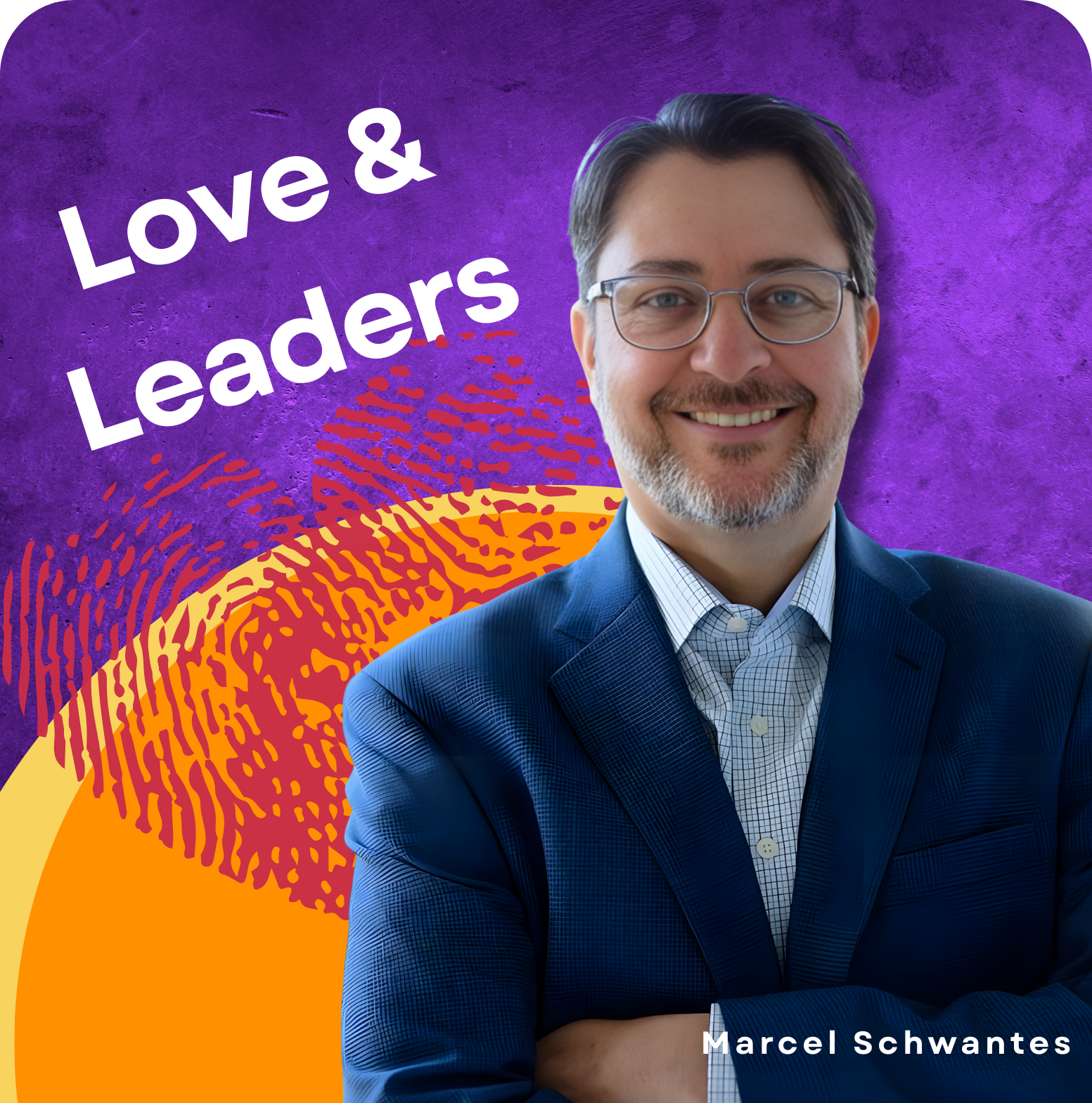
Marcel Schwantes is a speaker, author, acclaimed executive coach, and an Inc. Magazine contributing editor with a global following. Marcel delivers presentations, workshops, courses, and coaching programs about the human side of business and how cultures of care, connection, and belonging power companies to thrive and outperform the competition. Marcel hosts the popular "Love in Action" podcast, heard in over 160 countries.
At eleven, Marcel spent hours on his bedroom floor building imaginary cities from blocks, creating highways and streets where matchbox cars could travel. Today, he builds something far more complex yet equally imaginative: invisible structures of human connection and organizational culture. The childlike wonder that once constructed cities from nothing now architects environments where people feel seen, valued, and free to thrive—proving that the best leaders never stop building worlds where others can flourish.
Creative Process
Discuss Potential Outlines: Human + ai
Create Initial Drafts & Iterate: Human + ai
Ensure Guest Alignment: Marcel Schwantes
Ensure Final Alignment: Dr. Jiani Wu
Initial Publication: Jan 22, 2026
Disclaimer:
AI technologies are harnessed to create initial content derived from genuine conversations. Human re-creation & review are used to ensure accuracy, relevance & quality.
