Three Pillars of Wise Leadership | Dr. Gregory Stebbins
A conversation with Dr. Gregory Stebbins, who has spent four decades developing a comprehensive framework for wise leadership that integrates self-awareness, relational intelligence, and organizational consciousness to create more humane and effective work spaces.
Leadership paradigms are shifting. The command-and-control model that dominated the industrial age fails to inspire today's talents, who honor more humane organizations. What's emerging instead is a framework Dr. Gregory Stebbins calls "wise leadership"—an approach that transcends tactics and strategies to operate from a fundamentally different state of consciousness, embodying a sense of childlike wonder in adults.
After four decades of leadership research, Stebbins has identified three interconnected dimensions of wise leadership: self-wisdom, relational wisdom, and organizational wisdom. Together, they form a comprehensive approach to leading with the heart while maintaining business effectiveness.
The Foundation: Self-Wisdom
Self-wisdom begins with distinguishing between perception and projection. When someone cuts you off in traffic, do you see an objective situation or project your own inner state onto the other driver? According to Stebbins, most of what we experience as external reality is actually a projection from our unconscious beliefs, values, and attitudes.
"Everyone has their own inner wisdom, but not everybody has spent time discovering what that is," Stebbins explains. True self-awareness requires examining four aspects of consciousness: thoughts, feelings, imagination, and physical presence, as well as understanding how unconscious habit patterns influence behavior.
The practical path involves three steps: self-inquiry (asking whether reactions stem from beliefs, values, or attitudes), reflection (deepening one’s understanding of these patterns), and developing intuitive insight —a profound shift from purely analytical decision-making to accessing deeper knowing that transcends logical reasoning.
The simplest tool? Mindful breathing. "Focus on your breath—breathing in and breathing out," Stebbins suggests. "That tends to make you present." When emotions trigger projections into past regrets or future anxieties, breath anchors leaders in the present moment, where clear decision-making becomes possible.
-
MAGICademy Podcast (00:00)
Everybody has their own inner wisdom, but not everybody has spent time discovering what that is. Self-awareness is so critical. Using your loving instincts, caring, sharing, supporting connection is the heart of our humanity. Our ego is a child of the mind. Take care of yourself so you can take care of other people. What are you doing to take care of yourself? If you can't do those, it's like trying to write a review of a movie that you haven't seen yet. So joke is...
Breathe in, breathe out, repeat if necessary.
Jiani (00:30)
Welcome to MAGICademy podcast. Today with us is Dr. Greg. He has been
decades
focusing on wise leadership, a type of leadership that requires us to go beyond simple tactics and strategies.
and transcend into a different mindset as loving, caring and wise leaders and he tackles this concept from three different dimensions. One is self -wisdom. Second is relational wisdom.
The final piece is organizational wisdom. it will be interesting for us to dive deeper into learning exactly what that is and what that means. And so good to have you, Dr. Greg, to be with us and sharing your insight on wise leadership and the leadership for the future.
Gregory Stebbins (01:22)
Happy to be here.
Jiani (01:23)
Beautiful. So the first question is, beep beep beep beep. A spaceship lands right in front of you. Out walks a cute, friendly alien. If you were to use one word or one sound or one movement to introduce yourself what would that be?
Gregory Stebbins (01:41)
Well, if they just landed in front of me, I would probably say welcome.
Feels like somebody's knocking on the door.
Jiani (01:47)
Yeah, like you're welcoming them to your space, the space we call planet Earth.
Gregory Stebbins (01:50)
Yeah, yeah, open the door.
I want to find out who they are. Probably want to find out where they came from.
Jiani (01:58)
Yes. So curious why wise leadership? Why this becomes this focal point of your scholarship and experience and exploration?
Gregory Stebbins (02:11)
Well, that's a really great question. In my research on leadership and on wisdom, I've looked at both of those concepts going back probably a couple thousand years. And they've always been here. And they really point to the fact that everybody has their own inner wisdom.
but not everybody has spent time discovering what that is. taking the time to really delve into your inner wisdom to find out who you are and what you're about directly impacts the relationships you have as a leader and how you guide and steer the organizations that you're in. But the critical piece is uncovering your inner wisdom first.
So, you know, it's a natural process, but it's not a process most people have taken.
Jiani (02:55)
That's it.
And what is inner wisdom and how do you define that?
Gregory Stebbins (03:08)
A lot of people define inner wisdom as self -awareness. you have thoughts, have feelings, you have imagination, and then you have your physical presence in the world. Each of those are aspects of consciousness, or your being conscious. And then on top of that, you have your unconscious, which has the keeper of all your habit patterns.
So if you're really going to delve into your inner wisdom, you have to look at all four of those things and how they interplay with each other and how they impact your behaviors in the world. So we know that certain leadership behaviors are more effective than others, but you can't just go and change your leadership behaviors. You got to change what's the foundation of those leadership behaviors. That foundation is your beliefs about yourself.
about leadership, about your organization, your values, what it is you value on a day -to -day basis, and then more importantly, often forgotten, is the attitudes that you have towards those things. So that takes some time to delve into that. And our only connection with the world is really the experiences that we have and our perceptions about those experiences. So...
Jiani (03:56)
Mm.
Gregory Stebbins (04:18)
The question is, is it really a perception or is it a projection out of your own head? And if we go back to certain psychologists in the 30s, they made the comment that all perception is in fact
projection.
question is, when you have an experience, is it a perception or is it a projection? So let me give you some reality on that. Let's say a person is driving a car. And you can tell they're the ones driving because they're behind the steering wheel and they got their feet on the pedals. And they're driving along. So you can say that's a perception that they're driving a car.
Now somebody cuts him off. There's all kinds of ways you respond. One is you slam on the brakes. Two is you get very upset at the person. Three is you call the appropriate authorities and say there's a crazy person on the road. Most of those are projections about the other person. And they come from inside of ourselves. So when we talk about inner wisdom, we've got to find out.
The experience we had, was it a belief that we had? Was it a value mismatch? Was it our attitude about certain parts of the world? And are we projecting that on the other person?
So it takes some special skills that are easy to develop. One is self -inquiry. You've to ask yourself these questions. Was it my beliefs? Was it my values? Was it my attitude? And then you want to reflect on that to get a deeper understanding of what's going on there. If you do that well enough, eventually you begin to have intuitive insight.
Jiani (05:51)
Hmm.
Gregory Stebbins (05:56)
And you notice that a lot of what's going on is a projection.
Let's go.
Jiani (06:01)
So it's kind of like a self talk, like kind of an inner conversation and you have this wise sage sitting next to the inner you who creates all the perceptions and projections and just have a conversation with that sage
I think in the case of you seeing a crazy person cutting off in front of you
challenge is there's
Gregory Stebbins (06:27)
right on top of it. The foundation is the experience we had in those aspects of consciousness. So if we have a strong emotional experience that we have not resolved, that would tend to become our projection. We would tend to see that in other people, but it's really us projecting on top of them. And it's a simple process, but it's not easy.
And it's not easy because you've got to own up your own stuff. And a lot of people just don't want to do that. They'd rather make it the other person's fault. So that's part of the wisdom process is really taking a hard look at yourself or a look at yourself. Just looking at yourself and saying, OK, what is my projection here? So let's take emotions that you brought up.
Emotions is just a term for energy and motion.
your body's nervous system reacts to that energy and depending on the experiences you had could just cause you to either live in the past or project into the future. So I just recently had an experience where I kept mauling over something that happened in the past and I realized that I had never come to completion with those emotions.
So I spent some time working on myself for the emotions and getting it. And then interestingly enough, as soon as I tapped into that inner wisdom or that self -awareness, all of that stuff began to dissipate. I no longer have those thought process that were triggered by the emotions. The other extreme where I'm not living in the present is I start projecting a future. Typically, people who project a lot in the future
have challenges with being agitated because they can't tell whether the future is going to happen or not.
Jiani (08:06)
to angers and frustrations.
Gregory Stebbins (08:08)
Yeah, so,
and if you live in the past, you'll probably end up depressed because you can't resolve the past issues on that. You can only move to a form of acceptance with it. Acceptance does not necessarily mean acquiescence. In other words, you don't give into it. You say, okay, that happened. There's nothing I can do about that right now. So I'm just going to stay here in the present. What's happening right in front of me. The nice thing
Jiani (08:16)
Mm.
Gregory Stebbins (08:33)
When you stay present, right, with what's happening right now, a lot of stuff begins to clear up. And that's where you begin to see your relationships with other people in much more positive light. And you begin to, as leader, develop a really receptive organization, because you're not projecting anything on them and you don't have anxiety about how it's going to end up.
That's why there's three elements.
Jiani (08:54)
So big.
Being the present
empowers us to
Gregory Stebbins (08:59)
Yeah. Yeah.
Jiani (09:00)
Do all that. Beautiful.
Are there simple tactics? I mean, we're trying to go beyond tactics. However, I'm asking this question. Are there simple tactics or things that we can do on a daily basis that helps us to constantly orient our presence?
Gregory Stebbins (09:13)
Well, simplest tactic
right now is what's called mindful meditation, where you're breathing in and breathing out, breathing in and breathing out. That tends to make you present, tends to catch you present. So if you focus on your breath and you're breathing in and breathing out, you're focused on what's happening to you physically right there and then. Once you get the physical balanced out, then you can work with your imagination, because what will typically happen
is you're starting to do your breathing in, breathing out, and you hear a little voice inside that says, I'm hungry, let's go get a sandwich.
Jiani (09:47)
Hahaha
Gregory Stebbins (09:48)
So that's your imagination. Or you move into your emotions and that's where you begin to understand that, wait a minute, something's triggering me. What is that about? Is that happening to me right now? The answer is no. So it's a way to let go. And then your mind kicks in and our ego is a child of the mind. So our ego says, no, that shouldn't have happened to me. And it gets into defensiveness.
or what I refer to as Dexify, defend, explain, and justify.
That's what the ego does.
So just the simplest thing right now is just focus on your breath.
It balances everything out.
Jiani (10:24)
coming back to the example, so anything that triggers you emotionally, remember to breathe and
Gregory Stebbins (10:30)
Yeah, yeah, it's sort of the joke is breathe in, breathe out, repeat if necessary.
Jiani (10:44)
That's very useful. Beautiful. And let's now explore the second domain of the wise leadership, which is relational wisdom. What is relational wisdom? Is there a particular example, like the car example, and how can we develop relational wisdom?
Gregory Stebbins (11:01)
Well, relationships are sort of the key to our connections with people. So if you're well connected with a person, it's because you've taken who they are at just face value. So probably the best critical aspect of that is the process of acceptance. They are who they are. But most people try to change people.
That's why certain people get married and then get divorced right away because they don't want to get changed by the other person.
A lot of times, one of the key pieces on relationship is our ability to communicate with another person.
So what are their motivations? What are their communication styles? What are their behavioral styles? Those are three aspects that impact what kind of relationship you can form. We tend to automatically project our own system on top of the other person. And that doesn't work real well. So you have to take the time
pull back, see who they are, ask them about their motivations, ask them about how they want to have communication come to them, and check in to see what their behaviors are. Once you get those three out, you're on a good path to relationships.
Jiani (12:11)
as human beings, always develop, we always evolve, we always change, behaviors change, potentially values system change and things change.
And how do we, I'm kind of like asking a very kind of multi -layered question.
Gregory Stebbins (12:20)
Yeah.
I can give you an example if you'd like. OK, so this is a senior executive I was working for, working with. And the company was going through some major changes. And the senior executive had his entire team talk about the direction, the new direction. Everybody on that team.
Jiani (12:28)
Yes, please.
Gregory Stebbins (12:45)
wanted to go in that direction except the CFO of the organization. He totally did not get it and did not want to go in that direction. So I'm sure you know that you want to make sure the entire team is in alignment if you're going to change direction. So they had a conversation and the guy just did not want to make any changes. He believed it was the wrong course of action and the wrong thing. So as I was talking to him, I said,
You know, can always change CFOs. He said, well, Greg, I really can't because he's a lifelong friend. I said, OK, so you need to take care of your lifelong friend. So what do you mean? I said, it's your job as a relationship, a long -term relationship, to help him find an organization where his thought processes are in alignment with where that organization is going.
and then you can bring in a new CFO. He had never thought of that. So he started calling his friends up and finding out organizations that matched who he thought the CFO was. And he presented one of the organizations and set up an interview. The CFO loved it and
makes sense. I like this organization better because they had a direct
conversation about it. It wasn't done behind anybody's back. It was done up front. Then the CFO left and I gave an opportunity to bring in a different CFO who was in alignment with the direction of the organization. So both organizations and the CFO benefited. I had a conversation with my client a couple years later. I said, you still friends with him? So we're even better friends today.
because he loves the organization he's in.
Jiani (14:20)
beautiful story.
Gregory Stebbins (14:20)
So
you build a relationship, the relationship
beyond your day -to -day work environment.
Jiani (14:34)
And that's also, I know this word is a little kind of, and people may think it differently, but the moment that you share the story, the word that pops into my mind is love.
because what is love? I think it is doing what's best for that particular person and in your situation
they are he is trying to find a more nurturing environment for his lifetime friend
Gregory Stebbins (14:59)
Yeah, and actually it's interesting that you bring that up because it actually is a fourth wisdom. It's called the wisdom of the heart. And the fourth wisdom is a thing that connects your inner wisdom, relationship wisdom, and organizational wisdom.
You're more more organizations that are willing to take a look at loving, because it's an actual implementation of the word love. Many people defined love as an emotional construct. And they say love is really nothing more than...
an energy overload, which is not really appropriate in a organization. So I asked them, say, is it appropriate to have caring and sharing for the people you work with? And they go, yeah, yeah, yeah. Absolutely. Is it okay to have empathy and compassion for people? yeah, yeah, yeah, we can do that too. So why don't you define love or wisdom of the heart as that? Because that's what it really is.
You're not doing an emotional construct just to overpower people. That might be appropriate in a marriage or with your kids, but it's not appropriate in a business construct. But yeah, caring and sharing and empathy and compassion.
caring about people, sharing with people, and just being open and accepting with people. But you don't give in to them. You just go, OK, I accept that that's way you are, and that works in this organization, or that doesn't work in your organization. So you're back at that CFO paradigm again. His behaviors didn't work in your organization for the change that he wanted to make.
But he was able to change out the CFO by caring for the current CFO. So he implemented wisdom of the heart in taking care of both the organization and his friend.
Jiani (16:42)
That's beautiful.
element is organizational wisdom. What is that and any stories to invite us?
Gregory Stebbins (16:49)
Well,
that's probably the toughest one because you've got to get everybody in alignment with that. And the challenge is a lot of people have a belief that business is about beating up somebody and winning and creating an organization of destruction, if you will. They do not look at
Jiani (17:09)
making a dent.
Gregory Stebbins (17:11)
Yeah, they do not look at business, they do not look at organizations as for the highest good of the entire planet. So you find some companies that ship their pollution off to different places. And once it's out of their sight, doesn't matter anymore, but the pollution is still there. So the question is,
Jiani (17:12)
very masculine level of length.
Gregory Stebbins (17:31)
Is it their consciousness that's polluted that's creating an organization that is polluted? And my experience is, yes it is. But this is where the simple but not easy comes in. It's simple to start taking a look at that, but it's not easy. Because if you look at it, you'll find out, I haven't really been operating for the highest good of the planet.
I haven't been operating for the highest good of everybody who's involved. So a lot of organizations have defined their stakeholders as people in the organization, the management team, the stockholders, and our clients. They don't look at anybody else as a stakeholder.
Jiani (18:11)
and should be a collective stakeholdership.
Gregory Stebbins (18:11)
But you're, yeah,
collective is a great word. So it's cooperation with all of the people who are on the planet.
Conscious capitalism talks about that. And they're in the process of training people to do that.
Jiani (18:28)
played devil's advocate. mean, collectively, it usually takes a lot of time and energy. And sometimes organizations need to make decisions really fast or there are some emergency situations. How would they
balance this collective higher good versus the need for the moment and people need to, the organization needs to make quick decisions.
Gregory Stebbins (19:00)
The organization has to give the individuals in the organization time to do something different than just business every day. Because if you sit at your desk all day processing paperwork, that's all you're going to see the business as. So a key piece to organization development is what's referred to as childlike wonder.
Okay, so does the organization have an environment that supports people to do wonder things, to step outside of who they are? I'll give you an example of this.
An example would be the current CEO of Microsoft. When he came in, the core culture was what I refer to as intellectual. You were measured on how smart you were. You were compensated on how smart you were. He gradually changed that. And the way he did it was he got out of his office. He started talking to people. He didn't matter to him whether it was a lowest level person.
or if it was one of his senior executives. And he would ask them, how can we do this differently? And see what their response was. And he found out that some of the ways to implement it came from very lower level people. Because by the time you got to the senior level person, you were used to doing a certain way. So then he started implementing some of the lower level stuff and people were going, what?
And then they saw the results from it and he started changing. So he has radically changed the organizational culture and brought forward the layers of wisdom throughout the entire organization just by getting out of the office and asking questions.
Jiani (20:41)
and presenting people with an opportunities to
speak their heart and to gain a sense of like contribution. And one thing I'm always kind of just, find it confusing and not as empowering as the structure of the organizations. And it's all, it's almost very hierarchical.
Gregory Stebbins (20:46)
Yes.
Jiani (21:02)
And I do read some articles that in general globally, the organizations are moving more toward like a flatter structure. And how do you see the future of leadership within organizations as those organizations start to become flatter and more inclusive and more heart centered?
Gregory Stebbins (21:23)
Most of the companies that need to make this kind of change do not have what's referred to as psychological safety. You're not free to express yourself. You're only free to acknowledge how you're doing it with the corporate culture, the current culture. So Google's a great example of something different. They actually ask their people to create a project for themselves that doesn't require any permission.
maybe something radically different than what Google is doing, but ends up getting incorporated downstream. So people take the risk and you go, yeah, let's do this. And Google has the right to say yes or no. And some people who've been told no go out and form their own company and do it and they're marvelously successful. they've got a culture that supports this organizational safety.
I'm sure that there are parts of every organization where the leader is caught up in his own or her own ego about how things should be and don't have the organizational safety, do not have psychological safety. So if a leader has a great deal of self -awareness and they understand that there's many different perspectives to the way things can get done.
they will take the time to open up and listen. So another key piece to this is, is the leader willing to just shut up and listen?
And unfortunately, I find a lot of leaders aren't.
They want to be the boss. They want to have all the right answers. And those are the belief systems that need to be uncovered and worked on.
Jiani (22:52)
Yeah, I think that brought us into another interesting space is as leaders, kind of assume an invisible responsibility as if you put on this magical cape or a cape for others. immediately become sort of like a parent. You need to take care of the group and
you have to always be right and you have this responsibility to try your best to be right. And so you can take care of the team and maybe the intention is, is right. It's more of like, I wanted to make the right decisions and take care of people. Maybe there are ego evolved, but I believe most of them probably wanted to like do a good job. And maybe they're fearful that if they.
let it lose too much then they will lose control and they don't know how to lead and how to be responsible.
Gregory Stebbins (23:42)
Well, fear is a huge thing inside organizations. And if you have a culture of fear, you don't have psychological safety. A good friend of mine tells a story about he was working for this company in the late 60s. And his boss was very focused on his behavior and how it wasn't right for the corporate culture.
And finally his boss took him aside and said, look, you're going to have to change your behavior. You're going to have to go on a hillside and knit for a living. My friend looked at him and said, you know, I did that in 65. It wasn't too bad. Of course, he wouldn't was with the corporation for very long after that, but he wasn't going to collapse to the fear this guy was trying to put on him. So there's a lot of people who get wrapped up in the fear of an organization.
And when that happens, the organizational culture starts getting very stiff. And eventually, the joke amongst consultants is the organization has died. Unfortunately, the central nervous system is so dead it hasn't gotten to the brain yet.
So if you find your best people leading and the people you have left are not the ones that you want to keep, I would look at your corporate culture first and see what wisdom is lacking with the leaders that's created that organizational culture.
Jiani (25:00)
That leads to the next question is the heart the heart wisdom
incorporates self -wisdom relational wisdom organizational wisdom and moving organizational cultures and leadership toward more of a heart centered space in the future well how would you envision this heart centered wise leadership play its magic
show its magic, exude its magic, infuse its magic within organizations with all the advanced technologies happening like virtual realities, artificial intelligence, web 3 and yada yada yada.
Gregory Stebbins (25:46)
Well, there's lots of stuff written about empathic leadership or compassionate leadership. For me, the key piece is do you take care of yourself so you can take care of other people? So if a person is doing self -inquiry, a lot of people transition to self -inquisition. They literally beat themselves up when they're doing the questions. So if a person cannot take care of themselves,
and they beat themselves up, there's no way for them to take care of other people because they just won't see it.
Jiani (26:17)
And they will transfer this beat up mindset to people who they probably are most close to.
Gregory Stebbins (26:21)
Yeah.
Yeah. And then the second piece is, can you support yourself so you can support other people? So what are you doing to take care of yourself? What are you doing to support yourself? You know, if you can't do those, it's like trying to write a review of a movie that you haven't seen yet.
So you have to go through the process of watching this movie of caring and sharing and supporting before you can begin to do it with other people. So that's why this self -awareness piece is so critical. And using your loving instincts, caring, sharing, supporting are critical to doing that.
Jiani (26:56)
That's beautiful.
I think in the world of collective flourishing, this is exactly the type of leadership that we wanted to see more, experience more, and practice more. And are there any particular thought leaders in the space? I mean, you're definitely one of the, are there other thought leaders or startups that you've seen that you're like, ⁓ maybe they're contributing to that collective?
the flourishing future that you see.
Gregory Stebbins (27:25)
Probably the one that I'm most familiar with is a gentleman named Bill George. He was the CEO of Medtronic and then has been teaching at Harvard Business School. He's written a book called True North. And you see it in his book all the time and you hear it in his conversations all the time. And so his
Jiani (27:39)
Yes.
Gregory Stebbins (27:46)
Authentic leadership is critical, is a core piece. So there's authentic leadership, there's transcendent leadership, there's wise leadership, and they all have elements of each other embedded in. So.
Jiani (27:57)
I see a common nonality, it's all heart based,
Gregory Stebbins (28:00)
no one version is correct for everybody. So find a version that works for you and begin to emulate it.
Jiani (28:10)
Beautiful. As we move into the magic portion of the conversation, let's give our audience a brief recap. So we've talked
Gregory Stebbins (28:14)
Okay.
Jiani (28:19)
leadership, AKA heart -based or heart -centered leadership. it includes three interesting dimensions. One is self -awareness.
self -wisdom, the second is relational wisdom, and the third is organizational wisdom. And we explored the important factors of, as leaders, we really need to be self -aware. We have to always ask ourselves questions, sitting with that wise sage in your mind. As you experience the emotions that you experience, the reactions that you experience throughout the day.
And also another important factor is to breathe. Being able to live in present, not the past and not in the future, which you probably heard about many, many, many times, but the tangible strategy is to breathe. So whenever you find yourself getting behind
Remember to breathe and breathe until you find your center moment. Breathe until you can connect with your heart space where you are you and leading from the heart centered space and relational wisdom. talked about sometimes it is more about finding the ideal situation for the person that you really care of.
even though that means saying goodbye. However, it may transcend the relationship to a higher dimension where everybody benefits. The organizational wisdom is the most challenging one and to be able to build collective cohesion and synergy in terms of organization, the culture is the core piece and the culture that encourages people to be playful, activate their childlike wonder.
without fear, with plenty of psychological safety is the key. And it all comes down to the leaders, how aware they are, how heart centered they are, and the heart centered leadership will play the magic as a result.
Gregory Stebbins (30:20)
great synapses.
Jiani (30:21)
Beautiful the magic so Greg when you were Around 11 years old. What did you enjoy creating or playing so much that time disappeared for you?
Gregory Stebbins (30:34)
Well, it's kind of interesting. I grew up in a military family, so I never lived in one place for more than three years. Shortest was six months. When I was 11, I was living in Brussels, Belgium. So my biggest challenge was learning to speak French and operating downtown Brussels.
with a language that was totally different from mine. So it was okay when I was hanging out with my friends, but when I was by myself, I had to use French. So I learned pretty well to learn to speak French. I was never completely fluent at it. And then when I was a freshman in high school, I thought, well, I'll take a French class. That'll be easy. And the teacher
asked the class at very beginning, does anybody here speak French? But she did it in French. Now what was really difficult was she had a Southern accent when she asked it. And I responded in French with a correct French accent. And she was like, what, what? Nobody's ever done that.
Jiani (31:37)
Hahaha
Gregory Stebbins (31:38)
So unfortunately, my grammar in French never really progressed because I didn't really have to work that hard. I could answer all the questions she asked in class, and I could usually get a B or an A on the exam. But my French grammar was terrible. And when I had work in Paris, often when I'm off
some side street, know, buy a croissant or something like that. I'll do it in French. And the people just are very, very happy. Here's an American who speaks some French. So that was exciting for me. It was a great learning experience too.
Jiani (32:08)
You
That's beautiful.
Yeah. And I think sometimes I have, I had similar experiences when I was first learning English is I'm not particularly good at grammar because sometimes it restricts how you speak. learn more on the concept, the comprehensive kind of way, intuition, like a language intuition of some sort. that helps. So I totally resonate with you when you're, when you're learning French.
What role does childlike wonder play in your life?
Gregory Stebbins (32:42)
You know, I really don't know
I moved from Brussels, we moved to Montgomery, Alabama in 1964 during the height of the race riots. And I went to a school that was mostly cotton farmers kids. I was in eighth grade. What was very different for me is that many of my eighth grade classmates were 17 working to change.
transition out of school when he turned 18. They couldn't leave school until they were 18. So these kids were sometimes four five years older than me.
And obviously they were much more mature. And I've always been a big kid, so they thought I was the same age. But many times I did not understand what they were doing. So I had, that's where I started to learn the importance of culture, because I was not a fit in a culture.
Jiani (33:25)
⁓
Gregory Stebbins (33:34)
So that was a
Jiani (33:44)
your magic then?
Gregory Stebbins (33:45)
What's my magic? People.
Jiani (33:46)
Mm.
Gregory Stebbins (33:47)
I pay attention to people. I listen to what they're saying. I ask them lots of questions. So I'm very clear on the meaning behind what they're saying. And that has not been an easy process for me. I'm still working on it. That's the thing about wisdom. There's no end in sight. It's a continuous program.
Jiani (34:06)
Mmm.
Push is fun, right? Once you see the end of it, feels it's not as fun.
Gregory Stebbins (34:08)
Yeah.
If you
understand the process and learning from your experiences and it's okay to mess up because you've given yourself the freedom to do that, yeah, then it is fun. If you've got a very closed -in personality that looks at everything as a threat and you have fear going on, it's not going to be a lot of fun.
Jiani (34:30)
Yeah, and it's not gonna be a lot of fun working with that person as a
We will have some level of intuition, just various level of intuition. And sometimes intuition tells us things.
Gregory Stebbins (34:41)
A lot of people are afraid of their intuition. They think, well, this is a bad thing. And it's not. Like you said, everyone has their own intuition.
Fortunately, I got trained by my mother, who I referred to as Swami Mommy. My brother and I could not get into trouble, because she would know. And you know, at one point, she lived on the East Coast, I lived on the West Coast. The phone would ring and be my mom. Okay, what's going on? Nothing, mom. And then you'd hear the, don't lie to me.
And I have to tell her what was going on. She goes, okay, I was concerned. And so I said, okay, I gotta pay attention to this because she's got it nailed.
Jiani (35:16)
Hahaha
Mama's radar. Full coverage. It's beautiful. That's wonderful. And I think the intuition does play a huge kind of role behind your magic is how you get to know people, how you sense the culture of the organization. It's all coming from that intuition.
Gregory Stebbins (35:26)
Yeah. Yeah.
She had that ability and I developed it after that.
Jiani (35:49)
by birth and by development, by culture and by your own cultivation.
Gregory Stebbins (35:54)
So I would frame this from the point of view of connection is the heart of our humanity. So what are we doing to connect with people? And that means connecting with yourself, building relationships with others, building a depth with your organization. It's all about connection.
Jiani (36:10)
elbow connection,
heart centered connection, heart and heart connection.
If in the future world where people are able to like open their heart and connect with each other on a global scale, that would be like heaven on earth.
Gregory Stebbins (36:23)
Yeah, and some people you just won't connect with, and that's okay. Some people, some people you've tried very, very difficult times to connect with them, and maybe the best thing to do is just not respond to them. You have that right.
Jiani (36:27)
That's okay. They have their rights.
respect everybody's decisions. That's also loving is to give them space they need. Beautiful. And thank you, Greg, for sharing your wisdom and your insights about wise and heart -centered leadership and enjoyed all the stories that you shared and for folks who really wanted to get connected with Greg and increase your own magic.
His information is in the show notes below so we encourage you to get connected and chat and create magic.
Gregory Stebbins (37:08)
Thank you so much for having me on your program. It was great to be able to talk about this.
Building Connections: Relational Wisdom
Relational wisdom centers on acceptance—taking people as they are rather than trying to change them. This doesn't mean acquiescence; it means establishing clear boundaries for acceptable behaviors while respecting individual humanity.
Stebbins shares a powerful example: A company leader intended to align his entire leadership team on a new direction, but the financial leader—a lifelong friend—strongly opposed the change. Rather than forcing compliance or ending the friendship, the CEO helped his friend find an organization that better aligned with his values. The result? Both organizations benefited, the financial leader thrived in his new role, and the friendship actually strengthened.
"You build a relationship that goes beyond your day-to-day work environment," Stebbins notes. This approach embodies what he calls "wisdom of the heart"—reframing love in professional contexts as caring, sharing, empathy, and compassion.
Effective relational wisdom requires understanding three key aspects of each person: their motivations, communication styles, and behavioral preferences. Leaders (most of us) often unconsciously project their own systems onto others, creating friction. Taking time to understand how team members operate genuinely creates the foundation for authentic connection.
Creating Culture: Organizational Wisdom
Organizational wisdom challenges leaders to expand their definition of stakeholders beyond shareholders, talents, and customers to encompass the collective well-being of all parties affected by the organization's actions. This isn't just idealism—it's practical wisdom for long-term sustainability.
The key lies in creating psychological safety where people can express themselves without fear. Microsoft's current executive leader exemplifies this approach. When he came in, the culture rewarded intellectual superiority and created competitive dynamics. He transformed this by leaving his office, talking to people at all levels, and asking one simple question: "How can we do this differently?"
Some of the best solutions came from talents outside of the executive boardroom whose existing systems hadn't yet been conditioned. By implementing these ideas and showing results, he gradually shifted the entire organizational culture.
Organizational wisdom also requires fostering "childlike wonder" by creating space for exploration and play. Target's executive leader set up a mentorship program that sends leadership development participants to different stores to observe varied approaches, then compare notes. Google allows talents to create unauthorized projects that don't require permission, some of which become major innovations in and outside of Google.
The Heart Connection
The fourth element—wisdom of the heart—integrates all three dimensions. Many current executive leaders resist discussing love in business contexts, associating it with emotional overwhelm. However, Stebbins reframes love as caring for and sharing with colleagues, demonstrating empathy and compassion for their challenges.
"You can't just go and change your leadership behaviors," he explains. "You’ve got to change what's the foundation of those leadership behaviors." That foundation is beliefs about yourself, leadership, your organization, and the attitudes you hold toward these elements.
The critical principle: you must take care of yourself before you can effectively care for others. Leaders who engage in self-criticism rather than self-inquiry inevitably project that harshness onto their teams.
Leading Into the Future
Today's work space increasingly steers away from fear-based organizational cultures. The power dynamic has shifted, requiring leaders to develop genuine human connections rather than relying solely on positional authority.
Connection, Stebbins argues, is "the heart of our humanity." Wise leaders create environments where people can bring their whole selves to work, contribute meaningfully, and grow individually while serving collective purposes.
The path forward requires leaders who are willing to breathe deeply, examine their projections honestly, accept people authentically, and foster cultures of psychological safety. It's simple in concept but requires the courage to lead from the heart rather than the ego.
As organizations face increasing complexity and change, the question isn't whether heart-centered leadership works—it's whether all leaders are ready to do the inner work necessary to embody it.

⭐ Connect with Dr. Greg
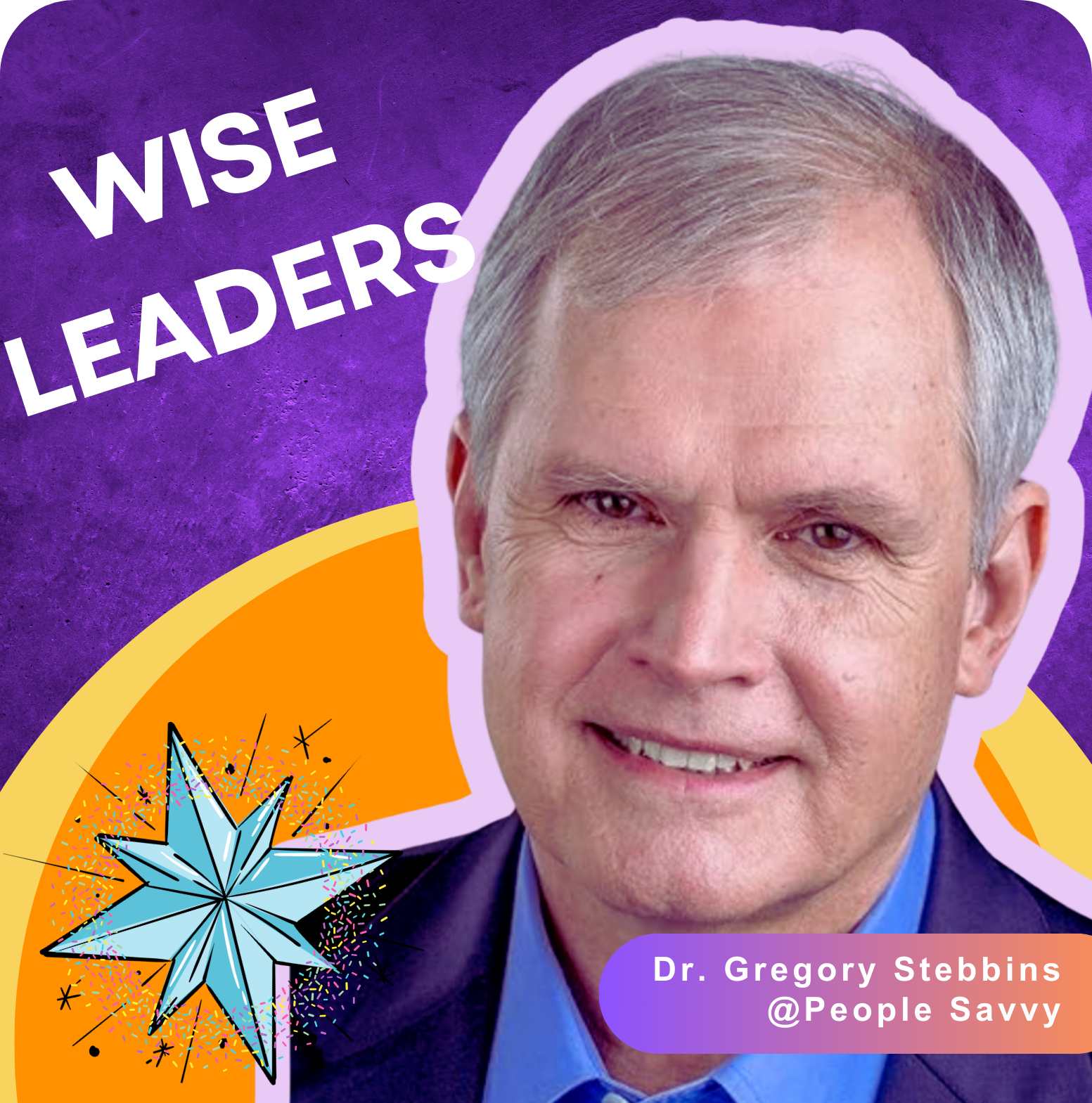
With a career spanning over four decades, Dr. Stebbins has become a global thought leader on Wise Leadership, Transcendent Leadership, and Loving Leadership, updating how we choose to lead in the modern era. Dr. Stebbins' mission is to positively impact the lives of leaders and their organizations by helping them cultivate inner, relational, and organizational wisdom. He teaches that true leadership encompasses, yet also transcends, mere tactics and strategies; it requires a profound shift in consciousness and a profound connection to one's authentic self.
https://www.linkedin.com/in/gregstebbins/
Greg’s Magic
His magic is "people"—his ability to pay deep attention, listen for meaning behind words, and ask revealing questions. Honed through decades of cultural transitions and sharpened by what he calls his mother's intuitive abilities ("Swami Mommy"), his gift lies in quickly reading organizational dynamics through careful observation and genuine curiosity about human behavior patterns.
Writing Process
Initial Draft: Claude ai
Story Revision: Dr. Jiani Wu
Guest Alignment Review: Dr. Gregory Stebbins
Final Alignment Review: Dr. Jiani Wu
Initial Publication: Sep 13, 2025
Disclaimer:
AI technologies are harnessed to create initial content derived from genuine conversations. Human re-creation & review are used to ensure accuracy, relevance & quality.
