Game of Life |Yu-kai Chou
Imagine for a period of life, spending 90 hours in one week playing a video game—while still maintaining a full-time job, family responsibilities, publishing books that would be sold over 100,000 copies, founding multiple successful companies and consultling for organizations like Google, Tesla, and Harvard University, and is now raising three children.
This isn't a hypothetical scenario; it's a real experience shared by Yu-kai Chou, the founder of the Octalysis Framework, a comprehensive gamification system that has impacted over 1.5 billion users worldwide.
Overworking like that is not what is advocated here. But, it would be interesting to know how he did it at all. His secret? He doesn't force himself to be disciplined. Instead, he's transformed his life into a game—one where productive activities feel as engaging as his favorite video games.
“If something is fun, you have motivation. You don’t need discipline,” Yu-kai explains. “You don’t need discipline to play your favorite game. You need discipline to stop playing your favorite game.”
This insight forms the foundation of Yu-kai's approach: instead of trying to develop discipline through sheer willpower, he's designed systems that make important tasks intrinsically enjoyable. His upcoming book, "10,000 Hours of Play," explores this concept further, suggesting that we can achieve mastery not through blood, sweat, and tears but through genuinely enjoyable practice and engagement.
But how exactly does this work? The answer starts with understanding the fundamental drivers of human motivation.
-
MAGICademy Podcast (00:00)
Growth is still more extrinsic motivation because it's results oriented. If it's intrinsic, then you don't even care about if you're growing up. You just enjoy the game. It's fun to do it, regardless if you're growing or not. Three pillars that make a good leader, which is vision, execution, and empathy. So vision is where the company's going or the group is going. Empathy is you know your team, how they feel, what they're worried about, ⁓ so they feel like you care about them. And execution is driving progress forward.
what we call white hat motivation core drives. It makes people feel powerful, they feel good, they feel in control, but there's no sense of urgency so they procrastinate. And then there's what we call black hat motivation core drives. They feel urgent, obsessed, sometimes even addicted, but in the long run, it leaves a bad taste in their mouths because they feel like they're not in control of their own behavior. Whereas there's intrinsic motivation core drives that are things that you're willing to pay money to just experience it because you enjoyed so much. And even if you lost all your progress the next day, you would still want to do that today.
because that's how we measure quality of lives. You how much time we spend on things we enjoy doing. Palady one, where you see everything as the game. Yeah, the game has to artificially add frustration. So every time you overcome these challenges, you feel like, yay, that was fun.
Jiani (01:23)
Welcome to MAGICademy podcast. Today with us is a special guest, Yukai Chou He is the founder of Octalysis gamification framework and he has been devoting decades and decades of expertise, experiences, research, practice, consultation, and speaking engagement into helping people understand the motivational drivers for us to design a super engaging game environment
if you were to share something that people have not known about you yet, what would that
Yu-kai Chou (01:59)
I am now a father of three kids, twin daughters, Symphony and Harmony that are turning six, and then Cello who just turned four months old.
Jiani (02:10)
That's amazing and I like how you name them
Yu-kai Chou (02:11)
So yeah, so I'm also
a proud father, as you can see.
Jiani (02:15)
I guess music plays some sort of important role in your life.
Yu-kai Chou (02:21)
I did play the violin in high school. I played in string quartet. I wrote three string quartet songs, but I didn't do anything beyond high school because I started my first business, first year of college. but I like, you know, music terms because they're just beautiful. It's like people would name their children after flower names, Daisy or Jasmine, right? But they don't necessarily have to be a botanist, to be that. So.
But I do think it's nice to have children with unique names that have a positive emotional association
Jiani (02:55)
I see, yeah. it's always gonna be staying with them and hopefully their life will be a beautiful song.
we've talked about Yu-Kai's
story, the founding stories of Octalysis framework, we touched upon the eight motivators of Octalysis framework and categorized them into white hat and black hat motivator. And then we also talked about the potentiality of associating or applying the Octalysis framework into building empowering, sustainable leadership.
that you can apply to your team, your growing teams and all even yourself. And we also talk about the new book that Yu Kai has been developing is called 10 ,000 hours of play and kind of translating and evolving and breaking through what he sees as the key motivators in the game environment and bring that into the real life situation and treat life as a game that we play. And then if you think you don't have any discipline or you
tend to procrastinate and everything to again, work on your mindset, work on how you see different things that you do, get connected to the big picture, and then that will help you to always improve and delve deeper into your inner motivation rather than the outer motivation, which is not sustainable at all. And we also talk about the potential future that Yu Kai has imagined in his mind.
based on his decades, decades of experiences. And we also talk about the potential challenges and uses for technologies like virtual realities and web three in a more abundant world brought by those advancement of technologies.
you invented the whole framework of octalysis framework and you're also in the process of publishing your new book, 10 ,000 hours of play and how to play the game of life. So can you share with us a little bit about the octalysis framework and also the upcoming book and how that kind of transits and evolve into this new upcoming book?
Yu-kai Chou (05:09)
Yeah, so my, when you say decades, decades, it's your right on terms of it's about two decades where I started my game vacation journey in 2003. So that 21 years ago. And at the time I decided that, Hey, my life was a game. And that was playing a lot of video games and wasting a lot of time building a strong character in the game. A lot of good gear, a lot of wealth. But then I realized when I quit the game, I would still be the same loser in the real world.
So I started thinking about are there games where the more hours you spend on it, the better your real life is. So I realized life is that game and I should play the game properly. So I turned my life into a game and then 2003, 2005, I started my first company related to gamification. And then 2012, I published on my blog, yukai -shou .com, the Octalysis framework. And so for those who don't know, it's between the words octagon and analysis. It's Octalysis.
And what does it breaks down all human motivation into eight core drives. So everything we do is based on one or more of these eight core drives. And so if there's none of these eight more core drives, there's zero motivation, no behavior happens. And then part of the insight is there's different natures of those core drives. There's what we call white hat motivation core drives. It makes people feel powerful. They feel good. They feel in control, but there's no sense of urgency. So they procrastinate. And then there's what we call black hat motivation core drives. They feel urgent, obsessed, sometimes even addicted.
But in the long run, it leaves a bad taste in their mouths because they feel like they're not in control of their own behavior. And then we have what we call extrinsic motivation core drives, where you do something for a reward, a goal, a target, but you don't necessarily enjoy the activity. So once you hit your goal, you get your reward or you get, you get bored of the reward, you stop doing the behavior. Whereas there's intrinsic motivation core drives that are things that you're willing to pay money to just experience it because you enjoyed so much.
And even if you lost all your progress the next day, you would still want to do the activity today, because that's how we measure quality of lives, how much time we spend on things we enjoy doing. So I created this Octalus framework, published in my blog. And within a year, it was picked up quite well. I think it was organically translated into 16 different languages. So then I started having a lot of opportunities to teach the framework, do consulting at places like Harvard University, Stanford, Yale, Oxford, Tesla, Google IDEO.
through the design work on the Octalysis framework with our clients, we calculate that we impacted the experiences of about 1 .5 billion users.
so just very happy to push that goal. So that's the octalysis framework and, that's like the origin. then I'm moving on to, I wrote my first book, actionable gamification beyond points, badges and leaderboard. So that one, I think sold a little more. yes. Over a hundred thousand copies, which is not like.
Jiani (07:48)
Yes,
Yu-kai Chou (07:55)
ultimate bestseller, but for a niche topic that you have to learn how to create things. ⁓
Jiani (07:59)
yes.
Yu-kai Chou (08:00)
now I'm moving on to my second book, which is 10 ,000 hours of play. And so the first book, actionable gamification is for
businesses, managers, educators, policymakers to design environments that are engaging for other people. And so that has company commercial value. And that's why I get a lot of consulting project or design for companies. But I think what truly made a bigger impact in my own life is in 2003 when I turned my own life into a game. And so that's where I wanted to write my second book, again, 10 ,000 Hours of Play.
which is really about gamifying your own life and turning into a six step process, which is choosing the game you're playing for your life, knowing your attributes, your talents and strengths, identifying your role in the game you're playing, and hopefully that's powered by your attributes. And then once you know your role, choosing to enhance your skills to make you the most powerful player in your role, and then build alliances, and then finally take on quests. So by following these six steps, the idea is that it'll be 10,
If you do it for 10 ,000 hours, your life will be successful, but it wouldn't be through blood, sweat, and tears, but it will be through a lot of enjoyment, a lot of fun. And so you're not only successful, but you're happy and joyful and passionate about every day that when you wake up.
Jiani (09:21)
I love that. It's kind of like you're bringing the magic into every single moment of their lives and help support by this like bigger six -step frameworks that you're developing. So hopefully everybody's living in harmony every day.
Yu-kai Chou (09:33)
Yeah, for.
Yeah, for a lot of people games are magical. They're just not as useful after the magic is over. So I plan to try to bring all the magic to every moment of our lives.
Jiani (09:48)
Break the game free from the game space and grow that, evolve that into the life space and turn that into a game to help people. Yeah, because you are the expert.
Yu-kai Chou (10:00)
Exactly. I mean, it's
a safe thing. For magic, right? Most of the time magic starts in magic performances, right? Or fictional. And what you're doing here is bringing magic from performances and fictional work to everyone's everyday life also. So I think we're doing very similar things.
Jiani (10:17)
similar work. Happy. Wonderful. So we're curious because the octalysis framework is really tapping into human motivators. And you're talking about the white hat, the black hat, like the good ones. I'm good. And all the ones like, you know, we can, we can do it. And then it'll help me to overcome the resistance or the procrastination. I can't do it, but it's not gonna last long. Can you help?
to kind of break it further down. I know the first one is the epic story, that kind of the mission, epic mission of the story.
Yu-kai Chou (10:49)
Yeah. And,
yeah, and I do want to clarify when we call it black hat motivation, it doesn't mean it's like dark forces. It's like, it's like negative. It just literally means the brain feels out of control. like for instance, core drive seven is unpredictability and curiosity. So if we read a novel and it's so engaging, we just can't put it down. you know, that's black hat. It's intrinsic black hat. Our brain enjoys it, but we feel out of control.
but we don't feel terrible about it, right? It would, if we, if we stopped doing some other things that were more responsive, but it just feels, it just means we feel out of control. So that's why, like you said very accurately, sometimes we want to do things. You want to go to the gym more often. We want to eat healthily and we just can't get ourselves to do it. So then we would use black hat motivation ourselves to push us to do
so it's just.
So there's there's always the intent of the motivation. What are you trying to get people to do? And that could be good or evil. But the white hat, black hat and the intrinsic extrinsic is just the nature of that motivation. Like how, what kind of trade offs does it make people feel when it happens? So, so yeah, that's a clarification, but yes. So for the eight core drives, the first one, like you said, is Epic, meaning calling. So this one is you feel like you're part of something bigger than yourself. So
anything that relates to faith or sustainability, protecting the world, honor, anything, sometimes politics, right? It deals with this type of core drive, you know, that you feel like you're doing something bigger than yourself, like making a bigger difference. Then we have core drive to develop an accomplishment. So that's like the feeling of improvement, leveling up, achieving mastery. And then we have core drive three, empowerment of creative and feedback.
So that is basically themes like meaningful choices, strategy, autonomy, and self -expression. And so those ones that I just mentioned, one, two, three, those are the normal white hat motivation core drives. Like again, if you're doing things because you feel like you're part of something bigger than yourself, you are improving yourself, leveling up, and you're using your creativity and expressing yourself, you feel very happy, right? And you feel good. But again,
you don't have a lot of urgency, so you might procrastinate that. Then we have Core Drives 4 and 5. Core Drive 4 is ownership possession, which is the drive to want to collect something to protect what you have and to get more of what you have. So this deals with things like virtual currency, collecting baseball cards or stamps, et cetera. And then we have Core Drive 5, which is social influence and relatedness. This is all an octagon shape in the framework, in case that's not obvious.
Jiani (13:43)
Mm.
Yu-kai Chou (13:44)
Core drive five is on the right side. So it's a social influence relatedness So this is basically your the things you do based on what other people do think or say so things like competition collaboration group quest social appreciation gifting and it also has the relatedness piece which is basically building rapport like if you meet someone from the same hometown or you realize you you like the same basketball team you feel this connection relatedness and you're much more likely to
do some kind of interaction with this person. And then we have core drive six, scarcity and impatience. So this is basically saying you want something simply because you can't have it or it's very difficult to obtain. So sometimes if something's very easy to get, you don't care, like why would I want that? But if you know like, you know, this is the last one left, then you want, then you actually go and grab it or there's only 10 seconds before you can, for you to get it.
Jiani (14:16)
Hmm.
Yu-kai Chou (14:40)
then even though you didn't care if you had a million seconds because there's only 10 seconds you go get it. So the idea that the scarcity drives motivation. So note there's no core drive called abundance because the feeling of abundance is actually not that motivating, but there's a core for scarcity because the feeling of scarcity is. Yeah. So, so that's scarcity. And then core drive seven is unpredictability and curiosity. So basically this is
Jiani (14:54)
I was about to ask this question. Okay,
Yu-kai Chou (15:09)
because you don't know what's gonna happen next, you're always thinking about it. So, you know, it deals
Jiani (15:11)
so...
Yu-kai Chou (15:13)
with things like in the gambling industry, whenever there's sweepstakes, lottery, raffle ticket system, mystery box, you have this core drive. And it's also, for instance, like I said, why would we want to finish a book or a movie? You know, we don't want spoilers because we want to be curious and want things to remain unpredictable. Yes, and then core drive eight is loss and avoidance.
Jiani (15:22)
Mr.
What's happen next?
Yu-kai Chou (15:36)
So that's very straightforward. You're doing something to avoid a loss. You don't want something bad to happen. It's the fear core drive. And then it just drives behavior because you're avoiding punishment or negative consequences. So the bottom one, six, seven, eight, again, scarcity, unpredictability and loss and avoidance. Those are black hat core drives in the sense that if you're always doing something, just avoid a negative punishment just because you can have something or just because you don't know what's going to happen next. It's still very, very powerful in driving our behavior.
But in the long run, we feel like, why can't I call the shots? Why can't I control myself? And so you do feel a little bit less confident about yourself or feel a little sad. So White Hat Motivation is usually good for community management, creative worker spaces, loyalty programs. Black Hat Motivation is good for short bursts of high level activities or one -time transactions. Like you want them to donate money or pick up your credit cards, et cetera.
so, so that's the white hat versus black hat. And then there's also on the octagon left side versus right side. I call them left brain core drives versus right brain core drives. you know, people debate, people can test that, Hey, it's not geographically left side versus right side geographically. but that's okay because for me, it's a design tool. It just symbolically represents the logical brain, for left brain core drives and symbolically represents the emotion before right brain core drives, because at the end of the day, people need to.
Use the tool and remember it's like, okay, left side is left brain, right brain, right side is right brain and they can design better. The interesting is the left brain core drives, like I said, deal with extrinsic motivation, things you do for a reward purpose or a goal, but you don't necessarily enjoy the activity. So you might stop once the reward's not exciting. Whereas right brain core drives deal with intrinsic motivation. So things you just enjoy doing. So as an example, again, the right bottom is core drive seven, unpredictability, curiosity. I've said this a few times. It's not the right bottom, which means it's right brain, black hat.
It means our brains enjoy it because intrinsic, but we feel out of control. So this is when, for instance, you want to go to bed at 10 PM, but then you end up binge watching Netflix at two in the morning, right? Your brain enjoyed that process, but you felt out of control. Yeah. So, so when you use Octalysis framework, yes. So when you use our college framework, not only can you kind of predict or analyze any sort of behavior, you can even create behavior.
Jiani (17:40)
happened.
Guilty too.
Yu-kai Chou (17:56)
but you can also understand the nature of it. Is it long -term or short -term? Is it intrinsic or extrinsic? So that is why I think the various industries have been very kind to value the framework and see that it creates a very useful value to the world.
Jiani (18:14)
I love that and I appreciate that you are kind of seeing black hat and white hat just like different tools and sometimes we get kind of trapped into one versus the other and now you are just bringing us into this meta level of like white this is what they do black this is what they do and we are in the middle we're like is like is ism like this is what it is and this is what we do that's great and have
Have people among your consultations and keynote speech and work with different organizations, have people been applying this octalysis framework into developing leadership, strategic thinking, and building towards business success or venture success in that capacity?
Yu-kai Chou (19:05)
Yeah, absolutely.
I mean, the goal of leadership is to motivate other people that motivate the team to do certain behaviors, right? And then do it in the way that's sustainable, long -term, people feel happy, they don't want to quit, right? So, you know, I think that's one of the main strong use cases where it's like the leader needs to set a higher meaning and purpose to motivate the team. So everyone's passionate about the mission itself. The leader needs to make people feel like there's growth.
Jiani (19:14)
Mm -hmm.
Mm.
Yu-kai Chou (19:34)
and accomplishment they need to celebrate win states. The leader needs to give people more autonomy, make them feel like they're meaningful choices, they're valid as individuals. The leader needs to give them a compensation package that kind of makes sense as quarter for ownership. The leader needs to provide social appreciation to everyone that's quarter five social influence, willingness, and sometimes put in healthy doses of competition within the team. A lot of times the leader, if they want to get people to push harder,
They go into the black hat with scarcity in terms of, there's only one person who could have this type of reward if you achieve this goal, right? So people work hard to get it or, hey, we only have a three day window to deliver this and make a difference in the world. So now everyone pushes very hard. Then unpredictability and curiosity and a lot of teams, their work, their tasks are very monotonous. It's boring, the same old thing.
And so the leaders able to add more dynametism, more unpredictably create delightful surprises in that experience so people feel more engaged. And of course, loss and avoidance. Some leaders are very effective at executing punishment, right? To take the consequences for those who are not doing a good job. So I think how do you balance those eight core drives is essential for a leader to become an effective leader. And then
Of course, you can use the eight core drives to motivate yourself. So the leader can say, I wish I was more like this as a leader. And they can design scenarios environments to make them a better leader through those eight core drives. Same with a company strategy, like you said, because most companies strategy is go into a market, selling more, right? It's always about changing people's behavior, whether it's customers being more loyal or buy more, they tell their friends, or we want to beat our competitors.
Jiani (21:18)
Mmm. Mmm.
Yu-kai Chou (21:24)
And so all of that deals with human motivation. And so, like I said, if there's none of these A -Core drives, no motivations, there's zero behavior. Your customers are not buying, your employees are not working, nothing happens. And so if you understand this, then you can get your customers to be more excited about your product. They want to be early evangelists for what you're doing. You can even motivate your competitors to not stand in your way, right? If you're good at executing all these kind of core drive strategies. So I think that's crucial.
and then since, since you're talking about leadership, it's interesting because in my second book, 10 ,000 hours of play, I also have a little, attribute chart about the, the three pillars that make a good leader, which is vision, execution, and empathy. So vision is, you know, you, you know, where the co the company's going or the group is going. Empathy is, you know, your team, how they feel, what they're worried about. so, so they feel like you care about them and execution is driving progress for it. So.
Most leaders have two out of the three, good leaders anyway, but not all three. So I have these different team player types. So if you only have vision, nothing else, you're a dreamer player type. If you only have empathy and nothing in your supporter, if you only have execution, you're a hustler. But if you have vision and empathy, you're a coach. If you have vision and execution, you're a commander. If you have execution, empathy, you're a manager. And if you have all three, I call them an OP leader, which just stands for overpowered.
And so each of these team player types have its own strategy. For instance, if someone's a dreamer, which means they only have vision, they don't have empathy or execution. Like, is this a dreamer? Sounds like a loser, but dreamers can survive in the world by, you know, being thought leaders. They can be ethicists. Yeah, they can come up with great concepts. And also as part of the team, they can be the advisor, the trusted advisor of another leader who is good at executing. Right.
Jiani (23:11)
coming up.
Yu-kai Chou (23:24)
So you just have to envision, you don't have to be able to execute anything or be empathetic, but as a dreamer, you can thrive if another leader trusts what you say. So depending on what pillars you have, out of the three and what team player type you are, you can still find a good spot to be. But if you want to become a good leader, you need to have, you know, hopefully all three of them.
Jiani (23:51)
And all these abilities can grow. People who have lots of empathy can develop the dreamer type and the executor type. Or it's more kind of naturally, because based on your sixth step, natural talent plays a huge role.
Yu-kai Chou (24:07)
Yeah.
Yeah, so yes. So step
two is called attributes, which are your talents, right? And some of the ingrained things that you have. And then step four is enhancing your skills, which are things you can take a class or read a book and obtain. Now attributes can grow slowly too over time through life experiences. And this goes into the idea of neoplasticity. Like our brain can actually mold and change based on
Jiani (24:28)
Mm.
Yu-kai Chou (24:41)
the environment what we need so we can actually grow beyond ourselves. But it's hard to suddenly take a class and suddenly you're good at empathy. You know, most of the time you have to develop it over time. And we talk about like vision, right? What is vision? Well, vision has three parts. One is in good imagination to see a future that no one can see it and see, right? You need good logical skills to check if that that imagination is realistic. Is there a path that can actually get there? And then you need
strong conviction, a belief that we can do this together. And if you add these three together, then you have vision. And these three can be trained individually, but it takes time. But again, it's something important for a team leader. And I think it's worthwhile to develop these attributes.
there's hundreds of attributes out there and everyone's different. So people have to decide, do they want to just constantly grow their existing strong ones or do they want to try to make up for their weaknesses? And yeah, most of the time it's doubling down your strength is, is better than making for weaknesses, unless your weakness.
Jiani (25:35)
Mm.
Yu-kai Chou (25:52)
punishes you so hard on a regular basis and you cannot avoid that, then it's worthwhile to solve that.
Jiani (25:59)
I love that because sometimes we, I think the world has an interesting way of like always finding the shortcomings of everyone. It's just so easy. Like those type of things stick out and then, and then whether the system or people around you always kind of say, Hey, this is your shortcoming. Please try your best to kind of overcome that versus, Hey, this is your strengths. Please double down on this. Here are the resources, the environment for you to flourish and thrive in this environment.
Yu-kai Chou (26:24)
Yeah.
I'll give you a powerful example. So one of my weakness attributes is discipline. Okay. And some people are surprised because they, well, look, you kind of, you started so many companies, drove two books. You have all these things like how come you say you don't have discipline, right? Yes. And so, but I truly don't have discipline. I just like, if I start playing a game sometimes
Jiani (26:42)
I have a system.
Yu-kai Chou (26:51)
I just, I just get really addicted to it. Like I remember I was in the middle of running my companies, doing all that stuff. And then my friend says, Hey, here's a new game. Let's play it together. I'm like, wait, let's try it out. And then a week later, I checked the log. I played this game for 90 hours in one week. Okay. And, and I, and it's again, I had a full -time work and all that, and a family, all that stuff. Right. So I don't have discipline. That was a weakness of mine. Yes. So I had a choice to say, all right, I'm going to try to force myself to have better discipline or.
Jiani (27:10)
Probably not a lot of sleep, I guess.
Yu-kai Chou (27:20)
I could use my strengths to make up for my weakness. What is it? What do I do? I created a system of gamification to make my life fun, to make doing important things like a joy balls, because if something is fun, you have motivation. You don't need discipline. You don't need discipline to play your favorite game. You need discipline to stop playing your favorite game. And then once you do it enough, once it becomes a habit, you don't need motivation to do a habit. You need motivation to stop doing a habit. So my hack is that I made.
Jiani (27:25)
Yeah, what do you do?
Yu-kai Chou (27:49)
starting a company fun I think writing my book is fun. I've made all these productive things fun. I am the player in my game and I'm doing all these things to level up, do well. So I become what people consider very successful, but it's not because I suddenly have discipline, it's because I use a strength to make up for my weakness.
Jiani (28:09)
I'm also curious, how did you make it fun? How did you make the discipline fun? Like in that case, how did you stop playing the games and make work fun? How?
Yu-kai Chou (28:27)
Yeah, I think there are two types of lifestyle game location. One is more of a mentality, like seeing everything from a gaming lens. And then the other is doing little tactical things that make each activity a little bit more fun through the eight quarter drive, a little more unpredictable, a little more social appreciation. Right. So there's two sides. I think the easier, but to me, very, very powerful one is the mentality one where you see everything.
Jiani (28:37)
Hmm.
Yu-kai Chou (28:54)
as part of a game. So instead of say, why should I read this book for class? It's so, so boring. It's like, this is a very important quest. And if I do it, I'll obtain these skills. I'll get these stats and I'll level up and, and it will prepare me for these higher level skills and higher level dungeons. Right. And it's, it's a change of mentality. And I think this mental is very important because if you think about it, like, if you play a game and the game is just easy to keep
100 % score. That's kind of boring, right? Like no one wants to play this game. The game, yeah, the game has to artificially add frustration, enemies that'll attack you, holes you can fall into and die, spikes. And so every time you overcome these challenges, you feel like, yay, that was fun. I used some of my abilities and I used my creative choice and my strategy and I overcame it. So every enemy and obstacle in the game is there to help you score higher, right? Feel great about yourself.
Jiani (28:58)
That's boring, yeah. Yeah, yeah.
Yu-kai Chou (29:25)
But so people play games and they have this mentality, but then they go in real life and every obstacle they hit, they're like, why does my life suck? Right? Why does my life suck? Why are these things happening? You might, you know, everything's terrible. Everything's falling apart. So by just switching that mindset, Hey, look, my life is the game. And that's that obstacle allows them to score higher and beat the game with more style and fashion. Right.
Jiani (29:30)
I lost it.
Yu-kai Chou (29:49)
So with that mentality, suddenly you're not a victim of your circumstance. You're a player trying to conquer the game and have some kind of legendary achievement. So that mindset is what really changed a lot of things. It's like, well, go out and meet people, make friends, network because you want to be an entrepreneur. it's so hard. Like, I don't know. It's so awkward. Like, Hey, look, you're, you're a tank and you need a wizard to do damage for you. As you, as you like defend against enemy damage, you need this role to help you as an ally. yes, I have to do it.
Right. It's essential. So you go out and you meet people and you see who has, who's playing the same game as you, but they have complimentary skills that can work with you and take on new quests and beat the game. So when you, when you see it in these lens, like everything becomes more enjoyable and fun. Right. And, and you don't need to get, you don't need discipline to do these things.
Jiani (30:36)
Yes.
Yes, it's all about rewards. It's all about growth. It's like a true growth mindset in a game, in a life like a game situation. That's amazing.
Yu-kai Chou (30:50)
Yeah, it's
about a growth mindset, but growth is still more extrinsic motivation left brain because it's results oriented. But if it's right brain intrinsic, then you don't even care about if you're growing up. You just enjoy the game. It's fun to do it, regardless if you're growing or not.
Jiani (31:15)
I love that. Yeah, that reminds me, somebody said there's no destiny of utopia. Utopia is not like a destiny. Utopia is the process. So we're kind of like building a utopia process. I like that.
Yu-kai Chou (31:26)
Yeah, it's in.
Yeah, this is why
I think it's a mistake if people's their goal is to just make a lot of money because I think money is a tool. It's like fuel to get you to the, to your destiny. Right. But your destiny cannot be just more fuel to get you to your next is with more fuel. Right. If you get field, just so you can have drive to get more fuel. I think that life is very circular and almost depressing, right? You make money. So it allows you to have resource to actually reach your destiny that you care about, that you're passionate about.
Jiani (31:45)
Feel.
more.
Yu-kai Chou (32:00)
And on the journey, that is the play, that is the fun. And I think it's important to enjoy the journey because there's a lot of games people don't finish playing, like they never beat it, but they have fond memories of playing like Super Mario in the original NES. A lot of people have great memories, but they had never beat the game. Yeah, they'd never competed, but no one thinks, I failed in playing that. That was a scarring traumatizing experience. I was a loser, right? By playing the game, you're winning. So the only way you don't win is if you don't play.
Jiani (32:14)
I've never completed that one.
Okay.
Yeah.
Yeah, the moment that I remember is I jump on that top of the flag and then get like a full point and then the fireworks started. Yes, yes.
Yu-kai Chou (32:36)
Da da
Jiani (32:50)
That's a good time. Yes. Beautiful. We can't we can't continue this conversation forever. However, let's let's kind of kind of take it take another direction and look into the future. What would be the best version of the future that you can envision with with your experience and your mindset?
you know, know, with all this advancement of technologies, artificial intelligence, virtual realities, and like human brain machine connections, neural links and whatever, more and more to com come whatever. How like, yeah, what would the best future look like in your version?
Yu-kai Chou (33:35)
I think the best future is that AI enables abundance. And I think that every time there's a huge technology leap, there's abundance. There's always people who are afraid of job displacement, but usually creates way more jobs. If everyone needs to be a farmer, then everyone's farming, but then a machine comes out and it can do the work of a hundred farmers. Yeah, so one farmer can do a hundred X, but that means 99 people can do other things. It's a booming society. Then they can research technology and do other things, right?
and so usually, unless, you know, the AI comes self -conscious alive and has like other agendas, which is a totally different conversation. AI as a tool, because it's so powerful, it decreases the cost of creating value. When you decrease the cost of creating value, that means it's, it's a abundantly growing industry. that's what software did to the world. Right. and when software got better and better, you know,
one engineer could do the work of 10 previous engineers that had to use their punch cards to validate the code and all that stuff. It didn't mean like, well, software engines no longer have jobs. When you have lower costs of creating value, suddenly it's a booming industry. You suddenly have all this software everywhere, eating the world. You have these jobs that are supporting software, all that stuff, right? So AI, it has the power to create abundance. And with that abundance, and this is almost going into a just dangerous territory, like Karl Marx talked, because when he saw the
the Industrial Revolution, he was actually impressed with the machines. Like, hey, one day if you machines are going to be so good, you press a button and then everything will show up. All the food will come out. And in that world, people who want to be a shepherd, they will be people who want to be a poet, poet, they will be. It's all intrinsic. So any country was inspired by that and they tried it, but it never got to a point where they had that technology that all the food comes out.
Jiani (35:17)
Mm.
Yu-kai Chou (35:24)
resources still dependent on human labor and motivation and the communist model just doesn't make people motivated to work hard and a lot of things. So it didn't work out so it possibly enables that. But I still think in that world there's still gonna be game rules that make people enjoy, that make people feel like, hey, I want to still strive for something higher to show that I am a good person. I wanna see my growth. I want to be creative.
And I want to be rewarded for the work I do. So I think still think it's going to have its abundance, but there is a level of, you know, what they call capitalism system where people who deliver, who work hard to deliver more value will be rewarded more in status and opportunities, you know, in game, we call it SAP status access power stuff. Yeah. And, but the key is that the people who should decide not to do it, they're not suffering. They have a very good safety net.
Jiani (36:13)
Mm.
Yu-kai Chou (36:21)
They're enjoying the abundance, but they're not playing the game. They're not playing the game. So they're low level players and they're not achieving that glory and, and, you know, high results. So I think this is the good case scenarios where Reese's are there and people are happy, but there's still, and there's still a system where, good work, good and hard work is a reward. I think those three things come in place really well. I don't necessarily like the, the future of, let's say everyone thinks.
The real world is bad, so they all live in VR all day long like the Matrix. I don't think that's a positive future I think augmented reality, making everything you see in the real world more dynamic, more interesting, give you knowledge. I think that's something very, very helpful and useful. I think blockchain technology will have its place in terms of, especially with this abundance, like how do you add scarcity to it, right? You have all this perfect art to it. So I think...
because everything so easily created replicable blockchain technology makes some things non fungible and also, and then the stories will be more important than anything. So the AI will create. Perfect art everywhere, but then this art is valuable because this is, this is the art, drawn by a 14 year old girl who survived cancer, right? And his story is powerful. She made her ex turn her experience into a painting. And then the painting is, becomes, let's say an NFT on the blockchain. There's only.
50 authenticated copies of that. And those, so there are these 50 ones are valuable because of the story behind it and because authentic, it's like she personally signed it herself, right? Where everyone could copy her artwork, there's only 50 that she signed it herself. So I think blockchain is actually useful for protecting IP and making things still scarce and valuable in a world of abundance. So I see where I see technology moving in those kind of places.
Jiani (38:13)
That's amazing. Yeah, I like how I think future the story, the authenticity of the story is the true value, the epic meaning and the epic story. It's the beginning and then it's the end kind of like full loop. Beautiful. Thank you, Yu Kai And before we move into the magic piece of the conversation, I would like to give a brief recap of everything we've talked about. So we've talked about Yu-Kai's
story, the founding stories of Octalysis framework, we touched upon the eight motivators of Octalysis framework and categorized them into briefly like white cap and then the black white hat and black hat motivator. And then we also talked about the potentiality of associating or applying the Octalysis framework into building empowering, sustainable and leadership.
that you can apply to your team, your growing teams and all even yourself. And we also talk about the new book that Yu Kai has been developing is called 10 ,000 hours of play and kind of translating and evolving and breaking through what he sees as the key motivators in the game environment and bring that into the real life situation and treat life as a game that we play. And then if you think you don't have any discipline or you
tend to procrastinate and everything to again, work on your mindset, work on how you see different things that you do, get connected to the big picture, and then that will help you to always improve and delve deeper into your inner motivation rather than the outer motivation, which is not sustainable at all. And we also talk about the potential future that Yu Kai has imagined in his mind.
based on his decades, decades of experiences. And we also talk about the potential challenges and uses for technologies like virtual realities and web three in a more abundant world brought by those advancement of technologies. So, all right, so now let's talk about the magic. So, Yu Kai when you were about like 11 years old, what did you enjoy creating?
so much that time disappeared.
Yu-kai Chou (40:43)
was 11 years old, it's interesting, because in middle school, the high school, I create a lot of things. This is an interesting story where, when I was in was elementary school, what did I create? I mean, I like to create stories in my head, I guess you could say that I like to converge all the stories I read fictional work.
Jiani (40:47)
Yeah.
⁓
Yu-kai Chou (41:05)
And I like to converge them all into one universe in my head and have all these characters, organizations interact with each other and have that world keep expanding and things happen in the world. So that's what I really enjoyed doing when I was 11.
Jiani (41:23)
I like that. And I see a lot of similarities. That's the work that you're doing is creating this framework and helping to build those characters so they can interact with each other and then now moving to like Game of Life. So it's kind of like continuing on that particular pathway. Nice.
Yu-kai Chou (41:44)
Absolutely.
But thanks for reminding me. I actually forgot about, I used to do that back in elementary school.
Jiani (41:51)
Beautiful. You have an imaginary garden. I recently watched a movie of a if imaginary friend.
Yu-kai Chou (42:02)
Okay, I've not seen it.
Jiani (42:02)
Have you watched that?
Yeah, I bet you probably have a lot of imaginary friends through, you know, as you create those stories to talk with them and help to guide them through how they should develop a game plan in that world that you imagined.
Yu-kai Chou (42:18)
Actually, in high school, I started writing a novel and novel there's two main characters. One was 16 and one's 25 and the 16 year old. I'm not sure if I did it on purpose, at least not consciously, but it was more similar to who I was at the time and I was about 16 and the 25 year old was more like who I wanted to become. And and the novel was more about their journey together and the 16 learning from the 25 year old. And so I think.
Over the years, I guess I became more like that 25 year old in my.
Jiani (42:53)
Like you've already played in your life like a game from a very early age That's amazing Were there any particular challenges that you have to overcome as a human being?
Yu-kai Chou (43:09)
Yeah, because my father's a diplomat, so I moved from country to country a lot. I spent six years in South Africa from two to eight. And so I moved back to Taiwan as a third grade and then eighth grade I moved to Kansas. But I think my journey as a child was more, you know, I get thrown in a new environment. I don't speak language very well. I'm behind in school and I'm socially awkward, cultural shock. So I get bullied and I work hard. So I try to catch up.
In school, I get okay grades and I started getting friends and learning how to get people's respect and then get thrown environments where I completely suck again and I have to pick up from there. So, I think it was difficult as a child, but it gave me a lot of attributes, you know, perseverance, adaptability. Yeah. And so when I started my first company, in college, you know, I recruited some of the smartest, people I know. I think they're much, way, much smarter than me.
Jiani (43:55)
Yes, you're collecting all the progress.
Yu-kai Chou (44:07)
But what I realized is that they didn't have that experience of perseverance. So everything was so easy for them growing up. They got easy A's, they're brilliant people. They didn't have to go out of their comfort zone to make new friends. So when startups hit difficult scenarios, everyone's like, we should give up. And I'm like, no, what are you talking about? This is like the norm. Struggling is easy and the norm. And then I was able to go out and meet.
you know, people in their forties, fifties, sixties raised funding and all that stuff. So I realized, you know, difficulty and hardship are just levels that make you gain skills and level up. So those were good. I failed companies before that was, that was hard. That would, those are struggling, but you know, like you said, you don't, you don't play a game and you lose, die once and you quit the game. Right. And it's like, okay, now I've learned let's play it again.
Jiani (44:46)
Yeah, and then we...
Yeah.
Yeah, and then let the Mario moment kind of come back to you whenever you need it and keep us going. I love that. What is your magic? Do you think? It's probably evolving over the years.
Yu-kai Chou (45:07)
Yeah, absolutely.
I think my magic is
being able to connect things that people think are unrelated and put it together and turn it into something new and useful. So whether it's gamification, combining game and business, or merging different theories, like I create a lot of different frameworks. My goal is to create 100 frameworks in the world in my life. I think I'm like 30 now. Dogtales is the most famous one.
Yeah, I think that's probably my magic, being able to synthesize things that people think are completely unrelated.
Jiani (45:52)
I love that. It's like cross -disciplinary, cross -dimension, cross -idea kind of connection. I love that. It's like creativity, but applied creativity, disciplined creativity, because you're always bringing like not just the framework that you create, but you're also bringing further guides, whether it's a community, whether it's like strategy and for people to not just know the framework, but also kind of
integrate the framework into their environment, their particular context and situation. That's deep, deep magic. I love that. Great. It's a great conversation, Yu Kai. And thank you so much for sharing your time with us and for folks in the community who are interested and want to have a conversation or create more magic or create new stories or apply his Octalysis framework to your leadership development program or read his
Yu-kai Chou (46:27)
Yeah, absolutely.
Jiani (46:47)
new
upcoming book of 10 ,000 hours of play, whatever way you prefer to do just his content information and resources are on the show note below. So we strongly encourage you to get connected, get inspired, and hopefully everybody who's listening can turn your life into a game that you never wanted to quit to play because it's so fun. Thank you so much, Yukai.
Yu-kai Chou (47:13)
Absolutely.
Jiani (47:15)
And thank you so much for your time and your gift, sharing your gift with us today.
Yu-kai Chou (47:19)
Thank
you. Yeah, thank you. And keep the magic going.
Understanding Human Motivation: The Octalysis Framework
The Octalysis Framework breaks down human motivation into eight core drives arranged in an octagon shape (hence the name—a blend of "octagon" and "analysis"). According to Yu-kai, every human behavior stems from at least one of these drives, and when none are present, zero motivation exists and no behavior occurs.
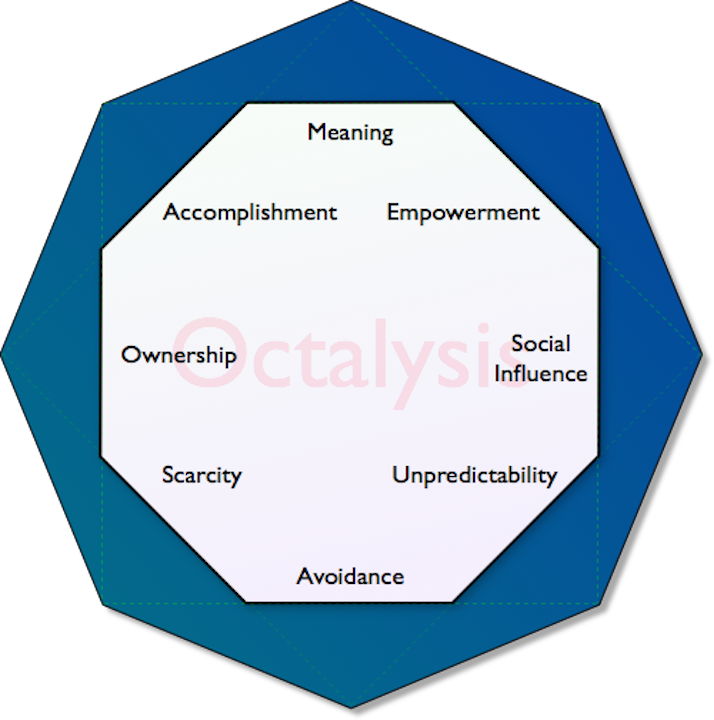
Credit: octalysisgroup.com
What makes this framework particularly powerful is how it categorizes these motivational drivers into distinct types:
White Hat vs. Black Hat Motivation
White Hat Motivation (Core Drives 1-5) makes people feel powerful, in control, and good about themselves. Even though those core drives may lack urgency, which often leads to procrastination, these are positive motivators that foster long-term engagement and well-being:
Epic Meaning & Calling: Feeling that you're part of something bigger than yourself
Development & Accomplishment: The drive for growth, mastery, and achievement
Empowerment of Creativity & Feedback: Engaging in creative processes and receiving feedback
Ownership & Possession: The drive to own, collect, and accumulate
Social Influence & Relatedness: Motivation driven by social connections and interactions
Black Hat Motivation (Core Drives 6-8) creates a sense of urgency, even obsession, but leaves people feeling out of control. While highly effective at driving immediate action, it can lead to burnout and negative feelings over time:
Scarcity & Impatience: Wanting something because it's rare or difficult to obtain
Unpredictability & Curiosity: Engagement driven by not knowing what will happen next
Loss & Avoidance: Acting to prevent negative outcomes
For example, when you are super engaged in building an initiative despite discouraging rising challenges, you are experiencing white hat motivation through Core Drive 1, epic meaning and calling. When you're so engrossed in a novel that you can't put it down until 2 AM (despite planning to go to bed at 10 PM), you're experiencing black hat motivation through Core Drive 7: Unpredictability & Curiosity.
Intrinsic vs. Extrinsic Motivation
The framework also distinguishes between left-side (extrinsic) and right-side (intrinsic) motivation:
Extrinsic Motivation (left side of the octagon) drives you to do something for a reward or outcome. Once you achieve that goal or if the reward loses its appeal, the behavior stops.
Intrinsic Motivation (right side of the octagon) makes activities inherently enjoyable. You'd willingly pay to experience them, and even if all progress were erased tomorrow, you'd still want to engage in them today.
Understanding these distinctions allows us to design more effective motivational systems, both for ourselves and others. The best approaches typically combine elements from multiple core drives, balancing immediate engagement with long-term satisfaction.
Finding Your Role: Playing the Game of Life as a Leader
With a clear understanding of motivation, we can now explore how to apply these insights to our own lives and leadership approaches.
Yu-kai's upcoming book outlines a six-step process for turning life into a game:
Choose the game you're playing - Define what success means to you
Know your attributes - Identify your natural talents and strengths
Identify your role - Find your optimal position based on your attributes
Enhance your skills - Develop abilities that make you powerful in your role
Build alliances - Create relationships with complementary players
Take on quests - Select challenges that advance your progress

Credit: Yukai Chou
This framework acknowledges that different people have different strengths. Rather than trying to excel at everything, Yu-kai suggests focusing on your natural attributes while finding ways to compensate for weaknesses.
When it comes to leadership specifically, Yu-kai identifies three essential pillars:
Vision: The ability to see a future others can't yet see
Execution: The capacity to drive progress forward
Empathy: Understanding and connecting with your team

Credit: Yukai Chou
Most leaders possess two of these three qualities, creating distinct leadership types:
Dreamer (Vision only): Excels at generating ideas but struggles to implement them
Supporter (Empathy only): Connects well with people but lacks direction
Hustler (Execution only): Gets things done but may miss the bigger picture
Coach (Vision + Empathy): Inspires others but may not drive completion
Commander (Vision + Execution): Achieves goals but might alienate the team
Manager (Execution + Empathy): Maintains productivity but may lack innovation
OP Leader ("Overpowered" - All three pillars): The complete package
Understanding where you fall on this spectrum allows you to leverage your strengths while finding complementary team members to fill your gaps. For instance, a Dreamer might thrive as an advisor to a Commander who can execute their visionary ideas.
Effective leaders apply the Octalysis Framework by activating the right motivational drives in themselves and in their teams. They create epic meaning through compelling missions, celebrate accomplishments, encourage creativity, provide ownership opportunities, foster social connections, strategically use scarcity, introduce unpredictability, and occasionally leverage loss avoidance—all while balancing white hat and black hat approaches for sustainable engagement.
From Victim to Gamer: Overcoming Life's Challenges
Perhaps the most transformative aspect of Yu-kai's philosophy is how it reframes obstacles and challenges.
In video games, difficulty is not just expected—it's designed intentionally. Games artificially add frustration through enemies, obstacles, and challenges. Each time you overcome these hurdles, you feel accomplished and engaged. The obstacles aren't bugs; they're features that make the experience more engaging and rewarding.
Yet in real life, we often adopt a victim mentality when facing challenges. We ask, "Why is this happening to me?" or "Why does my life suck?" instead of seeing obstacles as opportunities to "score higher" and demonstrate our abilities.
“It is a profound mindset shift: view your life as a game where challenges are not punishments but opportunities for growth and achievement. ”
With this perspective, you're no longer a victim of circumstances but a player striving for legendary achievements.
This reframing transforms even mundane tasks into meaningful quests:
Instead of dreading networking events, see them as opportunities to find allies with complementary skills for your journey
Rather than viewing a difficult book as boring task, consider it a quest that will grant you new abilities and prepare you for greater challenges
When facing setbacks, treat them as game levels designed to test your skills and creativity
“By playing the game, you’re winning. The only way you don’t win is if you don’t play.”
Yu-kai's relationship with discipline illustrates this approach. Instead of forcing himself to become disciplined (fighting against his natural attributes), he created gamified systems that made productive activities intrinsically enjoyable. He turned his weakness into a strength by changing the game, not by changing himself.
The Future of Play: Technology and Human Potential
Looking ahead, Yu-kai envisions a future where technology, particularly AI, enables abundance by drastically reducing the cost of creating value. Similar to how software transformed the world by allowing one engineer to do the work of ten, AI has the potential to create unprecedented productivity and wealth.
In this abundant future, Yu-kai believes several key elements will emerge:
Intrinsic Motivation Will Dominate: As basic needs are met through abundance, people will increasingly pursue activities they genuinely enjoy rather than those that merely provide sustenance
Stories Will Create Value: In a world where AI can create perfect art, authentic human stories and experiences will become increasingly valuable
Blockchain Technology Will Add Scarcity: Digital scarcity representing authenticity through blockchain can create value in an otherwise abundant digital world
Augmented Reality Will Enhance Experience: Rather than escaping into virtual worlds, augmentation will make our real-world experiences more dynamic and engaging
This vision doesn't eliminate competition or achievement. However, the key difference is that those who choose not to participate in these competitive games won't suffer materially. The safety net of abundance will allow everyone to play the games they find most meaningful.
Conclusion: Your 10,000 Hours of Play
The traditional view that success requires sacrifice and discipline is being replaced by a more sophisticated understanding: that proper design of our environments and mindsets has the potential to align our intrinsic motivations with our goals.
As Yu-kai points out, many people never complete Super Mario Brothers, yet they have fond memories of playing it. Nobody considers their Mario experience a failure just because they didn't finish the game. The joy was in the playing itself.

Super Mario Bros.Credit : Nintendo
Similarly, life isn't about reaching some final destination. It's about enjoying the journey—accumulating those 10,000 hours of meaningful, engaging play that simultaneously builds mastery and fulfillment.
By transforming our mindset from that of a victim to that of a player, we can reframe challenges as opportunities, weaknesses as design problems to solve, and work as a form of play. In doing so, we might just find that we've been approaching life backward all along—trying to force ourselves to do what we don't enjoy instead of redesigning our approach to make important activities inherently motivating.
As you reflect on your own life and leadership, consider: What game are you playing? Are you using sustainable motivational drivers? And most importantly, are you having fun along the way?
Because in the game of life, the only true failure is not playing at all.
Workbook


Editor’s Note
According to Weber, Grönewald & Ludwig (2022), the Octalysis framework, while increasingly referenced in both academic and practical contexts still need further empirical validation. Recent experimental studies suggest that motivation and performance may improve with the addition of more game elements—a finding that contrasts with some academic perspectives. Further, Octalysis sensitizes designers to "black hat" gamification and related dark patterns, suggesting its value not only as a design tool but also as an educational model for ethical considerations. While Octalysis shows promise for supporting idea generation and structuring the design process, its practical utility and influence on design outcomes require more robust, empirical validation.
If you want to dive deeper into the scope of human motivation, a recent study by Pincus (2023) proposed an interesting big picture called “The unified pyramid of human motivation,” which organizes all fundamental human needs into a comprehensive, symmetrical structure by crossing four core life domains—Self, Material, Social, and Spiritual—with three levels of attainment—To Be (foundational), To Do (experiential), and To Have (aspirational)—resulting in twelve distinct motivations. This framework, grounded in philosophy, psychology, and cross-cultural research, addresses gaps left by earlier models (like Maslow’s) by including overlooked needs such as autonomy, immersion, achievement, fairness, and morality. Each domain represents a major area of human striving, while each level reflects a different way people pursue fulfillment, from basic security to higher purpose. The model also predicts which domains are closely linked (e.g., Spiritual with Self and Social) and which are opposites (e.g., Material vs. Spiritual), offering a holistic map that can explain, measure, and address the full range of human motivation across cultures and contexts.
Why turning life into a game is so motivating? It may have something to do with the idea of “agency.” Nguyen’s book “Games: Agency as Art (2025)” argues that games are unique because they let us explore, practice, and expand our agency—the capacity to choose, act, and shape our own goals—by temporarily taking on new sets of rules, motivations, and abilities crafted by game designers. In games, we willingly adopt alternate forms of agency, experiencing what it’s like to pursue different goals or solve problems in new ways, which we might never try in ordinary life. This makes games a kind of “library of agency,” where we can experiment with and reflect on different ways of being an agent, ultimately helping us develop our autonomy and self-understanding. By gamifying aspects of life, we can borrow this clarity and flexibility of agency—setting clear goals, embracing challenges, and learning to navigate new roles—thus empowering ourselves to act with greater purpose, creativity, and control in the real world.
Reference
Nguyen, C. T. (2025). Games: Agency as art. Oxford University Press.
Pincus, J. D. (2023). The structure of human motivation. BMC psychology, 11(1), 308.
Weber, P., Grönewald, L., & Ludwig, T. (2022). Reflection on the Octalysis framework as a design and evaluation tool. In GamiFIN (pp. 75-84).
⭐ Yukai’s MAGIC

Yu-kai Chou's magic lies in his ability to connect seemingly unrelated concepts and transform them into practical frameworks. His Octalysis system identifies eight core human motivators that drive behavior, blending game design principles with business and personal development. Through this synthesizing talent, Yu-kai helps people reframe life's challenges as engaging quests, turning productivity into play. His unique gift makes discipline-requiring tasks intrinsically motivating, allowing people to achieve success through enjoyment rather than struggle, essentially transforming life itself into a game worth playing.
Connect with Guest
Yu-kai Chou is a pioneering Gamification Designer who created the influential Octalysis Framework and authored bestselling books including "Actionable Gamification." As the #1-rated gamification expert worldwide and founding partner of The Octalysis Group, he's lectured at institutions like Harvard and consulted for organizations including Google, Tesla, and multiple governments, impacting over 1.5 billion users. His expertise spans VR/AR as former Head of Creative Labs at HTC VIVE and blockchain as former CXO at Decentral. Beyond his professional achievements, Yu-kai leads Octalysis Prime with 30K+ members, holds prestigious recognitions including a knighthood from Korea's Joseon Imperial Family, and is a devoted father to three musically-named children: Symphony, Harmony, and Cello.
https://www.linkedin.com/in/yukaichou/
Credits & Revisions:
Story Writer/Editor: Dr. Jiani Wu
AI Partner: Perplexity, Claude
Initial Publication: May 22, 2025
Revision:
Updated workbook link + adjusted transcript (May 28, 2025)
Disclaimer:
AI technologies are harnessed to create initial content derived from genuine conversations. Human re-creation & review are used to ensure accuracy, relevance & quality.
