Soil research has traditionally focused on production and environmental quality, but there is a growing need to include multidimensional outcomes like human and societal well-being. A gap exists in the literature regarding the social and cultural co-benefits of soil stewardship. This research introduces "The Integrated Soil Well-being Framework" to examine linkages between individual and social well-being and soil research. The author proposes integrating social science and soil sciences to foster innovations that simultaneously promote human well-being and soil health.
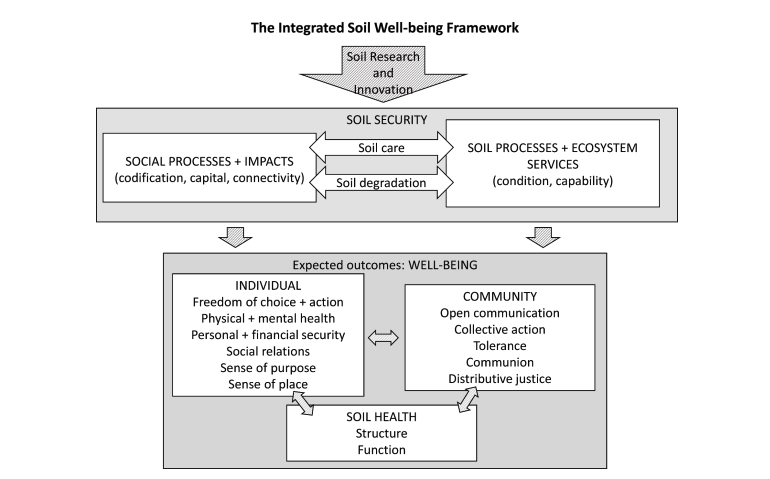
The Integrated Soil and Well-being Framework focuses on establishing soil research and innovation as the driver of social change.
Soil Health and Social Well-being
While soil's impact on physical human health (e.g., nutrition and disease) is recognized, the relationship between soil health and subjective well-being is yet to be explored. A bridging approach called Eudaimonic well-being (living life fully and meaningfully) is discussed. Research indicates that producers may perceive soil health facilitation as supporting their well-being through creativity, dignity, and a sense of connection to nature.
Soil Connectivity and Soil Stewardship
Soil connectivity refers to the emotional awareness or perceived importance of soil to individuals and society. Broadening soil valuation beyond production yield and economic profit is necessary to improve societal connection to soil. Social theories, behavior change models, and consumer education are potential tools to increase soil stewardship.
Evaluating Soil Capability
"Soil capability" is defined as what soil can do within its specific social-ecological system context. Quantitative economic methodologies (pedo-econometrics) and biocultural indicator approaches (participatory research) are suggested for evaluating this capability.
Integrated Soil Well-being Framework
This framework unifies existing concepts—soil security, ecosystem services, and nature's contribution to people—into a common vocabulary for transformative research. It views soil as a system where biophysical and social processes drive ecological and social health.
Under this framework, well-being is defined through three interconnected states:
Individual Well-being: This state includes personal aspects like freedom of choice and action, physical and mental health, financial and personal security, a sense of purpose and place, and healthy social relations.
Community Well-being: This state focuses on collective elements such as open communication, the ability to take collective action, tolerance, a sense of communion, and distributive justice.
Soil Health: This state is defined by the soil's physical structure and its vital role in sustaining the socio-ecological functions of the land.
Building Soil Research and Innovation Capacity
The paper calls for a shift in soil science training to include systems thinking and social science coursework. Western science has historically dominated, often erasing local and indigenous soil knowledge. The authors advocate for co-innovation that integrates diverse ways of knowing to nourish cultural diversity and individual identities. Also, the identity of a "soil scientist" should expand to be more inclusive of diverse backgrounds, epistemologies, and methodologies. After all, a "disciplinary inclusion" of human studies is essential, viewing humans as an integrated part of socio-ecological systems.
How Does it Relate to Regenerative Vitality?
Regenerative Vitality expands beyond human wellbeing into ecological context The paper explains that realizing "regenerative vitality" requires a shift to a "transformative soil science." This approach moves beyond traditional production metrics to value diverse cultural knowledge, emotional connectivity, and soil capability, defined by what soil can impact within its real-world social-ecological context. By integrating these human dimensions, the framework provides a foundation for soil health to drive overall societal and environmental flourishing.
Disclaimer: The summary story is co-developed with Gemini and reviewed by human.
