Research Methods
Every living thing grows from roots it rarely shows. This page shares ours: the research foundation beneath everything MAGICommons explores, from research essays and the Dialogic Lab to Living Labs.
In essence, our research is participatory, cross-disciplinary, and creative: done with people, not about them; exploring vitality wherever disciplines meet; and welcoming creative expression alongside words, as another way to know and to inquire.
Research foundation
All MAGICommons research listens and learns in the same way: the shared core. It is rooted in Participatory Action Research, and it is cross-disciplinary, exploring vitality across the arts, health, education, governance, economics, agriculture, architecture, and technology, and especially where they meet, because the health of people, societies, and the living world is one ecological whole. It grows from soil we honor: from Burns, Howard, and Ospina (2021), a way of seeing each community as a living system, and fairness in who holds knowledge, data, and power, carrying forward the work of Freire (1970) and Fals-Borda (Fals-Borda & Rahman, 1991); from Kara (2020), creative, arts-based ways of researching beyond words on a page; from Back and Puwar (2012), live methods attuned to everyday life as it happens; and from our own commitment to care, how every person is met, credited, and protected. We learn in three ways, close to home and across the world at once (cosmo-local, after Bauwens et al., 2019; Bauwens & Ramos, 2018): reading widely, listening in Living Labs rooted in place, and dialogue in the Dialogic Lab, a space of Ma, the meaningful space between things where meaning has room to form (Eringfeld, 2026). Together, they form a decentralized signal network held as a commons (Ostrom, 1990) (see Ecology). The shared core holds five practices:
An ecological lens. We see people, their relationships, the systems around them, and the living world as one whole: body, mind, spirit, society, and ecology together. Much research now understands wellbeing in this way: emerging in relationships, systems, and places, belonging to no one alone, and woven with the health of the living world (Atkinson, 2013; Bronfenbrenner, 1979; Prilleltensky & Prilleltensky, 2006; White, 2017; Whitmee et al., 2015). In this light, wellbeing may be understood as the systemic flow of regenerative vitality, a proposition each community explores in its own words. We listen for vitality at four levels: within each person, in the organizations they belong to, in their wider society, and in their relationship with the planet. In this, the sociological imagination, which links personal troubles to public issues (Mills, 1959), reaches outward to the living world.
The whole of what people know. We listen to what people think, feel, and sense in their bodies, and welcome drawing, movement, sound, or a meaningful object when words fall short. These carry what Heron and Reason (1997) call presentational knowing, a bridge between what people live and what they do. What a creation means is always for its maker to say.
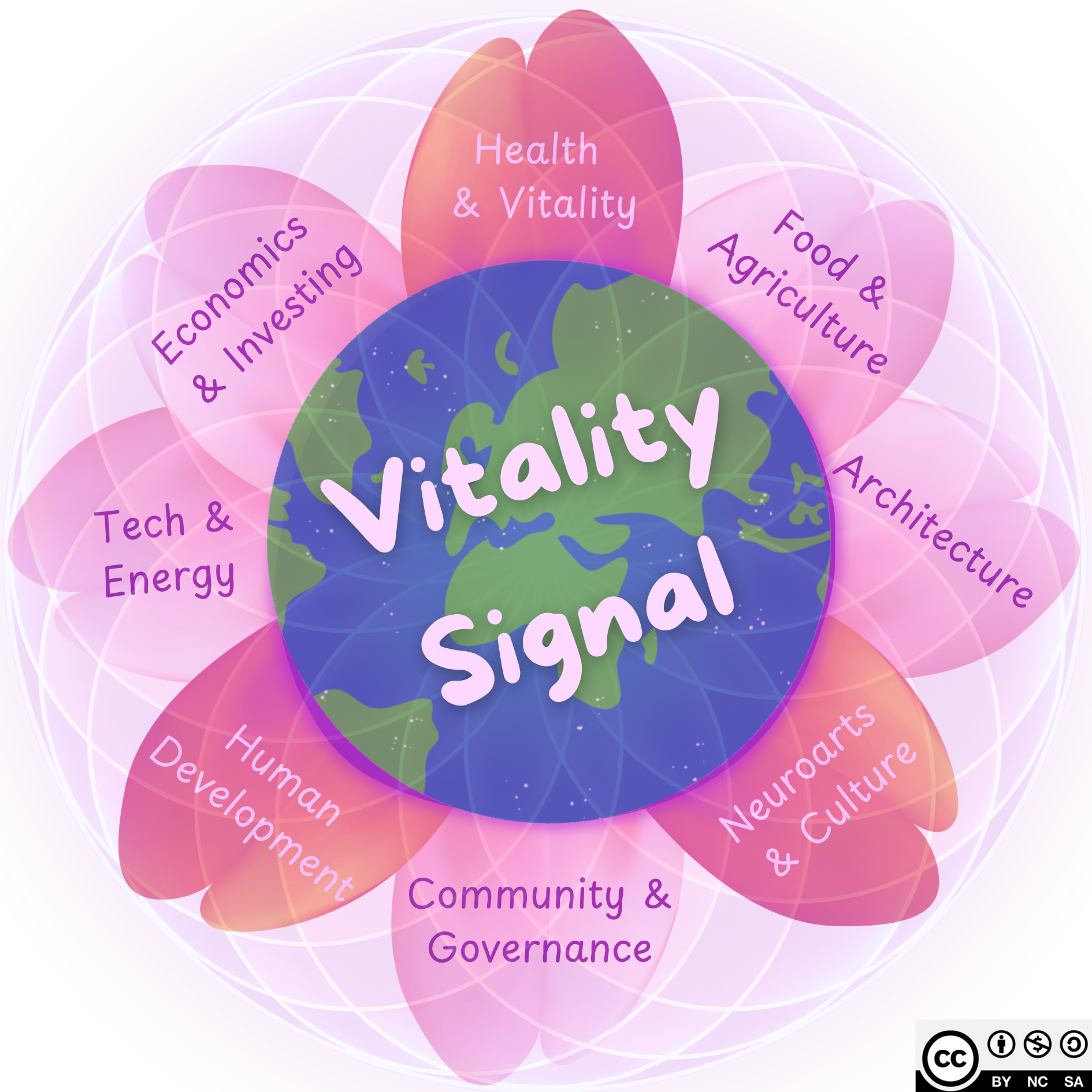
Letting meaning emerge. Themes grow only from what people share. MAGICommons' own early picture of vitality, the seven-petal flower, is held as a question still to be tested, and is never used to sort what people say.
Evidence you can trace. Every finding can be followed back to the words it came from, and anything we add by way of interpretation is clearly marked as ours.
Unfolding over time. Each inquiry deepens what came before, through cycles of acting and reflecting; in a Living Lab, cohort by cohort.
In Living Labs, this foundation moves in one rhythm: see, re-imagine, act. Re-imagining draws on a lineage that joined knowing to acting, from Freire's dialogues, opened with pictures of everyday life and turned toward futures not yet tried (Freire, 1994), to Boal's (1979) theatre, where audiences rehearse other endings before living them. Imagining what could be is itself a way of understanding society (Levitas, 2013), and a shared capacity that grows when it is welcomed (Appadurai, 2004; Greene, 2000).
Alongside the ecological lens, an inquiry may look through other lenses: particular ways of exploring and knowing, such as dialogue practices like Conscious Conversation (Montse, 2026), and embodied, ecological, and artistic practices. Lenses shape how people are invited to explore, while what they discover remains their own. All of this grows from MAGICommons' Principles for Regenerative Collaboration (see Principles for Regenerative Collaboration), and three questions guide it, which communities answer from within:
Three guiding questions
What is Regenerative Vitality?
What environmental and ecosystem conditions deepen or suppress it?
What practices allow individuals, organizations, societies, and our relationship with the living world to awaken and regenerate vitality?
Where it comes alive
This foundation lives in each of our ways of learning, in its own way:
In Living Labs, as participatory action research with communities, with creative expression invited in every dialogue (within this guide, see Inquiry).
In the Dialogic Lab, as open, unhurried dialogue with guests from many fields and traditions.
In research essays and a living literature review, as deep, careful study of one topic at a time, with essays shared as video, in service of communities.
References
Appadurai, A. (2004). The capacity to aspire: Culture and the terms of recognition. In V. Rao & M. Walton (Eds.), Culture and public action (pp. 59–84). Stanford University Press.
Atkinson, S. (2013). Beyond components of wellbeing: The effects of relational and situated assemblage. Topoi, 32(2), 137–144.
Back, L., & Puwar, N. (2012). A manifesto for live methods: Provocations and capacities. The Sociological Review, 60(1_suppl), 6–17.
Bauwens, M., Kostakis, V., & Pazaitis, A. (2019). Peer to peer: The commons manifesto. University of Westminster Press.
Bauwens, M., & Ramos, J. (2018). Re-imagining the left through an ecology of the commons: Towards a post-capitalist commons transition. Global Discourse, 8(2), 325–342.
Boal, A. (1979). Theatre of the oppressed (C. A. McBride & M.-O. L. McBride, Trans.). Urizen Books.
Bronfenbrenner, U. (1979). The ecology of human development: Experiments by nature and design. Harvard University Press.
Burns, D., Howard, J., & Ospina, S. M. (Eds.). (2021). The SAGE handbook of participatory research and inquiry (Vols. 1–2). SAGE Publications.
Eringfeld, S. (2026). Podcasting as a research method: A practical guide. Policy Press.
Fals-Borda, O., & Rahman, M. A. (Eds.). (1991). Action and knowledge: Breaking the monopoly with participatory action-research. Apex Press.
Freire, P. (1970). Pedagogy of the oppressed (M. B. Ramos, Trans.). Herder and Herder.
Freire, P. (1994). Pedagogy of hope: Reliving Pedagogy of the oppressed (R. R. Barr, Trans.). Continuum. (Original work published 1992)
Greene, M. (2000). Releasing the imagination: Essays on education, the arts, and social change. Jossey-Bass.
Heron, J., & Reason, P. (1997). A participatory inquiry paradigm. Qualitative Inquiry, 3(3), 274–294.
Kara, H. (2020). Creative research methods: A practical guide (2nd ed.). Policy Press.
Levitas, R. (2013). Utopia as method: The imaginary reconstitution of society. Palgrave Macmillan.
Mills, C. W. (1959). The sociological imagination. Oxford University Press.
Montse, M. (2026). Who must lose for tomorrow to be won? Relational imagination and the reproduction of war. Possibility Studies & Society, 27538699261492090.
Ostrom, E. (1990). Governing the commons: The evolution of institutions for collective action. Cambridge University Press.
Prilleltensky, I., & Prilleltensky, O. (2006). Promoting well-being: Linking personal, organizational, and community change. John Wiley & Sons.
White, S. C. (2017). Relational wellbeing: Re-centring the politics of happiness, policy and the self. Policy & Politics, 45(2), 121–136.
Whitmee, S., Haines, A., Beyrer, C., Boltz, F., Capon, A. G., ... & Yach, D. (2015). Safeguarding human health in the Anthropocene epoch: Report of The Rockefeller Foundation–Lancet Commission on planetary health. The Lancet, 386(10007), 1973–2028.