Collective Resonance: Why We Need Less Talk, More Music | Gary Muszynski
A conversation on the magic of music. When teams synchronize through rhythm and music, their nervous systems entrain together—creating the neurological foundation for empathy and cooperation that traditional cognitive approaches to organizational change cannot access.
"What could possibly go wrong?"
Gary, organizational facilitator and award-winning musician and bandleader poses this question to 115 operations team members sitting in a circle on the floor. They're about to pass rocks around while repeating four motions—grab, click, pass, clap. Within minutes, chaos erupts. Some accumulate 25 rocks while others have none. When Gary asks what happened, fingers point. Blame flies. Some people sweat, trying to manage the pile. Others pass the chaos forward. A few survey the whole system, working to redistribute resources.
The question isn't whether things go wrong. It's whether people respond with blame, panic, or systems thinking.
-
MAGICademy Podcast (00:00)
Culture change is about a shifting of the heart. Synchronization happened through rhythm. People were crying at the end when people's nervous systems entrain together. This is the neurological basis of empathy. Those neural networks predate language formation. Sound, rhythm, singing, very primal, ancient resource for connection, alignment, and that is nonverbal.
Jiani (00:29)
Welcome to MAGICademy podcast. Today with us is Gary Muszynski and he's the founder and CEO of Orchestrating Excellence. He's devoted his professional life and genius and magic into leveraging music to transform leadership, talent and organization in an ever changing and challenging
MAGICademy Podcast (00:55)
BBB in front of you lands a spaceship and out walks a friendly alien. If this alien walks and if you choose one word, one sound or one movement to invite the alien to play, what would that be?
Gary (01:09)
love that you invite
the alien to play.
I would say...
I would ask a question, what makes you happy?
And then I would engage the alien in that way because when people are feeling joy and they're playful, there's better chance of connection, collaboration, rapport, and learning.
MAGICademy Podcast (01:29)
So the joy is the foundation to start a communication. ⁓
Gary (01:32)
Yeah. Yeah.
Right, right.
MAGICademy Podcast (01:36)
That's nice, that's nice. So you've been in this space for almost 30 years, helping teams and organizations to connect closer together, transform beyond limitations and frictions into a space through invitation of music and music playing together. Can you tell us a little bit more of how everything all got started?
Gary (01:58)
sure. I've been a musician most of my life. And then in my, I guess it was actually as a teenager, I used to host parties, especially when my parents went out of town and I would hand out instruments, percussion instruments, and we go into essentially a group trance.
And it was a really powerful experience. And I had friends that kept saying, gosh, can we do that rhythm thing again? I haven't connected with people like that at a party before I started doing it in college. And finally friends urged me to do a workshop and said, you know, we'd like to do this for a full day. So I did my first workshop, hoping 10 people would show up and 60 people showed up. We had to go get more instruments.
And it was really an extraordinary peak experience for all of us, including me. And then I became very curious about the roots of rhythmic music in indigenous cultures and how rhythm and movement and singing can be used as a way of creating a stronger collective sense of unity in organizations we'd call it alignment.
MAGICademy Podcast (02:46)
you
Gary (03:12)
but essentially it's shared consciousness or shared mindset. So I started to become curious about how might I apply this to group dynamics. And so I started learning about group dynamics and organizational development and leadership. And I read a lot of books, I attend a lot of workshops, I went through different certification programs for coaching, for leadership development.
And then I began to approach a couple of companies to see, you know, to prototype my idea. And so I approached one company in, gosh, when was it? 1988, something like that, late eighties. And ⁓ they brought me in to do a program for their employees. went over really well. People loved it. Gave it very high marks.
And so then they put me on their payroll and I started developing some programs that they could roll out to their clients. At the same time, I read about a guy in time magazine. did a story on creative leadership and they mentioned someone by the name of Gordon McKenzie, at Hallmark cards. And Gordon was one of their top.
creative directors and illustrators. And he wrote a beautiful book called orbiting the giant hairball. And it was an early book. I know it was an early book, book about innovation, design thinking before it was called design thinking. And so I was living in St. Louis at the time. It's only four hours from Kansas city.
MAGICademy Podcast (04:31)
you
me.
Gary (04:46)
where he was located and where Hallmark Cards is headquartered. And so I drove there. He invited me. I sent him some info. I was just getting started. And he said, wow, this sounds like really interesting work. Do you want to come visit us and maybe do a program here? So I said, yeah, OK. So I went there and met him. And he was really a lovely person in a way.
MAGICademy Podcast (05:08)
you
Gary (05:14)
kind of became my first mentor and really had a lot of confidence in my ideas and the program at Hallmark went over really well. So that gave me confidence. And then the next big milestone really was in 1994, I filled out a request for proposal to the American Society of
and Development, ASTD. Now it's called ATD.
but it's one of the largest training organizations in the world, if not the largest. And this workshop was called Synergy Through Samba. They actually accepted my workshop. know, all the other workshops were like four steps to boosting ROI or, So Synergy Through Samba stood out.
MAGICademy Podcast (06:06)
You
Thank
Gary (06:11)
So much so that it was actually featured on the front page of the Wall Street Journal in the marketplace section. ⁓ But I was hoping that 100 people would show up and 300 people showed up. Fortunately, we had enough instruments. And again, like the experience I had in high school and in college, it was an extraordinary peak experience for people. People were
MAGICademy Podcast (06:20)
beautiful.
Gary (06:37)
crying at the end, they were so emotionally moved by the experience, the incredible synchronization that can happen through rhythm. When people's nervous systems entrain together, this is the neurological basis of empathy. And if you study the brain, you realize that those neural networks
predate language formation, sound, rhythm, singing, vocalizing. They're much older than language formation. And if any of your listeners have kids out there, they'll bear me out because oftentimes you'll see young kids making sounds, singing, being very playful before they can really speak.
So basically what I realized is that I tapped into a very primal, ancient resource for connection, alignment.
And,
that is non-verbal.
And this was particularly effective since a third of the audience at the ASTD conference were international. And that was part of the thing is they had never felt so connected to a North American audience before because of the difference in language and sensibility. And this moved their hearts. And
trying to think of who I just came across a beautiful quote recently.
I'm going see if I can find it quickly.
⁓ it's by David Brooks, the noted New York Times columnist. He said, culture change is about a shifting of the heart.
And I think in a sense, that's what happened is that emotions precede our concepts and beliefs and mindsets about the world, because they're the filters through which we make sense of the world and then create a narrative around our perceptions. So music, as my colleague,
⁓ Daniel Levitan writes in his beautiful book, which is called, I heard there's a secret chord music as medicine. It's out. Okay. good. Good. It's a beautiful book. And I recommend that people listen to it on audible, cause he's reading it and he's a great, his voice and his emotion inflection.
MAGICademy Podcast (08:42)
Mmm, yep, yep, I came across that book. Yet to finish it. It's on my reading list. Yes,
Gary (08:59)
is wonderful. really adds a lot to the content. So, yeah, he's done a lot of research on music as medicine, the healing powers of music. And so since music is my first love, and I'm also really passionate about organizational life.
collective intelligence, how to harmonize polarizing energies. Music has become a great asset and tool.
MAGICademy Podcast (09:27)
Can you, that gets me very interested in your programs that you have been sharing with people, shifting their hearts, harmonize the conflict into beautiful sounds and harmonies and how, what does the experience feel like? What was, what does that, how do you, what?
What, how does the experience flow in terms of a participant? Can you walk us like through a story?
Gary (09:55)
Sure. Happy.
there there's different templates. There's different programs or different instruments. There's sequence different differently. The important thing to realize is I always start with.
happening with the team? What's happening with the organization? What are the explicit goals? What's the ideal future state envisioned?
what's the current state and what's in the way of people reaching that more ideal future. So based on that information, I create a learning journey through music.
MAGICademy Podcast (10:37)
What are some common challenges? One thing I could think of is conflict, like if the leader wants to do something and part of the team can't seem to get on it on the same kind of wavelengths and say, yeah, so there's a lot of restrictions and conflict within the teams. Besides that, what are some common challenges that you've...
you've worked with.
Gary (11:08)
Well, I like the one you mentioned. So there could be a disconnect between the leader and the team that can show up in a variety of ways. There's a lot of talk about psychological safety on teams. And there are different things that can influence that leadership is one. ⁓ Role clarity, lack of role clarity, recent firings or layoffs.
MAGICademy Podcast (11:20)
Yeah.
Yep.
Gary (11:30)
You know, command and control structure. mean, there's lots of reasons why people might not feel psychological safety, which is a very complex topic. Another issue could be there've been many reorganizations. So there's a new leader, two teams are merging. Two teams are competing for resources. You know, merger and acquisition.
So now I remember doing a program where we were bringing two leadership teams and two sales teams together to work collaboratively through a four hour program. It was the update of synergy through Samba. We call it orchestrating excellence. two weeks earlier, these two leadership teams and sales teams were each other's biggest competitors.
They were part of the same company and they had to work together. Not so easy. So, we were hired by the CEO and his, you know, head of HR who had experienced my work at a conference or a different organization. And she actually wrote to us afterwards and said,
You completely revamped my understanding of what's possible with team building because your four hour session was more effective at getting the two teams to have the willingness and the openness to working together as compared with four and a half days.
of scenario planning and business content.
So again,
MAGICademy Podcast (12:59)
How do you do that exactly? How do you have this music programming that really kind of transform the teams? like, so we have some common challenges like conflict and clarity and conflict of interest. So do they deserve to be having different learning journeys? Like how do you, what kind of music helps people to
increase buy-in What kind of music play help people to gain clarity? What kind of music help people to turn conflict into synergy? Like, do you select different music?
Gary (13:32)
Well, these
are very perceptive questions you're asking.
Again, it stems from understanding deeply what the challenge Is it a surface challenge? Is it a middle challenge? Is it very deep?
how long has the dynamic been going on? So there's explicit needs assessment, and then there's what emerges and arises when people are playing music together. So let me talk a little bit more about this. Okay.
MAGICademy Podcast (13:58)
Tell us a story.
Gary (14:00)
So for an order for a group to be in a groove together, locked in to something that is really musically vibrant, cohesive, coherent, and synchronized, which is what you want in a business, in order for what? Everywhere in a relationship, right? But we fall in and out of rhythm all the time.
MAGICademy Podcast (14:16)
Everywhere. Everywhere, ideally. ⁓
Gary (14:24)
We can't be in the groove all the time. We're not always in flow. There's disruption, self-imposed, externally imposed. So the lesson is how do you fall out of rhythm? Do you notice? What do you do individually? How do you get everybody back on track? So those are the things that we work with explicitly through music. It's a simulation.
So once we talk about how are things going musically, where does it sound like we're aligned? Where is there a mismatch of either skills or resources or awareness? How can we improve? And then there's a transfer to how does this relate to the relevant issues your team is dealing with?
just worked with an operations team last week.
115 people. There've been a lot of changes and there's some issues with the ops team. So I took them through a rock passing
sitting on the floor. have two rocks. And they're having to grab, click, pass, clap, grab, click, pass, clap. And they're in a circle of 115 people. So this team might.
MAGICademy Podcast (15:44)
A circle
of 150. 150 people form a big circle.
Gary (15:50)
Right. And the circle represents the system. The ability of the rocks to pass through in a tight groove and flow represents the handoffs they need to make between their different functions to keep clients happy.
That could be IT stuff. could be sales versus fulfillment. It could be all kinds of things that you might imagine, right? But basically, businesses have to be well organized, internally synchronized so that they can produce a high level of customer service and delight for their customers. It's true internally too, in terms of the employee experience.
So they're learning about this metaphorically, but also semantically, like, my God, what happens when I have 25 rocks in front of me, the next 20 people have no rocks, how do I react? So sometimes they will react. I'll just ask them a neutral question like, whoa, what happened? How did you get 20 rocks? What happened? And oftentimes they'll start blaming other parts of the circle.
Okay, so that now we're surfacing a dynamic, right? And someone else might have the wisdom to say, ⁓ maybe the problem started in another part of the circle. ended up here. But that doesn't mean that the problem needs to be localized to these people right here. so that's a system level awareness. Now we're going from localized blame to a more systemic
awareness of we're all in this together, how do we, are we asking the right questions to diagnose the root cause? So that's an actual experience. Now, where did I derive this from? It's actually derived from Chinese traditional medicine.
Because in Chinese medicine, you have something called pulse diagnosis.
MAGICademy Podcast (17:39)
Yeah, yeah, we put it on like here and then just sense it.
Gary (17:42)
Right. But the thing
is that unlike Western pulse, you're mostly feeling amplitude of the pulse and the rate, the speed, beats per minute, beats per second. In Chinese medicine, you're feeling into the different organ systems on that side at three different levels. And you're getting a sense of you're getting many more data points.
On both sides, you're getting 18 data points instead of one.
MAGICademy Podcast (18:09)
Right, it's kind like
an analog signals versus a digital zero and one signals. Yeah, they're very comprehensive.
Gary (18:15)
Yes, exactly. So
when we're doing the rock passing game, what I'm looking for is what is the ability of this team or group or system to self-organize when there's change and chaos.
Some groups, when the rocks start piling up, they just stop. They give up. Some groups, like this ops team, they keep going. They keep trying. They don't give up. I mirror that back to them because one of the principles of organizational development is for the facilitator to mirror back what he or she is saying about the systemic dynamic.
So you can see how deep this stuff actually goes. On the surface, it's just a silly game passing two rocks. Right? Now.
MAGICademy Podcast (19:00)
something
when we were we would do in kindergarten let's pass the rocks and let's play ⁓
Gary (19:06)
Right now it puts everybody
on the same level.
And for people that are apt to think, who is this guy? What are we doing? What relationship does this have to anything serious? As soon as they start playing the game, they get it. Because I say, look, folks, this is a silly game. I want to apologize ahead of time for subjecting you to this.
MAGICademy Podcast (19:27)
you
Gary (19:28)
You're sitting on the floor, you're probably uncomfortable, low back, and you're going to be passing these things around. And, but you're just doing these four motions. And when it goes well, there's a good flow. There's good role clarity. The handoffs are clear. External customers are happy because they're getting the information or their products in a timely manner.
Everything is in flow.
What could possibly go wrong?
MAGICademy Podcast (19:56)
Yeah, what could possibly go wrong?
Gary (19:57)
So I like to ask
that as a provocative question because people then start to laugh a little nervously. Like, my God, okay, this is not just a simple game.
MAGICademy Podcast (20:11)
The hidden
patterns will get exposed by those rockling moments.
Gary (20:14)
Right. And one of the patterns is that
some people have a big pile of rocks and they just pass it on to the next person. It's no longer their problem. Now they're just delegating the chaos. Other people are sweating and like trying to manage it and figure out what to do and feeling like it, it's all my fault. I messed up. Something's wrong with me. And then other parts of the circle are working with each other.
to take the excess rocks and send them to where they're needed. They have what I call systemic awareness or I call it panoramic vision instead of myopic vision. So if you're in a stress pattern as you were just a little while ago, if you're in a stress pattern or fight, flight or freeze,
MAGICademy Podcast (20:56)
Yeah, I was.
Gary (21:02)
then you're not gonna have panoramic vision, you're gonna have myopic vision, you're in survival mode. So your solutions are not gonna be as effective. If you're more resourced and calm, you're feeling more connected with people about the changes, then you could think more strategically about how to skillfully adapt to change.
So I'm giving you an example. I'll mention one more story. I was working with one of the top five banks in the world. I'm not going to mention their name, but household name. And I was working with the head of an entire division. He was the SVP of e-commerce.
And he was given very, very, he was a new leader and he was given very lofty, ambitious goals for growing revenue in a flat growth business.
And this was early on in e-commerce days. They brought in two other very well-known professional service firms to try and get to the root cause of why they weren't able to grow their top line revenue. And neither
organization was successful and they spent millions of dollars. They brought us in.
After our program, we cascaded the same experience to five other parts of the leadership team. So everybody had a common experience, a shared mindset, common language, and he used that basically the language of synchronization and music to rally his people. So anytime they said, that goal's not realistic, he would say,
Do you remember what we did in Synergy Through Samba? Do you remember how we thought that level of cohesion was impossible? And what did we learn and what were the steps that we took to envision our success and work through the obstacles? So he was very smart about leveraging the experience. They grew their top line revenue from 90 million
to 180 million in two years. And he credits us with unlocking his leadership team's mindset around possibility.
MAGICademy Podcast (23:13)
doubled.
Gary (23:28)
oftentimes people want to know like, where did you get this stuff from? you know, sometimes our earliest memories and our childhood or teenage experiences kind of inform our lives, you know, they're kind of like,
fractal.
meaning there's a pattern that happens that we repeat and refine over the course of our life. In my case, it happened at age five. I was at Lomond Elementary School, suburb of Cleveland, Ohio, Shaker Heights, Ohio. And I was at, this was my elementary school and we had a musical assembly.
for 600 kids, we were all really excited, we were sitting on the floor cross-legged, we were chirping like little birds, and the principal comes over the mic and loudspeaker and says, we have something very special for you today, kids, that you probably will never forget. Now, in my case, that was true.
Next thing we knew, these plush purple curtains parted and this tall African-American musician, drummer, conga player started soloing on four conga drums. And this was my first introduction to Afro-Cuban music.
And I was transfixed. was, and I was a very shy kid. Emotionally, I, you know, was very socially shy. And, but I got up and I started dancing wildly in front of the whole school. And when I asked corporate audiences, now, how do you think these kids received me?
Some people say, ⁓ they must have clapped. And then someone said, they made fun of you, didn't they? I said, yep. They made fun of me because my behavior was not part of the mainstream. It was seen as aberrant, strange.
And so they were making fun of me. But I didn't care. I continued. And then something magical happened. Someone else got up and joined me.
Now this made it safer for other people to follow. And if you look at adoption curves with new technology, you realize that, you know, I was the innovator, the original founder, whatever, the early adopters. So he was my first early adopter. He was my first follower. You don't have, you're not a leader unless you have followers.
MAGICademy Podcast (25:36)
Yep, the early adopters. ⁓
Gary (25:49)
I created a compelling invitation outside the norm of that culture. He decided to accept the invitation. He joined me. And then all of a sudden other people started to join until almost everybody, all 600 people were on their feet, dancing, laughing, connecting, having a great time and changing the whole vibe of the school. Even
staunchy teachers, the principal, school board members, parents joined in too. And it totally changed and that went on for about five minutes. I heard a
in my head that said, I wanna do this someday.
And I had no idea what that voice meant, but it became the basis of my life's work to explore rhythm and its impact on groups.
And so that led me to study music in Brazil, Africa, Indonesia, Peru, Cuba, and around the world. So that was my initiation. That was my call, if you will.
And from then I began to experiment with different groups, whether it was my friends at the party, you know, I told you about when my parents went out of town in high school or what I did with my college friends or I just kept investigating one population to the next, culminating with, you know, executives in major fortune 100 companies.
and the impact was always the same.
MAGICademy Podcast (27:28)
Thank you, Gary, for sharing with us this beautiful story of you in early years and also sharing with us the stories about how music, just as simple as passing the stones, making the sound, actually reflect the hidden dynamics of an organization and actually makes...
the dynamic visible, more visible in one setting rather than everybody guessing in their silo spaces. So then that creates us a safe space for us to then talk about it and not only talk about it, but also embody it, feel it. And so everybody at that moment do share a common experience because sometimes what prevents us from understanding each other is the very lack of experiences. So you come there.
you provide a space and then you help people to have these shared experiences then there's stronger common ground literally to lay the discussions and talks through. That's beautiful. And so as we conclude this conversation, if you were to...
tell or share with our audience is something that keeps you always on track with your childhood inspirations and turn that fractal moments into and refining it into this bigger presence as you are now. What is the simple practice that you do that helps you ⁓
Alive helps you to stay focused, helps you to stay on calling.
Gary (29:02)
Right. Well, listening to music, listening to music that is inspiring, that helps me settle my nervous system or music that activates me if I need more energy or if I'm feeling sad, music that is soothing. mean, music can be so flexible in terms of the type of impact on the nervous system and health.
Another thing is capturing the power of rhythm in the way you walk, in the way you run, in the way you exercise, in the flow of your day. I need a slower rhythm in the morning. I want a faster rhythm early in the afternoon. You know, this idea of a wave. If you're doing mindfulness practice, whether it's meditation or following the breath,
using rhythm to understand the power of intervals, you know, could be four breaths in, four breaths at the top of the ellipse as a pause, four breaths as an exhalation and four breaths as resting at the bottom of the exhalation. This is sometimes referred to as square breathing or elliptical breathing, but it's following a rhythmic pattern.
to create a sense of
in the nervous system. So there's all kinds of ways that you can apply rhythm, music, and sound. And this kind of leads into my last comment. After three decades of doing this around the world, I'm preparing to launch my first Train the Trainer session.
in early 2025. So any of your listeners are interested, they can email me at gary at orchestrating excellence.com or they can go to that website and there will be a blog post describing it. But I'm really interested in the next stage for me is take the design principles, the methodology, the actual exercises.
how I think about design and sequencing, and really teach a group of 16 to 20 other people from around the world to do it at a high level.
MAGICademy Podcast (31:19)
Yeah, for folks who
are curious to learn more about the programming. We will also attach the link in the show notes below together with the information that you can get connected to Gary as
encourage you to get connected with each other and I look forward to spread the words and make the space and visibilities for the magic and the power of music, of rhythm, of synchronicity and how that can.
heal humanities at large, starting from one individual, one team, one group, and one organization at a time.
Gary (31:58)
Great. And if people want to just hear the music I've produced, they can go to oneworldmusic.com, O-N-E, worldmusic.com. You can stream Roots and Wings, medicine music. The album won the top global music award in 2021 out of all the submissions around the world and also 24 musicians from 10 countries.
And then the newest one came out in fall of 2024. It's called the Journey Home Songs of Longing and Belonging.
MAGICademy Podcast (32:30)
I've listened to the Roots and Wings and I still play that from time to time to help me focus and feel grounded as I work throughout the day. So music is medicine. We all need some healings to restore our energy, our childlike wonder and our passion and our callings in whatever context we all play. We all play a role.
Gary (32:33)
wonderful.
Beautiful.
Thank you so much. I'm honored by your great questions and you're providing such an important service to people that are interested in healing and creativity and conscious business.
MAGICademy Podcast (33:06)
Thank you, Gary, and I feel grateful to get connected with you and share your stories with the audience. I hope our audience feel the same and I hope the program is a success. ⁓
Gary (33:18)
Thank you.
Thank you.
Rhythm Before Words
Rhythm predates language as a tool for human connection. This isn't metaphor—it's neuroscience.
"If you study the brain, those neural networks predate language formation," Gary explains. "Sound, rhythm, singing—they're much older than language." Children make sounds and sing before they speak. We're wired for rhythm first, words second.
When people synchronize through rhythm, their nervous systems entrain together (Kim, Reifgerst, and Rizzonelli, 2019). This entrainment is the neurological basis of empathy—the foundation of cooperation. It happens beneath conscious thought, in ancient brain structures that govern connection (Hernandez-Ruiz, 2019).
"Culture change is about a shifting of the heart," Gary quotes columnist David Brooks. The sequence matters: emotions precede concepts and beliefs. They're the filters through which we make sense of the world. Music shifts those emotional filters before strategy is spoken.
Pulse Check through Wisdom of Ancient Technology
Indigenous cultures have preserved powerful technologies for millennia that modern organizations increasingly need. West African drumming ceremonies create "shared consciousness"—a collective state where individual silos dissolve. Brazilian samba preparation for Carnaval, with its intricate coordination of hundreds of performers, offers a blueprint for aligning disconnected teams. The rock-passing simulation, derived from Chinese pulse diagnosis in Traditional Chinese Medicine (TCM), reveals systemic patterns invisible to Western approaches: where conventional diagnostics capture single data points, this ancient practice reads multiple dimensions of flow within a group of people.
From Cognition to Somatic Resonance
The fundamental shift is profound: from cognitive to somatic, from individual to collective.
Traditional organizational development operates in the realm of cognition—strategic planning, competency frameworks, rational persuasion. It asks people to think their way into alignment. This approach works through the body and nervous system instead.
When 115 people are grab-click-pass-clapping together, there's no time for analysis. You're either in sync or you're not. Your nervous system knows before your mind catches up.
The results speak to a different order of change. A senior vice president at a major bank brought in two well-known consulting firms to grow revenue in his e-commerce division. Both initiatives failed despite millions spent on consulting fees. A three-hour rhythm-based simulation—moving from cacophony and cynicism to coherence and high performance—succeeded where traditional consulting could not.

The division doubled its revenue—from $90 million to $180 million—in just two years, a feat the leadership team had previously believed impossible. When interviewed by a third-party consultant about what shifted, the executive pointed to the catalytic nature of the experience: "The leadership team needed a pattern disrupt—an interruption of an outmoded and stagnant mindset. This provided the reset we needed, and it propelled us forward."
The key wasn't just the experience itself, but how the language and felt memory of synchronization became woven into daily operations. When someone claimed a revenue growth goal wasn't realistic in a flat-growth business, the response became: "Remember what we thought was impossible three hours ago?" The experience didn't fade once the music stopped—it became a reference point for what's possible when groups move from individual effort to collective flow.
What This Means for Leadership
If culture change happens first in the heart, not the head, then standard interventions address symptoms, not causes. PowerPoint decks about collaboration can't create the felt experience of synchronization. Workshops about psychological safety can't substitute for actually feeling safe enough to make mistakes, learn, and grow in front of peers.
"Some groups, when rocks pile up, just stop. They give up," Gary observes. "Some groups keep going. They don't give up." This reveals what no survey can: how does this team actually respond under stress?
At a major training conference, a third of the audience was international. They reported never feeling so connected to a North American audience—language and cultural differences dissolved in rhythm. The experience wasn't about individual mastery but collective coherence. The question shifted from "Am I doing this right?" to "Are we in the groove together?"
Organizations don't think their way into new ways of being. They feel, move, and synchronize their way there.
Reference
Hernandez-Ruiz, E. (2019). How is music processed? Tentative answers from cognitive neuroscience. Nordic Journal of Music Therapy, 28(4), 315-332.
Kim, J. H., Reifgerst, A., & Rizzonelli, M. (2019). Musical social entrainment. Music & Science, 2, 2059204319848991.
⭐ Gary & MAGIC
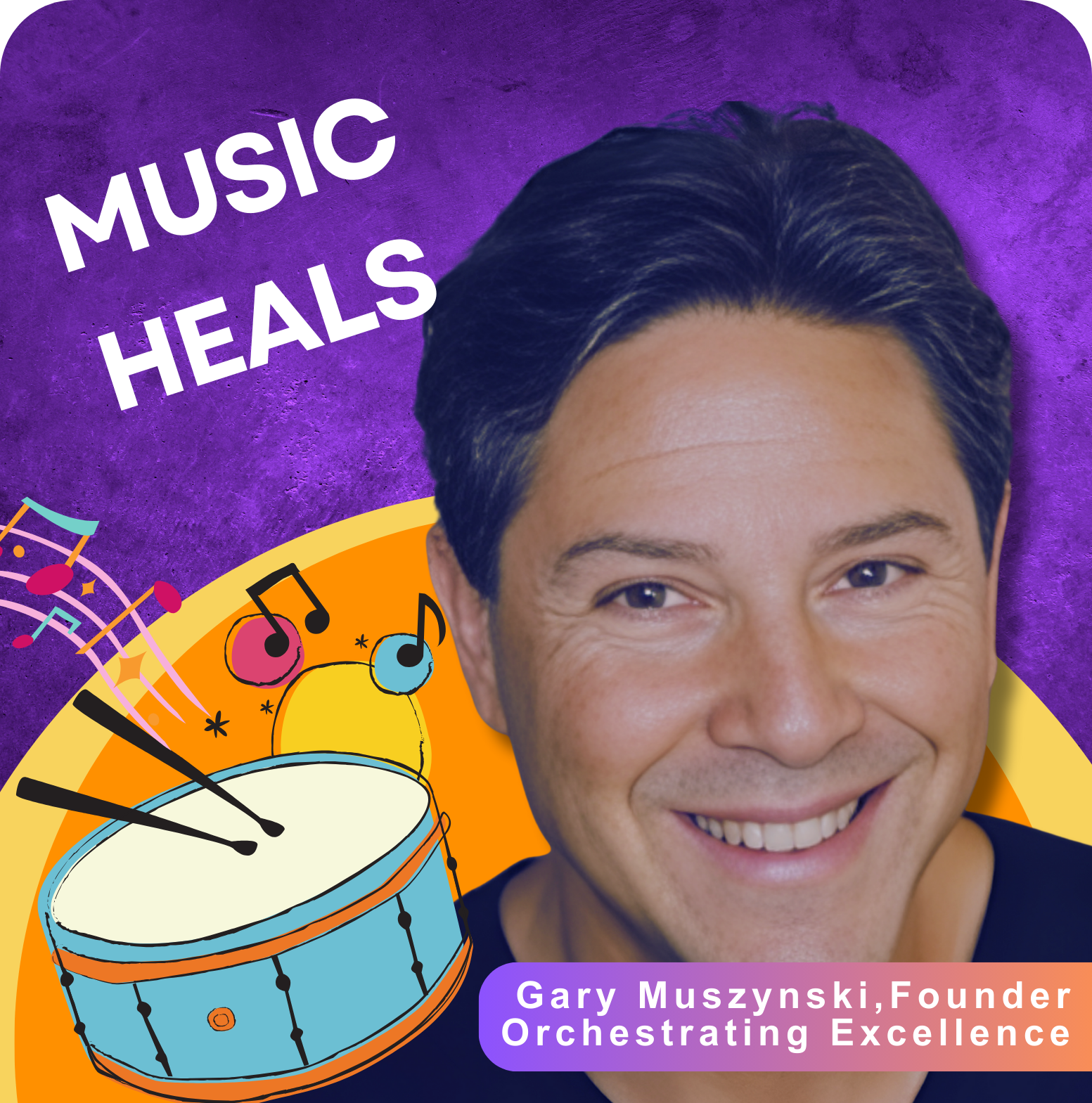
An award-winning composer, leadership coach, and two-time TEDx presenter, Gary bridges business, the arts, and neuroscience through multi-sensory learning experiences. His rhythm-based methodology has transformed teams at Apple, Pixar, Google, Disney, Johnson & Johnson, Kaiser Permanente, Stanford Graduate School of Business, Deloitte, and dozens of other organizations. Drawing from ancient traditions and contemporary science, his work treats rhythm not as metaphor, but as technology for change where conventional consulting fails.
Meanwhile, as a musician and producer, Gary has performed or recorded with Bobby McFerrin, Afro-Cuban pianist Omar Sosa, classical Hindustani bansuri master Deepak Ram, and raga-meets-jazz vocalist Varijashree Venugopal, among musical luminaries from 16 countries. This global collaboration—recognized with gold medals at the Global Music Awards for albums Roots & Wings (2021) and The Journey Home (2024)—fuels his pioneering work in organizational transformation.
What keeps Gary aligned with his calling? Listening to music that settles or activates his nervous system, depending on what he needs. Capturing rhythm in how he walks, runs, and exercises—slower in the morning, faster in the early afternoon. Using rhythmic breathing like square breathing: four breaths in, four at the top, four out, four at the bottom. "There are all kinds of ways that you can apply rhythm, music, and sound," he says—medicine for humanity at large.
Orchestrating Excellence: https://orchestratingexcellence.com/gallery/
Linktree: https://linktr.ee/garymuszynski
Current Program Offering: https://orchestratingexcellence.com/resources/OE-Transformational-Experiences.pdf
Creative Process
Discuss Potential Outlines: human + ai
Create Initial Drafts & Iterate: human + ai
Guest Alignment Review: Gary Muszynski
Ensure Final Alignment: Dr. Jiani Wu
Initial Publication: Jan 18, 2026
Disclaimer:
AI technologies are harnessed to create initial content derived from genuine conversations. Human re-creation & review are used to ensure accuracy, relevance & quality.
