A Living Planet Earth
This paper proposes a new way of understanding the physical world called "monstrous matter". Instead of viewing matter as passive stuff for humans to use, it suggests matter is a lively, creative, and "unruly" force that constantly changes through interactions with life.
Part 1: Toward a Monstrous Synthesis
This section reimagines matter not as a dead, passive object, but as an active participant in the story of Earth. The author uses the "Extended Evolutionary Synthesis" to propose that life is a collaborative effort between different species and their environments, rather than just a competition between individual genes. By looking at the planet through the lens of Gaia, the Earth is seen as a giant, ongoing negotiation between living and non-living forces. This part of the paper traces how massive events—like ancient space impacts or the first bacteria producing oxygen—weren't just accidents, but "monstrous" moments where matter and life worked together to fundamentally transform the planet.
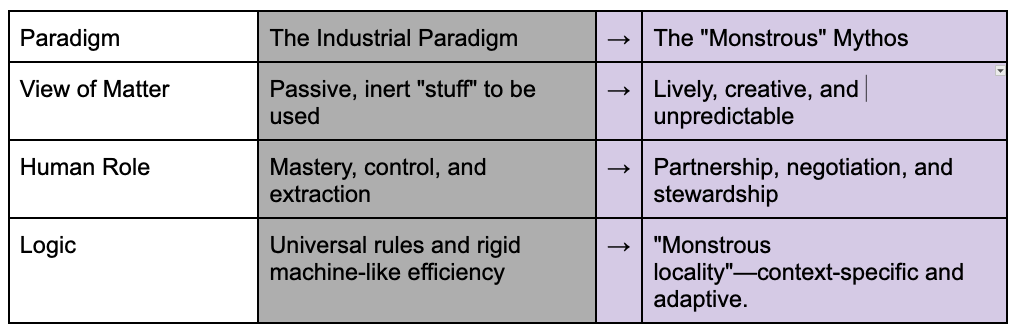
Toward a Monstrous Synthesis
Physics and Life
The author explores the history of how humans have defined "life." It explains that while we once thought of matter as a lifeless machine that needed a "soul" to move, 20th-century science shifted this view. Through cybernetics and systems theory, scientists began to see that living things are actually self-regulating systems that exchange energy and information with their surroundings to stay organized. This section bridges the gap between mechanical machines and biological bodies, suggesting that life is a special way matter organizes itself to resist falling into total disorder.
Chemistry of Matter
This section describes chemistry as "lively" and "rebellious." It moves away from the idea that chemical reactions are just predictable outcomes of fixed laws. Instead, it highlights how molecules can "make decisions" and organize themselves into complex structures when energy flows through them—a process called "dissipative adaptation." The author also touches on quantum biology, explaining that life is incredibly efficient (like in photosynthesis) because it uses quantum effects that go beyond traditional physics to move energy with almost no waste.
Natural Computing
The paper proposes that nature itself is a form of computer. Unlike digital computers that use code, the physical world "calculates" through chemical reactions, tides, and growth patterns. For example, a colony of slime mold or a chemical reaction that creates a pattern is performing "computation" by solving how to grow and move in its environment. This section suggests that metabolism is a "bottom-up" way for living things to process information and adapt to changes in real-time, making nature an intelligent, problem-solving system.
Microbial Alchemy
Microbes are presented as the "unseen engines" that keep the Earth's life-support systems running. They are expert chemists that recycle dead matter into new life and manage the planet’s atmosphere. The author calls them "monstrous" because they are both our essential partners and potentially dangerous opportunists (like pathogens) that we cannot fully control. By watching how microbes manipulate matter, humans can learn to move away from a "human-centered" view and start cooperating with the microbial world to sustain the environment.
Part 2: Ecological Technological Platforms
In the second half, the paper argues that our current "machine-like" technology is a major cause of the climate crisis because it treats the world as a resource to be extracted. To fix this, we need a "living technology" that partners with microbes. This section introduces the idea of a "living household," where domestic spaces are designed to work with microbial colonies to turn waste into useful resources, like energy or clean water, through natural metabolic processes.
Case Studies: Living Architecture, ALICE, and Mi-Hy
These three projects show how "monstrous matter" works in practice. Living Architecture involves "living bricks" filled with microbes that can clean wastewater and produce electricity for a home. ALICE is a digital interface that translates the electrical signals from these microbes into visual animations, allowing humans to "talk" to and care for their microbial systems as if they were pets or plants. Microbial Hydroponics (Mi-Hy) creates a "fake soil" made of specialized microbes that help plants grow in apartments while simultaneously making useful chemicals and capturing carbon dioxide.
Conclusion: Toward a New Mythos of Matter
The final section calls for a new "story" for the 21st century—one where we stop trying to dominate nature and start negotiating with it. By embracing the "monstrous" and unpredictable nature of matter, we can build a more respectful and regenerative relationship with the planet. This requires an "ethics of care," where we treat microbial life as vital collaborators rather than just tools, ensuring that our development supports the life cycles of the biosphere instead of destroying them.
How Does it Relate to Regenerative Vitality?
Regenerative vitality is cultivated by moving away from industrial exploitation toward practices that align with nature's own cycles of change and renewal. By designing with the unruly but creative "monstrous matter" found in microbial systems, architects can create adaptive environments that actively support life and ecological flourishing. This transformation centers on collaborating with microbial metabolic processes to restore and sustain the living systems upon which we depend.
Disclaimer: The summary story is co-developed with Gemini and reviewed by human.
